THE CLASSIC COLLECTION✦An outlaw’s diary: the CommuneCLASSIC FREE BOOKS
An outlaw’s diary: the Commune
Cécile Tormay
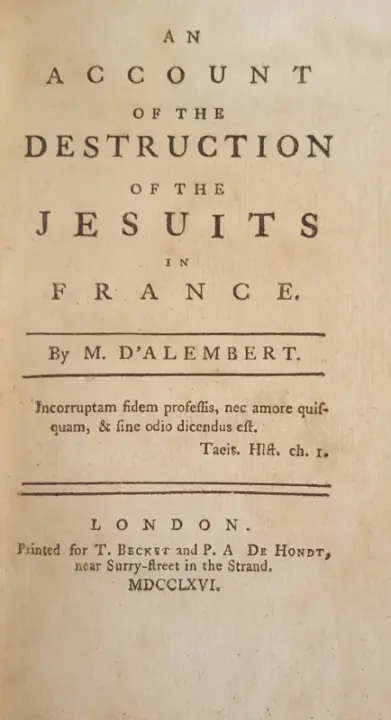
THE CLASSIC COLLECTION · 1766
"An Account of the Destruction of the Jesuits in France" by Jean Le Rond d'Alembert is a historical account likely written in the late 18th century. The book discusses the rise and fall of the Jesuit order in France, examining the events and circumstances that led to their eventual suppression. It provides an in-depth analysis of the society's influence and opposition, focusing on the political and theological conflicts that surrounded it. The opening of this work sets the stage by presenting a historical context in which the Jesuit order was both powerful and contentious. D'Alembert reflects on the broader societal and political upheavals of his time, noting how public opinion shaped the fate of the Jesuits. He begins with a brief history of the society's founding and growth, highlighting the various obstacles they faced, particularly from the universities and rival religious factions. D'Alembert aims to provide a balanced perspective by examining both the negative perceptions of the Jesuits and their contributions to education and society, suggesting that their complexity ultimately led to their dramatic downfall.
Introduction adapted from the source catalogue; source summaries may be automatically generated.
Free to read · English · 29,543 words · No account needed
MAKE TIME FOR A GOOD BOOK
On by default. Untick to stop anonymous reading totals. Each page counts after 10 seconds in view. How this works.
Anonymous counting is on unless you have switched it off.
The contest occasioned by the refusal of the sacraments to the Jansenists, was the first spark of the conflagration, the Helen of that war, as small in its first object, as it is now become important by its consequences. One of the principal archbishops of the kingdom, and a bishop of Mirepoix, his aid and counsellor, both of them thoroughly persuaded of the excellence of the bull, and of the damnation of those who rejected it, resolved, like consistent prelates, to order the communion to be refused to Jansenists at the point of death. This refusal had before been attempted in some provinces, but twice or thrice only, at wide intervals, and with little noise: it was now thought time to take off the mask, and absolutely to treat the enemies of the bull Unigenitus as hereticks cut off from the church. If we believe the crowd of constitutionary theologists, the two prelates, authors and executors of this project, were extremely in the right: but let us be permitted to relate here (as mere historians) the singular reasons which were alledged in their favour, and those that were opposed to them. “The bull Unigenitus,” said its partisans, “ill received without doubt, and even spit upon at its birth, had terminated in being unanimously received: there was not, in all Christendom, one bishop who rejected this production, whether good or bad, of the court of Rome: it was in vain to say that it overturned the principles of Christianity; that the acceptance of it had not been free; that some had received it through fear, others through interest: it was accepted, and without opposition, by the whole body of pastors. Here then we see, in the principles of the Catholic church, all that ought to serve, by way of compass, to plain Christians in their faith. It is not for them to examine either the doctrines themselves, or the nature of the acceptance; it is sufficient to them that they see clearly, that the visible church adopts them. We understand here by the visible church, what every Catholic understands by the term; that is to say, the pope, the bishops, and almost all the ecclesiasticks, secular and regular, of the second order. Whatever be the doctrine which this visible church teaches, the faithful ought to believe firmly, notwithstanding even the strongest appearances to the contrary, that it has always taught the same; otherwise Jesus Christ would not have said true in promising that church to be always with her. The passages of scripture, and of the fathers, which may appear the most evidently contrary to the new catechism, will be explained in a manner favourable to it: the church has alone the right of fixing the meaning of them. In a word, from the moment the church speaks, we must submit to her, whatever she may say. After the council of Nice, the divinity of Jesus Christ was very far from being as solemnly, as universally, as uniformly received by the body of pastors, as the bull Unigenitus hath been in these latter times. Nevertheless, after the council of Nice, the Arians were, from that time, hereticks declared, not withstanding the partisans that still adhered to them. It may be; it is even out of doubt, that in the councils which have decided on matters of faith, many of the bishops declared for the good cause, through views of policy, interest, or passion. Witness the unhappy facility with which most of the prelates, who, under Constantine, had declared that the Word was God, declared afterwards, under Constantius, that it was but a man. Witness again the violent conduct of St. Cyril, and of the council of Ephesus, with regard to Nestorius. Witness, lastly, the intrigues which too often disturbed those holy assemblies, and affronted, as we may say, the Holy Ghost, that presides in them. But still, once more, it is not the motives, it is the result of the decision, that the faithful ought to consider. It is by this result alone that they ought to abide: they would have too much to do, if it were necessary for them to go back again to the causes which dictated the decree. God hath promised to his church infallibility in her decisions; but he has not promised to every individual purity in his motives: he makes use of all sorts of means, even of the passions of men, for making the truth triumph, and be known; and he employs human things, in order to make divine matters succeed.”
Your reading position is saved on this browser. Take it to another device with a library code. Reading pages adapt to text, rather than matching a printed edition.
BEHIND THE BOOK
This eBook is for the use of anyone anywhere in the United States and most other parts of the world at no cost and with almost no restrictions whatsoever. You may copy it, give it away or re-use it under the terms of the Project Gutenberg License included with this eBook or online at www.gutenberg.org. If you are not located in the United States, you will have to check the laws of the country where you are located before using this eBook. Read the source licence.
The original source file, including credits and licence, is retained by this library. Request an original-format copy at no charge. Please include the book title and Project Gutenberg identifier #59729.
KEEP YOUR CURIOSITY GOING
Cécile Tormay

Moritz Busch
John L. Ransom
Frances Wright
Cécile Tormay

Mabel Potter Daggett