THE CLASSIC COLLECTION✦An outlaw’s diary: the CommuneCLASSIC FREE BOOKS
An outlaw’s diary: the Commune
Cécile Tormay
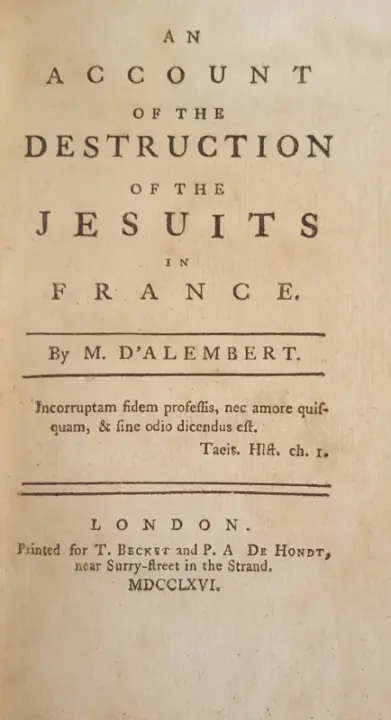
THE CLASSIC COLLECTION · 1766
"An Account of the Destruction of the Jesuits in France" by Jean Le Rond d'Alembert is a historical account likely written in the late 18th century. The book discusses the rise and fall of the Jesuit order in France, examining the events and circumstances that led to their eventual suppression. It provides an in-depth analysis of the society's influence and opposition, focusing on the political and theological conflicts that surrounded it. The opening of this work sets the stage by presenting a historical context in which the Jesuit order was both powerful and contentious. D'Alembert reflects on the broader societal and political upheavals of his time, noting how public opinion shaped the fate of the Jesuits. He begins with a brief history of the society's founding and growth, highlighting the various obstacles they faced, particularly from the universities and rival religious factions. D'Alembert aims to provide a balanced perspective by examining both the negative perceptions of the Jesuits and their contributions to education and society, suggesting that their complexity ultimately led to their dramatic downfall.
Introduction adapted from the source catalogue; source summaries may be automatically generated.
Free to read · English · 29,543 words · No account needed
MAKE TIME FOR A GOOD BOOK
On by default. Untick to stop anonymous reading totals. Each page counts after 10 seconds in view. How this works.
Anonymous counting is on unless you have switched it off.
The Jesuits, loaded from that time with so much hatred, and such a number of imputations, were not to be till long after the victims of it: they triumphed in the first violence of the attack, and became but the more powerful, the more animated against their enemies, and the more formidable to them. Yet what enemies had they to deal with? With men of the greatest merit and reputation, and whose consideration with the public still increased by their very persecution; an Arnauld, a Nicole, a Saci; in one word, all the writers of the celebrated house of Port-Royal. These adversaries were much more to be dreaded by the society than plain theologists, whom the common run of mankind listen not to, understand not, and have no esteem for: they were great philosophers (as great at least as could be in those days) men of the first class in literature, excellent writers, and men of an irreproachable conduct. They had in the kingdom, and even at court, respectable and zealous friends, whom they acquired by their talents, their virtues, and the signal services for which literature was indebted to them. The general and rational grammar, called the Port-Royal grammar, from their being the authors of it; the excellent Logic called by the same name; the Greek Roots; their learned grammars of the Greek, Latin, Italian, and Spanish; such were the productions of this free and respectable society. The illustrious Racine had been their scholar, and had preserved, as well as Despréaux, his friend, the most intimate connections with them: their works on religion and morality were read and esteemed by all France; and by the masculine and correct style in which they were written, had contributed most of any, next to the Provincials, to the perfection of our language, while the Jesuits counted yet among their French writers only des Barris and des Garrasses. What pity that those writers of the Port-Royal, those men of such superior merit, should have thrown away so much genius and time in ridiculous controversies on the good or bad doctrine of Jansenius, on idle and endless discussions on free-will and grace, and on the important question, Whether five unintelligible propositions be in a book which nobody reads? Tormented, imprisoned, exiled for these vain disputes, and employed perpetually in defending so futile a cause, how many years of their lives have philosophy and letters to regret as lost! What lights would they not have added to those with which they had already illumined their age, if they had not been carried away by these unhappy and pitiful distractions, so unworthy of taking up the thoughts of men like them! May we venture to say a little more of this, at the risk of deviating one moment from our subject? Can reason withhold shedding bitter tears, when she sees how many useful talents the quarrels, so often excited in the bosom of Christianity, have buried? how many ages these wretched and scandalous contests have destroyed to the human understanding? and how many geniuses, formed for discovering new truths, have employed (to the great regret of true religion) all their sagacity and abilities, in supporting or giving reputation to ancient absurdities? When we run through, in the vast royal library, the first apartment, of an immense extent, and find it destined, for the greatest part, to a collection, without number, of the most visionary commentators on the scriptures, of polemical writers on, questions the most void of meaning, of school divines of every sort; in short, of so many works from whence there is no drawing one single page of truth, can we refrain crying out with sorrow (ad quid perditio hæc?) “To what end all this loss?” Again, human nature would have been in no very great degree to be pitied, if all these frivolous and absurd objects, these holy trifles, as a celebrated magistrate calls them[11], had ended in ill language only, and had not occasioned the shedding of torrents of blood. But let us shut our eyes on these dismal objects, and make only one other reflexion, as consolatory as it is humiliating to the human mind. How is it possible, that the same species of beings which invented the art of writing, arithmetic, astronomy, algebra, chemistry, watch-work, the art of weaving, so many things in short worthy of admiration in the mechanical and liberal arts, should have invented the philosophy and divinity of the schools, judicial astrology, the concomitant concourse, versatile and congruous grace, the victorious delectation, absolute accidents, and so many other fooleries, as would occasion the suspending, by authority of justice, the person who should first broach them now-a-days? Plato defined man, “an animal with two feet without feathers.” How ridiculous soever this definition may appear, it was perhaps difficult (the lights of religion set aside) to characterise otherwise the indefinable human species; which on one side seems, by master-pieces of genius, to have approached the heavenly beings, and on the other, by a thousand incredible marks of folly and cruelty, to have set itself on a level with the most stupid and ferocious animals. When we measure the interval between a Scotus and a Newton, or rather between the works of Scotus and those of Newton, we must cry out with Terence, Homo homini quid præstat! “What difference there is between man and man!” Or must we only attribute this immense distance to the enormous difference of ages, and think with sorrow that the subtile and absurd doctor, who wrote so many chimeras, admired by his contemporaries, had perhaps been a Newton in an age more enlightened? Let us weigh well all these reflexions; let us add thereto the perusal of ecclesiastical history, those kalendars of the virtue of some men, and the weak wickedness of so many others; let us behold in that history the usurpations, without number, of the spiritual power; the robberies and the violences exercised under the pretext of religion; so many bloody wars, so many cruel persecutions, so many murders committed in the name of a God who abhors them; and we shall have pretty nearly an exact catalogue of the advantages which the disputes of Christianity have brought upon mankind.
Your reading position is saved on this browser. Take it to another device with a library code. Reading pages adapt to text, rather than matching a printed edition.
BEHIND THE BOOK
This eBook is for the use of anyone anywhere in the United States and most other parts of the world at no cost and with almost no restrictions whatsoever. You may copy it, give it away or re-use it under the terms of the Project Gutenberg License included with this eBook or online at www.gutenberg.org. If you are not located in the United States, you will have to check the laws of the country where you are located before using this eBook. Read the source licence.
The original source file, including credits and licence, is retained by this library. Request an original-format copy at no charge. Please include the book title and Project Gutenberg identifier #59729.
KEEP YOUR CURIOSITY GOING
Cécile Tormay

Moritz Busch
John L. Ransom
Frances Wright
Cécile Tormay

Mabel Potter Daggett