THE CLASSIC COLLECTION✦An outlaw’s diary: the CommuneCLASSIC FREE BOOKS
An outlaw’s diary: the Commune
Cécile Tormay
THE CLASSIC COLLECTION · 1852
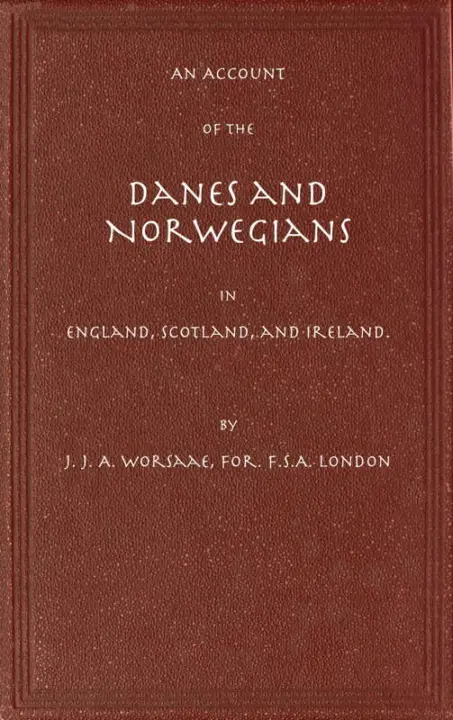
"An Account of the Danes and Norwegians in England, Scotland, and Ireland" by J. J. A. Worsaae is a historical account written in the mid-19th century. The book delves into the influence and legacy of Scandinavian settlers on the British Isles, exploring the historical connections between the Danes, Norwegians, and the cultures of England, Scotland, and Ireland. Worsaae seeks to present a more balanced and comprehensive view of the impact these Norse people had during their conquests and settlements, challenging previously biased narratives. The opening of this work introduces readers to the author's intent, detailing his travels and research conducted at the behest of the Danish monarchy to investigate Scandinavian monuments across the British Isles. Worsaae outlines his aim to shed light on a historical period that has been overlooked and misrepresented, promising a clearer understanding of the Danish and Norwegian contributions to English history and culture. The author offers insights into the geographical context of the land and the significance of the Viking expeditions, setting the stage for a detailed exploration of their impact on local societies, customs, and institutions.
Introduction adapted from the source catalogue; source summaries may be automatically generated.
Free to read · English · 129,924 words · No account needed
MAKE TIME FOR A GOOD BOOK
On by default. Untick to stop anonymous reading totals. Each page counts after 10 seconds in view. How this works.
Anonymous counting is on unless you have switched it off.
Footnote 8:
Many of these words are Scotch.
These numerous and striking Danish terms, still existing in the north of England almost a thousand years after the destruction of the Danish power there, and after an almost equally protracted struggle with the constant progress of the English language, show that the Scandinavian tongue must possess no mean degree of durability. These Scandinavian words, moreover, taken in conjunction with the unusually numerous Scandinavian names of places in England, put it beyond all doubt that a Scandinavian population must have been far more diffused, and have taken much deeper root there, than in any other foreign land.
The popular language of the north of England is particularly remarkable for its agreement with the dialects found in the peninsula of Jutland. Several words which are common to the north of England and Jutland, are not to be found elsewhere. For instance, in the north of England, the shafts of the carts used there are called limmers, a word clearly of the same origin as the Jutlandish liem, a broom; both being derived from the old Scandinavian limi, which signifies boughs, branches. But it is the broad pronunciation in particular that makes the resemblance so surprising. Thus, for instance, we have in the north of England, sty’an (Dan., Steen; Eng., a stone), yen (Dan., een; Eng., one), welt (Dan., vælte; Eng., to upset), swelt (Dan., vansmægte; Eng., overcome with heat and exercise), maw (Dan., Mave; Eng., stomach), lowe (Dan., Lue; Eng., flame), donse (Dan., dandse; Eng., dance), fey (Dan., feie; Eng., to sweep), ouse (Dan., Oxe; Eng., ox), roun (Dan., Rogn; Eng., spawn or roe of fishes), war and war (Dan., værre og værre; Eng., worse and worse); with many others of the same kind, which are pure Jutlandish.
On the whole, of all the Danish dialects the Jutland approaches nearest to the English. The West Jutlander uses the article æ before words like the English “the,” although the Danish language in other provinces does not recognise such an article; and the broad open w, which the natives of Funen and Zealand can, after the greatest difficulty, only pronounce with tolerable correctness, is as easy for the Jutlander as for the Englishman. Many Danish words pronounced in Jutlandish become purely English; as, for instance, foul (Eng., fowl; Dan., Fugl), kow (Eng., cow; Dan., Ko), fued (Eng., food; Dan., Fod), stued (Eng., stood; Dan., stod), drown (Eng., drown; Dan., drukne); besides many others. Many words are even quite common to Jutland and England; such as the Jutlandish forenoun and atternoun (Eng., forenoon and afternoon; Dan., Formiddag and Eftermiddag), stalker (Eng., stalker; Dan., en Stork), kok (Eng., cock; Dan., en Hane), want (Eng., to want; Dan., mangle, behöve).
Your reading position is saved on this browser. Take it to another device with a library code. Reading pages adapt to text, rather than matching a printed edition.
BEHIND THE BOOK
This eBook is for the use of anyone anywhere in the United States and most other parts of the world at no cost and with almost no restrictions whatsoever. You may copy it, give it away or re-use it under the terms of the Project Gutenberg License included with this eBook or online at www.gutenberg.org. If you are not located in the United States, you will have to check the laws of the country where you are located before using this eBook. Read the source licence.
The original source file, including credits and licence, is retained by this library. Request an original-format copy at no charge. Please include the book title and Project Gutenberg identifier #55409.
KEEP YOUR CURIOSITY GOING
Cécile Tormay

Moritz Busch
John L. Ransom
Frances Wright
Cécile Tormay

Mabel Potter Daggett