THE CLASSIC COLLECTION✦An outlaw’s diary: the CommuneCLASSIC FREE BOOKS
An outlaw’s diary: the Commune
Cécile Tormay
THE CLASSIC COLLECTION · 1852
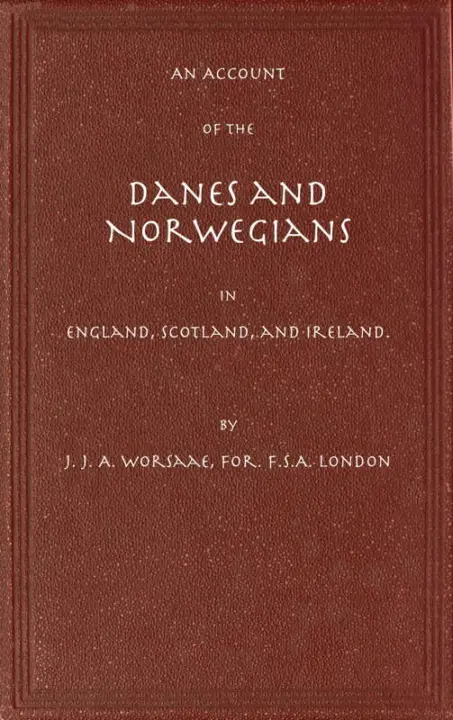
"An Account of the Danes and Norwegians in England, Scotland, and Ireland" by J. J. A. Worsaae is a historical account written in the mid-19th century. The book delves into the influence and legacy of Scandinavian settlers on the British Isles, exploring the historical connections between the Danes, Norwegians, and the cultures of England, Scotland, and Ireland. Worsaae seeks to present a more balanced and comprehensive view of the impact these Norse people had during their conquests and settlements, challenging previously biased narratives. The opening of this work introduces readers to the author's intent, detailing his travels and research conducted at the behest of the Danish monarchy to investigate Scandinavian monuments across the British Isles. Worsaae outlines his aim to shed light on a historical period that has been overlooked and misrepresented, promising a clearer understanding of the Danish and Norwegian contributions to English history and culture. The author offers insights into the geographical context of the land and the significance of the Viking expeditions, setting the stage for a detailed exploration of their impact on local societies, customs, and institutions.
Introduction adapted from the source catalogue; source summaries may be automatically generated.
Free to read · English · 129,924 words · No account needed
MAKE TIME FOR A GOOD BOOK
On by default. Untick to stop anonymous reading totals. Each page counts after 10 seconds in view. How this works.
Anonymous counting is on unless you have switched it off.
As the matter stood, the Danish power apparently gave way to the Anglo-Saxon dominion; but, in reality, it was little more than the name that was changed. It is said, indeed, that the new Anglo-Saxon king, Edward the Confessor, some years after his accession (in 1048), expelled the great Danish chiefs and their descendants from his court, and drove them into exile; as, for instance, Osgod Clapa, sheriff of Middlesex, and Asbjörn, a brother of King Svend Estridsen of Denmark, whose second brother Björn, a jarl in the west of England, had shortly before been killed by the jarl Svend Godvinsön. He also banished Canute the Great’s niece, Gunhilde. By her first marriage with her cousin, Hagen Jarl, Stadtholder of Norway, Gunhilde had a daughter named Bothilde; by her second with Harald, a son of Thorkil the Tall, who also succeeded to the Stadtholdership, she had two sons, Hemming and Thorkil. Gunhilde went into exile with her sons by way of Bruges in Flanders, and thence to her relatives in Denmark.
Nevertheless the signatures to Edward’s letters-patent prove that this king, alleged to have been so favourably disposed towards the Anglo-Saxons, must have had many chiefs of Danish extraction about his person, even after this expulsion of the Danes; nay, even to the day of his death. We need not look for them among the “Huskarle,” or body-guards, alone, amongst whom are named Thurstan and Urk; for Huskarle with Scandinavian names are mentioned at a still later period in England; and we find, under William the Conqueror (1071), Eylif Huscarl, and, even in 1230, Roger Huscarl. Even in King Edward’s suite, and occupying considerable offices, were such men as “Atsere Swerte (Adser the black), Atsur röda (Adser the red), Eiglaf (Eylif), Guðmund, Ulfketil, Thord, Siward, Thurstan, Harold, Turi, Yrc (Erik), Anschitil (Osketil), Tofi, Neuetofig, Esgar, Ingold, Tosti, Thorgils, Wagen, Ulf Tofis sune, Askyl Toke’s sune, Jaulf Malte’s sune.” Also the knights Esbern (Asbjörn) and Siward, together with several others, the greater part of whose names appear in letters that were issued after the expulsion of the Danes in 1048. Many of the royal fiefs were still in the hands of Danes. Jarl Siward Digre governed the extensive district of Northumberland with the same power and influence as before, till his death in the year 1055. Somersetshire, lying far towards the west in the Saxon part of England, had a sheriff (vice-comes) named “Touid,” or “Tofig,” who can scarcely have been an Anglo-Saxon. We find a person named “Toli” filling the same high office in East Anglia; as well as in Huntingdonshire a “Tuli;” in Hamptonshire, a “Norman;” in Lincolnshire a “Marlesuuein.” Northmen, or at least chiefs of Scandinavian origin, filled the highest posts at Edward’s court. Between the years 1060 and 1066, a letter mentions the following royal chiefs, or “Hofsinder:” “Jaulf, Agamund, Ulf, Wegga (Viggo), Locar (Loke), and Hacun.” In one of Edward’s letters, dated 1062, the following names appear:—“Esgarus, regiæ procurator aulæ;” “Bundinus, regis palatinus;” “Adzurus, regis dapifer;” “Esbernus princeps;” “Siwardus princeps;” “Hesbernus regis consanguineus.” These are all pure Danish names, viz., Esgar, or Asgier, Bonde, Adser, Asbjörn, and Sivard. The different Latin titles here given to Esgar, Bonde, and Adser, are translated in contemporary letters by one and the same word, “steallere” or “stalre.” The dignity of “Staller” was also, as is well known, an established one in the courts of the Scandinavian kings, at all events after the time of Canute the Great. The Staller was superintendent of the court, or a sort of High Steward, and attended the “Thing” meetings for the king, but more particularly in cases which concerned the court. From an English diploma, dated 1060-1066, and signed by “Esegar steallere,” “Bondig steallere,” and “Roulf steallere,” we see that there were several “Stallers” at the same time in England; which certainly arose from the Stallers being also the king’s commissaries.
Your reading position is saved on this browser. Take it to another device with a library code. Reading pages adapt to text, rather than matching a printed edition.
BEHIND THE BOOK
This eBook is for the use of anyone anywhere in the United States and most other parts of the world at no cost and with almost no restrictions whatsoever. You may copy it, give it away or re-use it under the terms of the Project Gutenberg License included with this eBook or online at www.gutenberg.org. If you are not located in the United States, you will have to check the laws of the country where you are located before using this eBook. Read the source licence.
The original source file, including credits and licence, is retained by this library. Request an original-format copy at no charge. Please include the book title and Project Gutenberg identifier #55409.
KEEP YOUR CURIOSITY GOING
Cécile Tormay

Moritz Busch
John L. Ransom
Frances Wright
Cécile Tormay

Mabel Potter Daggett