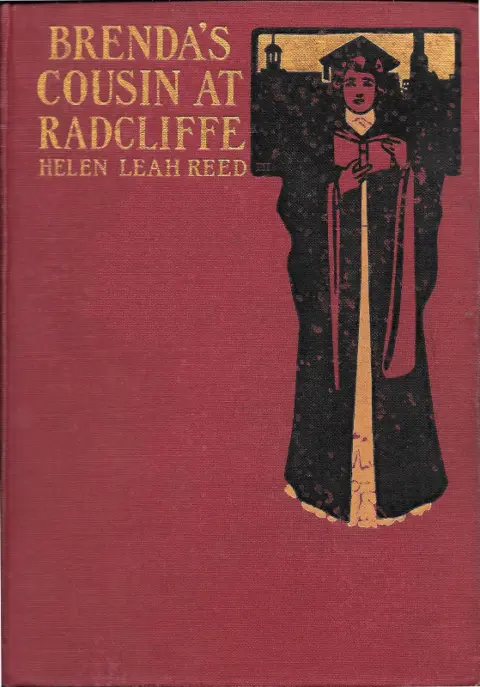
Brenda’s cousin at Radcliffe
Helen Leah Reed
THE CLASSIC COLLECTION · 1905
"Amy in Acadia: A Story for Girls" by Helen Leah Reed is a fiction work written in the early 20th century. The story follows the experiences of a young girl, Amy Redmond, as she embarks on a journey to Acadia, a region in Nova Scotia, along with her mother and friends. Themes of friendship, adventure, and cultural exploration are central to the narrative, highlighting the interactions and relationships formed as they navigate the historical and beautiful landscapes of the area. At the start of the book, readers are introduced to Amy’s determination to travel without her friends, Fritz and Taps, who she believes would be a hindrance to the purpose of their trip, which includes rest and study. The conversation reveals Amy's character as conscientious and slightly conflicted about her decisions, while Fritz's playful persistence showcases his friendship with her. As the narrative progresses, Amy, along with her companions Priscilla and Martine, arrives in Yarmouth, Nova Scotia, where they quickly realize the cultural richness of the area. The opening chapters set a light-hearted yet thoughtful tone as the group engages with the local Acadian culture, including meeting new characters and experiencing daily life — all leading them toward their adventures in the picturesque Nova Scotia.
Introduction adapted from the source catalogue; source summaries may be automatically generated.
Free to read · English · 82,948 words · No account needed
MAKE TIME FOR A GOOD BOOK
On by default. Untick to stop anonymous reading totals. Each page counts after 10 seconds in view. How this works.
Anonymous counting is on unless you have switched it off.
"Oh, the runic stone?" asked Amy. "There isn't so very much to tell about it, except that it was found more than seventy years ago, and is thought by some people to be a memorial of the Norsemen."
"The Norsemen in Nova Scotia? But why didn't they discover the stone
before?"
"It was found by a Dr. Fletcher in a cove on his own property. The inscription was on the under side, and showed signs of great age. There, I believe I have something about it here;" and pulling a small notebook from her pocket, Amy refreshed her memory.
"Yes, it weighed about four hundred and fifty pounds, and some antiquarians have translated the inscription, 'Harki's son addressed the men.' It seems that there was a man named Harki among those Norsemen who sailed along the coast of America in 1007."
"That is certainly worth knowing," said Mrs. Redmond, "and I hope that we can see the stone before we go."
"Well, it's only fair," continued Amy, "to tell you that some learned people do not believe in the Norse theory."
"Perhaps it's like the inscription on the Dighton rock," interposed Priscilla, "that they now think was made by Indians."
"Yes," added Amy, "but the strange thing is that a few years ago a second stone was found about a mile away from the other, and the inscription on it was almost the same."
"Well," exclaimed Martine, "it doesn't matter whether the Norsemen really were here or not, as long as we can imagine that they may have been. I like the romantic part of history, if it gives you something entertaining to think about. It's all the same whether or not it is true."
After which heretical sentiment, Priscilla, Plymouth-born Priscilla, felt herself to be farther away than ever from Martine.
When Priscilla nestled down beside Mrs. Redmond to watch the growth of her sketch, Martine became impatient.
"Let us go back. We've seen everything there is to see in this part of the town, and perhaps I shall have time for a letter or two before dinner."
"I'll go with you," responded Amy. "I have some packing to do."
"Packing?"
"Oh, just to rearrange some of my things."
"Very well," said Mrs. Redmond. "Priscilla and I will wait until this sketch is finished, and then we'll return by the electric car."
"Any one would know that you and your mother are from Boston," said Martine, turning to Amy with a laugh. "I have heard my father say that Bostonians are the only people in the world who take the trouble to say 'electric cars.'"
"What do others say?"
Your reading position is saved on this browser. Take it to another device with a library code. Reading pages adapt to text, rather than matching a printed edition.
Helen Leah Reed
Helen Leah Reed
Helen Leah Reed
Helen Leah Reed
BEHIND THE BOOK
This eBook is for the use of anyone anywhere in the United States and most other parts of the world at no cost and with almost no restrictions whatsoever. You may copy it, give it away or re-use it under the terms of the Project Gutenberg License included with this eBook or online at www.gutenberg.org. If you are not located in the United States, you will have to check the laws of the country where you are located before using this eBook. Read the source licence.
The original source file, including credits and licence, is retained by this library. Request an original-format copy at no charge. Please include the book title and Project Gutenberg identifier #35985.
KEEP YOUR CURIOSITY GOING
Wilfrid Scawen Blunt
Wilfrid Scawen Blunt

E. W. (Edgar Watson) Howe
Cécile Tormay

Moritz Busch
Coulson Kernahan