THE CLASSIC COLLECTION✦An outlaw’s diary: the CommuneCLASSIC FREE BOOKS
An outlaw’s diary: the Commune
Cécile Tormay
THE CLASSIC COLLECTION · 1917
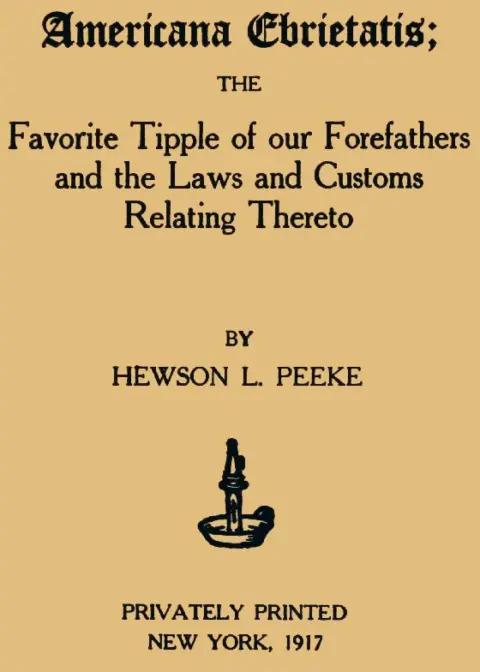
"Americana Ebrietatis" by Hewson L. Peeke is a historical account written in the early 20th century. The book explores the traditional American drinking customs and the evolution of laws and sentiments related to alcohol in society. Peeke discusses the connection between alcohol consumption, social practices, and influential figures throughout American history, particularly in the context of the liquor commerce and its social implications. The opening of Americana Ebrietatis provides an overview of the drinking habits of early American colonists, detailing different regional customs linked to race and cultural background. It examines how various immigrant groups favored specific alcoholic beverages—such as beer, wine, and cider—over water due to health concerns, positioning alcohol as a staple in daily life. The text sets the stage for a broader discussion about how alcohol was intertwined with significant social events, cultural practices, and even governance, establishing a framework for understanding the changing views on the liquor trade in America that the author aims to clarify throughout the rest of the work.
Introduction adapted from the source catalogue; source summaries may be automatically generated.
Free to read · English · 24,975 words · No account needed
MAKE TIME FOR A GOOD BOOK
On by default. Untick to stop anonymous reading totals. Each page counts after 10 seconds in view. How this works.
Anonymous counting is on unless you have switched it off.
There were but few storekeepers in Virginia in early days who were not engaged in the Indian trade. Guns, ammunition, rum, blankets, knives, and hatchets were the articles in greatest demand among the tribes. When in the ordinary course of events a young American in Virginia or elsewhere felt himself impelled to leave the paternal roof he put aside his gun and fishing rod, and asked of his father some money, a slave, and a canoe. His brow grew thoughtful, and he adopted a pipe. With his money he purchased beads, trinkets, blankets, guns, powder, not forgetting for various reasons a supply of rum. With these he purposed laying the foundation of his fortunes as an Indian trader. If the trader had several servants with him or was associated with other traders he would fix his quarters in some large Indian town and send his subordinates to the surrounding villages, with a suitable supply of blankets, guns, hatchets, liquor, tobacco, etc. This wild traffic was liable to every species of disorder, a fruitful source of broils, robberies, and murders. The fur traders were a class of men held in contempt among the Iroquois and known among them by the significant title of Rum Carriers. The white trappers seem to have been as dissipated as the Indians. One writer declares that most of the Canadians drink so much brandy in the morning that they are unfit for work all day. Another says that when a canoe man is tired he will lift a keg of brandy to his lips and drink the raw liquor from the bung-hole, after which, having spoiled his appetite, he goes to bed supperless, so with drink and hardship he is an old man at forty. The type of French trapper left in the old Northwest may still be seen far north in the great fur land; he is idle, devoted to singing, dancing, gossip, and drinking to intoxication; having vanity as his besetting sin. The Jesuits denounced the traffic. Their case was a strong one, but so was the case of their opponents. There was a real and imminent danger that the thirsty savages, if refused brandy by the French, would seek it from the Dutch and English of New York. It was the most potent lure and the most killing bait. Wherever it was found, there the Indians and their beaver skins were sure to go, and the interests of the fur trade, vital to the colony, were bound to go with it. Cadillac was especially incensed against the Jesuits on account of their opposition to the sale of spirits. So strong was their hostility that Louis XIV, in 1694, referred to the Sorbonne for decision the question of allowing French brandy to be shipped to Michilimackinac. The decision of the Council gave to the Northwest its first prohibitory law; and the commandant was not more willing to enforce the order than his successors have been to carry out similar laws. "A drink of brandy after the repast," he maintained, "seems necessary to cook the bilious meats and the crudities which they leave in the stomach." Again, at Detroit, Cadillac quotes from a sermon by Father Carhail, whose wing he was engaged in plucking. The Jesuit had maintained that there was "no power, either human or divine, which can permit the sale of this drink." Hence, you perceive, argues the crafty commandant, "that this Father passes boldly on all matters of state, and will not even submit to the decision of the pope." The question was indeed a hard one for Cadillac. He understood clearly that unless he had liquor to sell to the savages he might as well abandon his post; for the Indians would go straight to the English at Albany where goods were cheap and rum was unlimited. To give up Detroit never entered Cadillac's plan. He therefore chose the middle course. Instead of prohibition he would have high license. In the restrictions which he threw about the traffic in liquors he was both honest and earnest; and, as events proved, he was far in advance of his times. In the report of M. d'Aigrement, who inspected Detroit in 1708, it is mentioned as one of the grievances of the savages against Cadillac that "in order to prevent disturbances which would arise from the excessive use of brandy, he caused it all to be put into the store-house and sold it at the rate of twenty francs a quart. Those who will have brandy, French as well as Indians, are obliged to go to the store-house to drink, and each can obtain at one time only the twenty-fourth part of a quart. It is certain that the savages cannot become intoxicated on that quantity. The price is high, and as they cannot get brandy only each in his turn, it sometimes happens that the savages are obliged to return home without a taste of this beverage, and they seem ready to kill themselves with disappointment. Though the Jesuits refused absolution to all who sold brandy to the Indians, they sold it themselves. LaSalle had detected them in it." Count Frontenac declares that "The Jesuits greatly exaggerate the disorders caused by brandy and they easily convince persons who do not know the interested motives which have led them to harp continually on this string for more than forty years.... They have long wished to have the fur trade entirely to themselves." Appeal was made to the King, who with his Jesuit confessor, guardian of his conscience, on the one side, and Colbert, guardian of his worldly interests, on the other, stood in some perplexity. The case was referred to the fathers of the Sorbonne and they pronounced the selling of brandy to the Indians a mortal sin. It was next referred to the chief merchants and inhabitants of Canada. Each was directed to write his views. The great majority were for unrestricted trade in brandy, a few for limited and guarded trade, and two or three declared for prohibition. Decrees of prohibition were passed from time to time, but they were unavailing. The King was never at heart a prohibitionist. His Canadian revenue was drawn from the fur trade, and the singular argument of the partisans of brandy, that its attractions were needed to keep the Indians from contact with heresy, served admirably to salve his conscience. The Dutch and English being the heretics, he distrusted the Bishop of Quebec, the great champion of the anti-liquor movement. He wrote to Saint Vallier, Laval's successor in the bishopric, that the brandy trade was very useful to the kingdom of France, that it should be regulated, not prevented, that consciences must not be disturbed by denunciations of it as a sin, that the zeal of the ecclesiastics might be affected by personal interests and passions.
Your reading position is saved on this browser. Take it to another device with a library code. Reading pages adapt to text, rather than matching a printed edition.
BEHIND THE BOOK
This eBook is for the use of anyone anywhere in the United States and most other parts of the world at no cost and with almost no restrictions whatsoever. You may copy it, give it away or re-use it under the terms of the Project Gutenberg License included with this eBook or online at www.gutenberg.org. If you are not located in the United States, you will have to check the laws of the country where you are located before using this eBook. Read the source licence.
The original source file, including credits and licence, is retained by this library. Request an original-format copy at no charge. Please include the book title and Project Gutenberg identifier #45177.
KEEP YOUR CURIOSITY GOING
Cécile Tormay

Moritz Busch
John L. Ransom
Frances Wright
Cécile Tormay

Mabel Potter Daggett