THE CLASSIC COLLECTION✦Letters to His ChildrenCLASSIC FREE BOOKS
Letters to His Children
Theodore Roosevelt
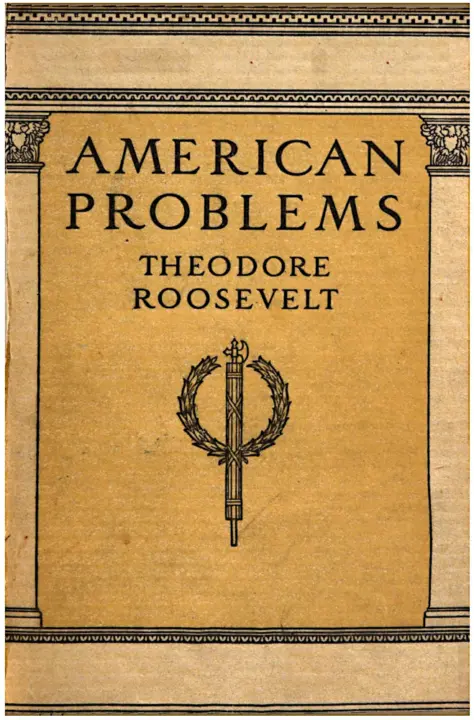
THE CLASSIC COLLECTION · 1910
"American Problems" by Theodore Roosevelt is a significant collection of essays and articles written in the early 20th century. This book represents Roosevelt's views on pressing national issues of his time, shedding light on topics such as tariffs, rural life, and political reform. Through these writings, the author aims to foster a national conversation about the challenges faced by America and the potential solutions that could lead to progress and unity. In "American Problems," Roosevelt discusses various key topics, starting with the management of small states and their capacity to govern themselves effectively. He asserts that certain nations may benefit from foreign intervention to foster stability and progress. Additionally, he evaluates the influence of selfish legislation and calls for political reform to improve the integrity of Congressional practices. Further, Roosevelt emphasizes the importance of rural life, advocating for improved living conditions and recognition of farmers' needs. The book also delves into the historical context of American progressivism, highlighting the spirit of innovation and community that characterized the nation's development. Ultimately, Roosevelt championing a moral approach to issues such as tariffs, pushing for fairness and justice in economic policies to benefit all citizens.
Introduction adapted from the source catalogue; source summaries may be automatically generated.
Free to read · English · 19,103 words · No account needed
MAKE TIME FOR A GOOD BOOK
On by default. Untick to stop anonymous reading totals. Each page counts after 10 seconds in view. How this works.
Anonymous counting is on unless you have switched it off.
Let me, in closing, put my position in a nutshell. When I say that I am for the square deal, I mean not merely that I stand for fair play under the present rules of the game, but that I stand for having these rules changed so as to work for a more substantial equality of opportunity and of reward for equally good service. So far as possible, the reward should be based upon service; and this necessarily implies that where a man renders us service in return for the fortune he receives, he has the right to receive it only on terms just to the whole people. For this reason there should be a heavily progressive National inheritance tax on big fortunes. The really big fortune, by the mere fact of its size, acquires qualities which differentiate it in kind as well as in degree from what is possessed by men of relatively small means. A heavily progressive inheritance tax on all such fortunes (heaviest on absentees) has the good qualities of an income tax, without its drawbacks; it is far more beneficial to the community at large, and far less burdensome to private individuals, as well as far more easily collected. A moderate, but progressive, income tax, carefully devised to fall genuinely on those who ought to pay, would, I believe, be a good thing; but a heavy and heavily progressive inheritance tax on great fortunes would be a far better thing.
I have tried to set before you my creed. I believe in property rights, but I believe in them as adjuncts to, and not as substitutes for, human rights. I believe that normally the rights of property coincide with the rights of man; but where they do not, then the rights of man must be put above the rights of property. I believe in shaping the ends of government to protect property; but wherever the alternative must be faced, I am for man and not for property. I am far from underestimating the importance of dividends, but I rank dividends below human character. I know well that if there is not sufficient prosperity the people will in the end rebel against any system, no matter how exalted morally; and reformers must not bring upon the people permanent economic ruin, or the reforms themselves will go down in the ruin. But we must be ready to face any temporary disaster—whether or not brought on by those who will war against us to the knife—if only through such disaster can we attain our goal. And those who oppose all reform will do well to remember that ruin in its worst form is inevitable if our National life brings us nothing whatever but a swollen and badly distributed material prosperity. In other words, I feel that material interests are chiefly good, not in themselves, but as an indispensable foundation upon which we should build a higher superstructure, a superstructure without which the foundation becomes worthless. Therefore I believe that the destinies of this country should be shaped primarily by moral forces, and by material forces only as they are subordinated to these moral forces. I believe that material wealth is an exceedingly valuable servant, and a particularly abhorrent master, in our National life. I think one end of government should be to achieve prosperity; but it should follow this end chiefly to serve an even higher and more important end—that of promoting the character and welfare of the average man. In the long run, and inevitably, the actual control of the government will be determined by the chief end which the government subserves. If the end and aim of government action is merely to accumulate general material prosperity, treating such prosperity as an end in itself and not as a means, then it is inevitable that material wealth and the masters of that wealth will dominate and control the course of national action. If, on the other hand, the achievement of material wealth is treated, not as an end of government, but as a thing of great value, it is true—so valuable as to be indispensable—but of value only in connection with the achievement of other ends, then we are free to seek through our government, and through the supervision of our individual activities, the realization of a true democracy. Then we are free to seek not only the heaping up of material wealth, but a wise and generous distribution of such wealth so as to diminish grinding poverty, and, so far as may be, to equalize social and economic no less than political opportunity.
Your reading position is saved on this browser. Take it to another device with a library code. Reading pages adapt to text, rather than matching a printed edition.
Theodore Roosevelt
Theodore Roosevelt
Theodore Roosevelt

Theodore Roosevelt & Kermit Roosevelt
BEHIND THE BOOK
This eBook is for the use of anyone anywhere in the United States and most other parts of the world at no cost and with almost no restrictions whatsoever. You may copy it, give it away or re-use it under the terms of the Project Gutenberg License included with this eBook or online at www.gutenberg.org. If you are not located in the United States, you will have to check the laws of the country where you are located before using this eBook. Read the source licence.
The original source file, including credits and licence, is retained by this library. Request an original-format copy at no charge. Please include the book title and Project Gutenberg identifier #64224.
KEEP YOUR CURIOSITY GOING

David Patterson (Spirit) Hatch

David Patterson (Spirit) Hatch

David Patterson (Spirit) Hatch
Cécile Tormay

Moritz Busch
John L. Ransom