THE CLASSIC COLLECTION✦Stories of Later American HistoryCLASSIC FREE BOOKS
Stories of Later American History
Wilbur F. (Wilbur Fisk) Gordy
THE CLASSIC COLLECTION · 1901
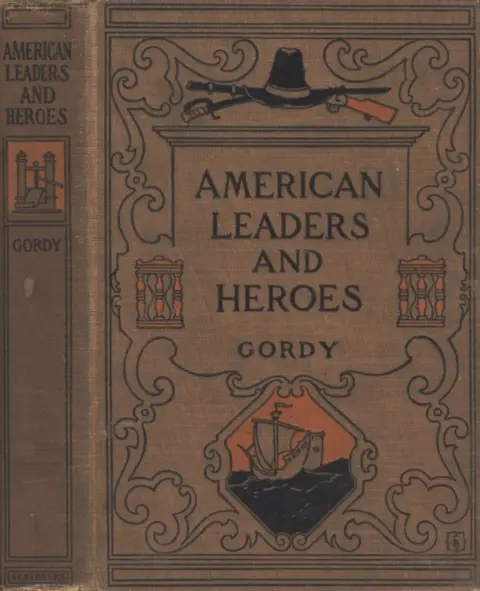
"American Leaders and Heroes: A Preliminary Text-Book in United States History" by Wilbur F. Gordy is a historical account written in the early 20th century. This text serves as an educational resource aimed primarily at young readers, introducing them to significant figures and events in American history, emphasizing personal stories and ethical lessons derived from the past. The book likely covers a time span from early exploration to the establishment of American society, highlighting leaders like Christopher Columbus and figures from the colonial period. The opening of the book sets the stage for a narrative on Christopher Columbus and his quest to discover a new route to the Indies. It emphasizes Columbus' childhood in Genoa and his formative experiences that fueled his ambition to sail west across the Atlantic. The text explores the skepticism he faced, detailing the challenges encountered in securing royal support from Spain. Significant moments of his journey are described, including the challenges at sea, interactions with various characters, and the landmark moment of landing in the New World, presenting Columbus not only as a navigator but as a symbol of determination in the face of adversity.
Introduction adapted from the source catalogue; source summaries may be automatically generated.
Free to read · English · 69,550 words · No account needed
MAKE TIME FOR A GOOD BOOK
On by default. Untick to stop anonymous reading totals. Each page counts after 10 seconds in view. How this works.
Anonymous counting is on unless you have switched it off.
"Oh, no," said Mr. West, "look here, and here, and here," pointing to
defects in the drawing.
After spending another week upon it, Morse took it to his teacher. Again Mr. West praised it and added:
"Very well, indeed, sir; go on and finish it."
"Is it not finished?" Morse asked with surprise and disappointment in
his voice.
"Not yet," said his critic.
Morse spent three or four days more in trying to perfect the work, and again handed it to his teacher, who, after again praising it, said:
"Well, sir, go and finish it."
"I cannot finish it," said Morse, by this time thoroughly disheartened.
"Well," replied Mr. West, "I have tried you long enough. Now, sir, you have learned more by this drawing than you would have accomplished in double the time by a dozen half-finished beginnings. It is not numerous drawings, but the character of one, which makes a thorough draughtsman. Finish one picture, sir, and you are a painter."
After four years of study, Morse returned to Boston. But in the meantime, like Fulton, he had gradually turned his thought from painting to invention. His energies were now, for many years, divided between the two.
During these years Morse had to depend for a livelihood mainly upon drawing and painting. He travelled through New Hampshire and Vermont, and even as far as South Carolina, everywhere painting miniatures on ivory, and establishing his reputation as an artist.
In 1829 he went once more to Europe for study and remained three years; but upon his return, although painting occupied much of his time, his career as an artist ended. His change of vocation turned upon an incident of his voyage home.
On the ocean steamer the conversation at dinner one day was about recent experiments with electricity. The special question of inquiry was this: "Does the length of wire make any difference in the velocity of the electric current passing through it?" One of the men present, Dr. Jackson, said that so far as experiments yet indicated, electricity passed through any length of wire in an instant.
"Then," said Morse, "thought can be transmitted hundreds of miles instantaneously by means of electricity. For if electricity will go ten miles without stopping, I can make it go around the globe." What a wonderful idea, in an instant to send thought thousands of miles and make a record of it there! That is what the telegraph was to do!
Your reading position is saved on this browser. Take it to another device with a library code. Reading pages adapt to text, rather than matching a printed edition.
BEHIND THE BOOK
This eBook is for the use of anyone anywhere in the United States and most other parts of the world at no cost and with almost no restrictions whatsoever. You may copy it, give it away or re-use it under the terms of the Project Gutenberg License included with this eBook or online at www.gutenberg.org. If you are not located in the United States, you will have to check the laws of the country where you are located before using this eBook. Read the source licence.
The original source file, including credits and licence, is retained by this library. Request an original-format copy at no charge. Please include the book title and Project Gutenberg identifier #35742.
KEEP YOUR CURIOSITY GOING
Cécile Tormay

Moritz Busch
John L. Ransom
Frances Wright
Cécile Tormay

Mabel Potter Daggett