
The Writing of News A Handbook with Chapters on Newspaper Correspondence and Copy Reading
Charles G. (Charles Griffith) Ross
THE CLASSIC COLLECTION · 1920
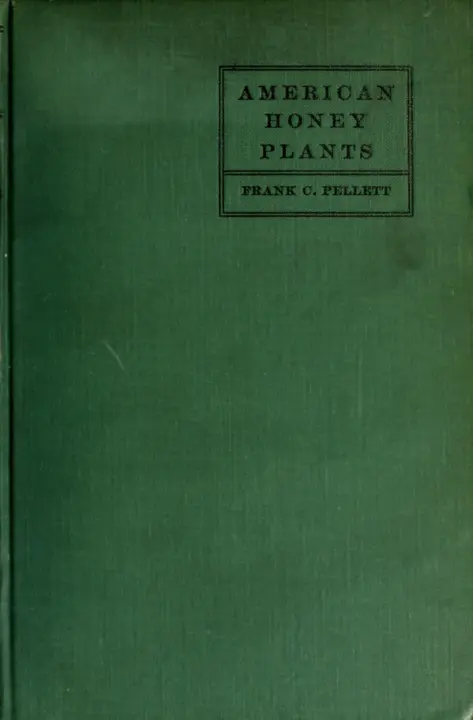
American honey plants by Frank C. (Frank Chapman) Pellett. Explore this classic work in a free online edition. Subjects include Honey plants -- United States. Read the locally hosted text below, adjust the reading display, and continue where you left off.
Introduction adapted from the source catalogue; source summaries may be automatically generated.
Free to read · English · 89,732 words · No account needed
MAKE TIME FOR A GOOD BOOK
On by default. Untick to stop anonymous reading totals. Each page counts after 10 seconds in view. How this works.
Anonymous counting is on unless you have switched it off.
The range of black sage is given as “Mt. Diablo, Los Trampas Ridge, near Hayward, San Mateo County, Glenwood and Brieta, southward to southern California. April-May.” (Jepson). “Coast ranges and ascending to 5,000 feet in the San Bernardino Mountains. March to June. San Diego County, February to May.”
Mr. J. E. Pleasants, of Orange, California, writing in American Bee
Journal (June, 1914) describes the peculiarities of the sages as
follows:
“The black sage is king of them all. When climatic conditions are favorable I think black sage can be relied upon to produce more ‘gilt edge’ than any other plant in the West, and for body and flavor it is hard to excel. It blooms for weeks. The blossom is small and inconspicuous, but what a flow of nectar it can yield.
“The white sage is a much prettier plant. Its soft, grey leaves and tall blossom spikes make it quite showy, while its pleasing aromatic odor breathes the very essence of wild perfumes. But this queenly plant is much more inconstant than its plainer sister. Some years it produces a good harvest, others very light.
“The silver or purple sage, which has silvery leaves and brilliant light purple blossoms, is usually a good producer, but is much restricted as to locality.”
The purple sage (=Salvia leucophylla=) (Fig. 123), also called white-leaved sage, or silver sage, is reported as a good yielder, although not as abundant as either of the foregoing species. The Richter catalog gives the range as occasional in the foothills of the Santa Monica and San Fernando Mountains, April to July, and from San Luis Obispo to San Diego Counties and not extending inland beyond the coast ranges.
=Salvia amabilis=, loving sage, is reported from Santa Barbara, March-June, but probably not important.
=Salvia carduacea=, thistle or annual sage. “Inner coast range valleys and throughout the San Joaquin Valley, southern California, June.” (Jepson). “A well-known honey plant.” (Richter).
=Salvia columbariae=, annual sage. “Throughout the coast ranges, Sierra Nevada and southern California, on hill and mountain slopes.” (Jepson).
=Salvia sonomensis=, Greene, creeping sage. “Montana species at middle altitudes. Ramona Mountains west of Calistoga, Mt. Shasta, Calaveras and Mariposa Counties, San Diego County. May.” (Jepson). “Also June, Sierra foothills from Sierra to Inyo Counties, main source of honey in many districts.” (Richter).
Concerning the regularity of yield from sage, Mr. P. C. Chadwick wrote in Gleanings in Bee Culture (January 1, 1911), as follows:
Your reading position is saved on this browser. Take it to another device with a library code. Reading pages adapt to text, rather than matching a printed edition.
BEHIND THE BOOK
This eBook is for the use of anyone anywhere in the United States and most other parts of the world at no cost and with almost no restrictions whatsoever. You may copy it, give it away or re-use it under the terms of the Project Gutenberg License included with this eBook or online at www.gutenberg.org. If you are not located in the United States, you will have to check the laws of the country where you are located before using this eBook. Read the source licence.
The original source file, including credits and licence, is retained by this library. Request an original-format copy at no charge. Please include the book title and Project Gutenberg identifier #79164.
KEEP YOUR CURIOSITY GOING
Charles G. (Charles Griffith) Ross
Hannah Webster Foster

Emily Lawless
Edwin Hamlin Carr

Charles De Lano Hine
Andrew Ure