
The Writing of News A Handbook with Chapters on Newspaper Correspondence and Copy Reading
Charles G. (Charles Griffith) Ross
THE CLASSIC COLLECTION · 1920
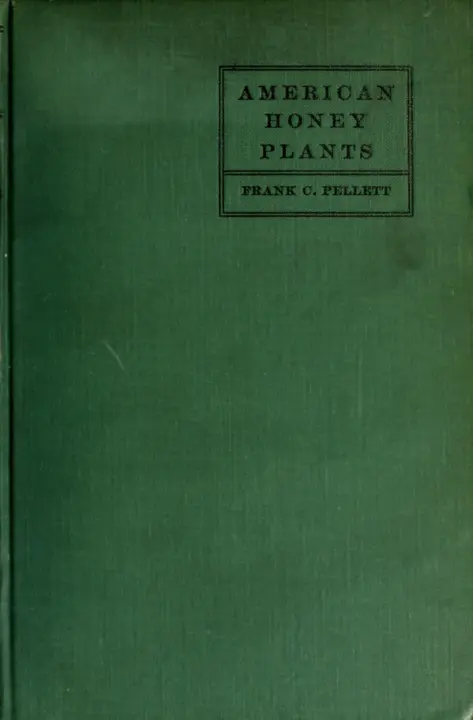
American honey plants by Frank C. (Frank Chapman) Pellett. Explore this classic work in a free online edition. Subjects include Honey plants -- United States. Read the locally hosted text below, adjust the reading display, and continue where you left off.
Introduction adapted from the source catalogue; source summaries may be automatically generated.
Free to read · English · 89,732 words · No account needed
MAKE TIME FOR A GOOD BOOK
On by default. Untick to stop anonymous reading totals. Each page counts after 10 seconds in view. How this works.
Anonymous counting is on unless you have switched it off.
Aster (=Aster=). The asters are of some value in this State, and in late fall bees may be seen frequently on the flowers. =Aster paniculatus= appears to be the most important. In some localities in the Middle States the ground is white with the blossoms of field asters. Pure honey, white or perhaps sometimes light amber. It is gathered so late that often it may not be fully ripened.
Apple (=Pyrus malus=). Yields a small surplus occasionally in this State. Honey of fine quality, light amber with aromatic flavor.
Basswood (=Tilia americana=). So rare in this State as to be of little
importance.
Blackberry (=Rubus=). Yields little nectar in the Northern States; but a surplus is reported in Georgia and California.
Boneset (=Eupatorium perfoliatum=). Visited by insects in large numbers, but not common enough to yield a surplus.
Buckwheat (=Fagopyrum esculentum=). Not extensively grown in Maine, but fields of it are cultivated in many localities. A dark, purplish honey.
Button-bush (=Cephalanthus occidentalis=). Common in swamps, but not
important.
Canada Thistle (=Cirsium arvense=). Not very important in this State, but more common westward. Honey light and well flavored.
Carrot (=Daucus Carota=). Naturalized from Europe, common in fields.
Clover, white (=Trifolium repens=). A fine white honey of delicious flavor. Alsike clover (=T. hybridum=) is an equally good honey plant, honey similar. Both are abundant in Maine, especially northward. In dry seasons bees are able to gather nectar from red clover, a bumblebee flower.
Cucumber (=Cucumis sativus=). A good honey plant in the neighborhood of pickle factories. Honey with flavor of the fruit, but improves with age.
Currant (=Ribes=). The various species of currants and gooseberries, both wild and cultivated, are of some importance.
Dandelion (=Taraxicum officinale=). More valuable for pollen than nectar in this State. Honey golden yellow, thick, strong-flavored, crystallizing in a few weeks.
Goldenrod (=Solidago=). A most valuable honey plant in New England. In southern Maine it never fails to give a large surplus, the main dependence of the beekeeper for winter stores. Honey golden yellow, fine flavored, candying with a coarse grain in a few months. =Solidago graminifolia= and =S. rugosa= are the most important species in this State.
Heartsease (=Polygonum persicaria=). This plant, so valuable in Illinois and Nebraska, is of no importance in Maine; a bee is rarely seen on the flowers.
Horse-chestnut (=Aesculus Hippocastanum=). Not common, bees gather both nectar and pollen. Bumblebee flowers.
Locust, black (=Robinia pseudo-acacia=). Yields a surplus of white honey further south, but not abundant in Maine. Often cultivated.
Maple (=Acer saccharum=). The rock maple blooms in spring before the leaves appear and the flowers are visited by bees in great numbers. The red maple also yields nectar.
Your reading position is saved on this browser. Take it to another device with a library code. Reading pages adapt to text, rather than matching a printed edition.
BEHIND THE BOOK
This eBook is for the use of anyone anywhere in the United States and most other parts of the world at no cost and with almost no restrictions whatsoever. You may copy it, give it away or re-use it under the terms of the Project Gutenberg License included with this eBook or online at www.gutenberg.org. If you are not located in the United States, you will have to check the laws of the country where you are located before using this eBook. Read the source licence.
The original source file, including credits and licence, is retained by this library. Request an original-format copy at no charge. Please include the book title and Project Gutenberg identifier #79164.
KEEP YOUR CURIOSITY GOING
Charles G. (Charles Griffith) Ross
Hannah Webster Foster

Emily Lawless
Edwin Hamlin Carr

Charles De Lano Hine
Andrew Ure