THE CLASSIC COLLECTION✦Letters to His ChildrenCLASSIC FREE BOOKS
Letters to His Children
Theodore Roosevelt
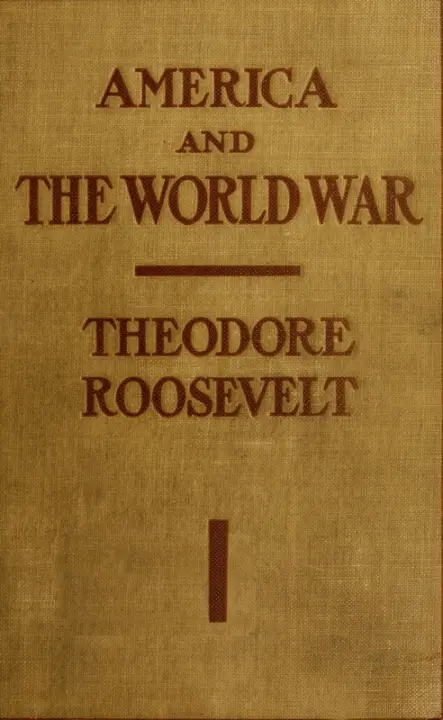
THE CLASSIC COLLECTION · 1915
"America and the World War" by Theodore Roosevelt is a historical account written in the early 20th century. This work delves into the implications and lessons the United States can learn from the context of World War I, which was unfolding during this period. Theodore Roosevelt discusses the necessity of national preparedness and the importance of supporting oppressed nations, especially as exemplified by Belgium's plight during the war. At the start of the text, Roosevelt reflects on the unexpected devastation of the war, drawing parallels between the calamity in Europe and historical disasters. He emphasizes the need for America to learn crucial lessons from the conflict, highlighting the inadequacy of existing treaties that failed to protect nations like Belgium. Roosevelt argues for a proper military preparedness and a moral stance against oppression, advocating for a balance between peace and righteousness. He urges Americans to consider the broader implications of isolationism and the responsibility to act against aggression in defense of justice and international law.
Introduction adapted from the source catalogue; source summaries may be automatically generated.
Free to read · English · 66,289 words · No account needed
MAKE TIME FOR A GOOD BOOK
On by default. Untick to stop anonymous reading totals. Each page counts after 10 seconds in view. How this works.
Anonymous counting is on unless you have switched it off.
The capital work done by the German cruisers in the Atlantic, the Pacific, and the Indian Oceans shows how much can be accomplished in the way of hurting and damaging an enemy by even the weaker power if it possesses fine ships, well handled, able to operate thousands of miles from their own base. We must not fail to recognize this. Neither must we fail heartily and fully to recognize the capital importance of submarines as well as air-ships, torpedo-boat destroyers, and mines, as proved by the events of the last three months. But nothing that has yet occurred warrants us in feeling that we can afford to ease up in our programme of building battle-ships and cruisers, especially the former. The German submarines have done wonderfully in this war; their cruisers have done gallantly. But so far as Great Britain is concerned the vital and essential feature has been the fact that her great battle fleet has kept the German fleet immured in its own home ports, has protected Britain from invasion, and has enabled her land strength to be used to its utmost capacity beside the armies of France and Belgium. If the men who for years have clamored against Britain’s being prepared had had their way, if Britain during the last quarter of a century had failed to continue the upbuilding of her navy, if the English statesmen corresponding to President Wilson and Mr. Bryan had seen their ideas triumph, England would now be off the map as a great power and the British Empire would have dissolved, while London, Liverpool, and Birmingham would be in the condition of Antwerp and Brussels.
The efficiency of the German personnel at sea has been no less remarkable than the efficiency of the German personnel on land. This is due partly to the spirit of the nation and partly to what is itself a consequence of that spirit, the careful training of the navy during peace under the conditions of actual service. When, early in 1909, our battle fleet returned from its sixteen months’ voyage around the world there was no navy in the world which, size for size, ship for ship, and squadron for squadron, stood at a higher pitch of efficiency. We blind ourselves to the truth if we believe that the same is true now. During the last twenty months, ever since Secretary Meyer left the Navy Department, there has been in our navy a great falling off relatively to other nations. It was quite impossible to avoid this while our national affairs were handled as they have recently been handled. The President who intrusts the Departments of State and the Navy to gentlemen like Messrs. Bryan and Daniels deliberately invites disaster, in the event of serious complications with a formidable foreign opponent. On the whole, there is no class of our citizens, big or small, who so emphatically deserve well of the country as the officers and the enlisted men of the army and navy. No navy in the world has such fine stuff out of which to make man-of-war’s men. But they must be heartily backed up, heartily supported, and sedulously trained. They must be treated well, and, above all, they must be treated so as to encourage the best among them by sharply discriminating against the worst. The utmost possible efficiency should be demanded of them. They are emphatically and in every sense of the word men; and real men resent with impatient contempt a policy under which less than their best is demanded. The finest material is utterly worthless without the best personnel. In such a highly specialized service as the navy constant training of a purely military type is an absolute necessity. At present our navy is lamentably short in many different material directions. There is actually but one torpedo for each torpedo tube. It seems incredible that such can be the case; yet it is the case. We are many thousands of men short in our enlistments. We are lamentably short in certain types of vessel. There is grave doubt as to the efficiency of many of our submarines and destroyers. But the shortcomings in our training are even more lamentable. To keep the navy cruising near Vera Cruz and in Mexican waters, without manœuvring, invites rapid deterioration. For nearly two years there has been no fleet manœuvring; and this fact by itself probably means a twenty-five per cent loss of efficiency. During the same periods most of the ships have not even had division gun practice. Not only should our navy be as large as our position and interest demand but it should be kept continually at the highest point of efficiency and should never be used save for its own appropriate military purposes. Of this elementary fact the present administration seems to be completely ignorant.
Your reading position is saved on this browser. Take it to another device with a library code. Reading pages adapt to text, rather than matching a printed edition.
Theodore Roosevelt
Theodore Roosevelt
Theodore Roosevelt

Theodore Roosevelt & Kermit Roosevelt
BEHIND THE BOOK
This eBook is for the use of anyone anywhere in the United States and most other parts of the world at no cost and with almost no restrictions whatsoever. You may copy it, give it away or re-use it under the terms of the Project Gutenberg License included with this eBook or online at www.gutenberg.org. If you are not located in the United States, you will have to check the laws of the country where you are located before using this eBook. Read the source licence.
The original source file, including credits and licence, is retained by this library. Request an original-format copy at no charge. Please include the book title and Project Gutenberg identifier #53651.
KEEP YOUR CURIOSITY GOING
Cécile Tormay

Moritz Busch
John L. Ransom
Frances Wright
Cécile Tormay

Mabel Potter Daggett