THE CLASSIC COLLECTION✦King TimeCLASSIC FREE BOOKS
King Time
Percy Keese Fitzhugh
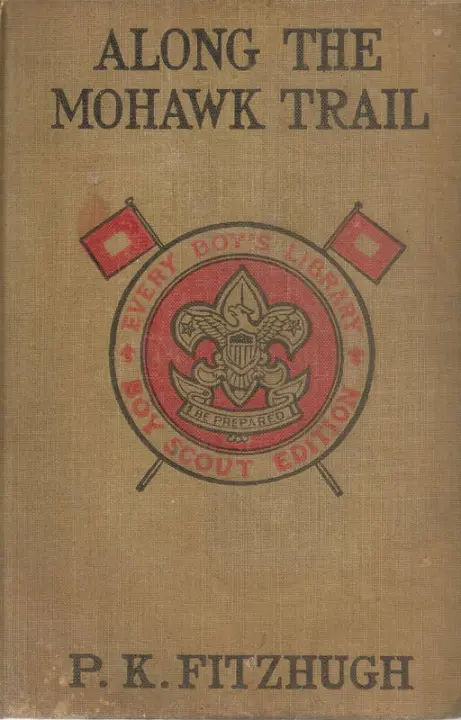
THE CLASSIC COLLECTION · 1912
"Along the Mohawk Trail; Or, Boy Scouts on Lake Champlain" by Percy Keese Fitzhugh is a children's adventure novel written in the early 20th century. The story centers around Gordon Lord, a young scout who sets out to find his troop, which is camping somewhere along Lake Champlain. The narrative captures the spirit of scouting and the importance of adventure, camaraderie, and resourcefulness in the lives of boys exploring the outdoors. The opening portion of the book introduces Gordon as he sets off for a summer camping trip but misses the train due to his distraction while helping a former teacher. After some initial flurry, he eventually decides to embark on a quest to locate his troop. As Gordon navigates through the woods, he discovers clues indicating that his fellow scouts have recently passed through the area, including an arrow marked in pink chalk and signs of disturbance near a river. His determination leads him to the realization that adventure awaits, as he pushes onward to find his friends while encountering various challenges and showcasing his keen scouting skills.
Introduction adapted from the source catalogue; source summaries may be automatically generated.
Free to read · English · 88,939 words · No account needed
MAKE TIME FOR A GOOD BOOK
On by default. Untick to stop anonymous reading totals. Each page counts after 10 seconds in view. How this works.
Anonymous counting is on unless you have switched it off.
Two seats, side by side, were cozily placed in the center between the upper and lower planes, with the control device near at hand, and thus every movement that a bird makes,—the flex of wing, the flap of tail, the guiding tendency of this or that little stir of throat and body,—was at the command of the operator. The telescope, the first tool of aviation, had forced the swallow and the sea-gull to yield up their secret, and here it was amid a network of frame and wire, at the service of man.
Goodwin’s voice aroused Harry from his absorption. “No questions answered after the train leaves,” he said. Harry felt very much at home with him already. Here was a man, unaffected, simple, offhand, competent, self-assured, and levelheaded. Nothing of the crank or the visionary,—the kind of man who helps to advance the science of aviation.
“I thought the propeller looked pretty big across the field,” said Harry; “but it doesn’t look so big now. That all there is to the motor,—just that that’s on the propeller?”
“That’s all, but it’s enough,” Mr. Goodwin answered.
“It makes a whole lot of fuss, anyway.”
“Right you are, and she fits like a suit of clothes. It isn’t wholly a question of how much power you have, you know, but does the power fit? That’s the question. See?”
“But doesn’t more power mean more speed?” Harry asked.
Goodwin laughed. “No, not exactly. The motor sustains the machine in flight. Now, if there’s a good big supporting wing area, why, the engine can be smaller—it’s got to be, in fact.”
“I’m afraid I’ll have to go to the foot of the class,” laughed Harry.
“So? Why? You never studied the subject? Well, see here, now, I’ll give you the A B C of it and then we’ll hop in. The more spread there is, the less supporting work the propeller has to do. So a powerful motor fits a small machine, and a big machine takes less power to get the same results. Now, you take Curtiss; he cuts down his planes, makes his machine small, and what’s the answer? Does he get along with less power? No, he needs more. You see, it isn’t a case of more power, more speed. It’s having your power to fit your machine. The propeller is more than a propeller,—it’s a sustainer as well. Stop the propeller of a boat, and the boat stands still. Stop an aero propeller, and down she comes. Propeller keeps her up and keeps her going—two jobs. If you lessen your support in one way, you must make it up in another. An aeroplane is sustained by its speed with help from its planes. Well, now, the more area you have, the less the motor has to do. You’ve heard aviation compared to sailing, and that’s just the very thing that it isn’t a bit like. Did you ever skate on thin ice? Well, there you have it. If you want to keep from going in, skate fast. Now, if you put a large motor on a large machine, you don’t get a normal increase of speed, by any means. So you see, it’s not a question of power—it’s a question of a nice, neat fit, as you might say.”
Your reading position is saved on this browser. Take it to another device with a library code. Reading pages adapt to text, rather than matching a printed edition.
Percy Keese Fitzhugh
Percy Keese Fitzhugh
Percy Keese Fitzhugh
Percy Keese Fitzhugh
BEHIND THE BOOK
This eBook is for the use of anyone anywhere in the United States and most other parts of the world at no cost and with almost no restrictions whatsoever. You may copy it, give it away or re-use it under the terms of the Project Gutenberg License included with this eBook or online at www.gutenberg.org. If you are not located in the United States, you will have to check the laws of the country where you are located before using this eBook. Read the source licence.
The original source file, including credits and licence, is retained by this library. Request an original-format copy at no charge. Please include the book title and Project Gutenberg identifier #60269.
KEEP YOUR CURIOSITY GOING
Wilfrid Scawen Blunt
Wilfrid Scawen Blunt

E. W. (Edgar Watson) Howe
Coulson Kernahan

Maurice Baring
Frances Wright