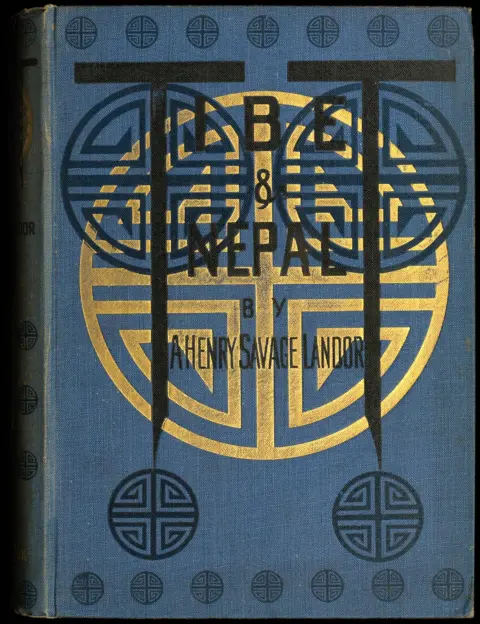
Tibet & Nepal
Arnold Henry Savage Landor
THE CLASSIC COLLECTION · 1893
"Alone with the Hairy Ainu" by A. H. Savage Landor is a travel memoir written in the late 19th century. This engaging narrative chronicles the author's extraordinary journey across Hokkaido, Japan, delving into the customs and lifestyle of the Ainu people, who are described as "hairy men." Landor's observations and experiences aim to contribute to the fields of anthropology and ethnology, offering a unique perspective on a culture that was little understood at the time. At the start of the memoir, the author reflects on his motivations for undertaking the arduous journey alone, which combined a desire for adventure and personal insight. After arriving in Hakodate, he quickly learns of the challenges that await him, including difficult terrain and minimal accommodations. As he encounters the Ainu in their villages, he describes their living conditions, customs, and practices—often with a mix of fascination and repulsion. His initial interactions with the Ainu are marked by cultural misunderstandings, particularly surrounding his artistic endeavors, which lead to humorous and sometimes dangerous situations. This opening portion sets the stage for a deeper exploration of Ainu culture, as Landor embarks on a journey filled with personal anecdotes, vivid descriptions, and insightful commentary.
Introduction adapted from the source catalogue; source summaries may be automatically generated.
Free to read · English · 109,525 words · No account needed
MAKE TIME FOR A GOOD BOOK
On by default. Untick to stop anonymous reading totals. Each page counts after 10 seconds in view. How this works.
Anonymous counting is on unless you have switched it off.
Basing conclusions on wrong premises, writers on the Ainu religion have been naturally led astray altogether. For instance, the composite word Kotan-kara-kamui,[39] which a learned missionary has translated "Creator," only means "the man who made the village"--a description which hardly corresponds to the grandeur attributed to the words by its imaginative translator.
[39] Kotan, village, place, site; kara, to make, build; kamui, the man, ancient, strength.
Then again, Kamui kotan, which according to some means "the home of God," in its real signification is "an ancient village; a beautiful place." When Kamui is applied to persons, it is generally a suffix; when to things, it is a prefix.
But let us come to the inao, which by some have been called the "Ainu gods," by others "Divine symbols." These inao are willow-wands, with shavings depending from the upper end, sometimes from the middle, and occasionally from near the lower end as well.
The larger wands are about four feet in length, and have either one or two bunches of shavings at the upper end only. They go by the name of inao netuba, or "big inao." Other smaller inao, like the Chisei-kara-inao,[40] are kept in the house, and stuck in the eastern corner of the hearth, and in the wall directly opposite the entrance door. Some of the inao are shaved upwards from the bottom, others downwards from the top; and one, a big inao, is often thrust through the small window facing the east. Sometimes they are placed about singly, especially inside the huts; but outside, close to the eastern wall, I have often seen eight or ten standing together in a row. When so taken collectively they are called nuza. On Volcano Bay, up the Saru River, and on the Lake Kutcharo, where it is the custom of the Ainu to make trophies of the skulls of bears and deer which have been killed in the hunt, one or two inao are placed at the foot of the trophy. Sometimes, but very rarely, a whole nuza is to be seen in front of a trophy; but in most cases the nuza I saw were near huts that had no trophy at all, and, as I say, only very seldom were they in front of the trophy itself, unless a bear feast was going on. I am therefore under the impression that these nuza are only put up when some festival takes place, and that they are not kept there permanently. I remember that at Piratori there were no inao and no nuza outside Benry's house, but on the day that the festival took place one was put up, and several inao were placed inside the hut, in the hearth and on the north wall. Likewise, a nuza was put up on the same day at the east end of the hut in which the feast was given, and the inside was also adorned with inao of various sizes and descriptions. Each inao is pointed at the lower end, so as to be easily stuck in the ground. The inao of all sizes and shapes impressed me as being mostly for ornament. Then some are held as charms against misfortune and disease; but they never impressed me as being offerings to the gods. Inao are placed near springs, so that the good water may not turn into pestilential, and occasionally inao of a peculiar shape are hung in the doorway of newly-built huts. They are made of a number of small willow sticks tied together, from which hang five or six bunches of shavings; they are hung horizontally, and not in a vertical position, like the other inao. They are very uncommon, and only used on certain specified occasions. For example, when a child is born an inao, in the shape of a doll, is made of a bunch of reeds folded double and tied with a string about an inch from the bend, which thus forms the head; it is then tied lower down to indicate the waist. By dividing the reeds into two equal portions they produce a pair of legs, and a stick is then passed through the reeds between the head and the waist to form the arms. When this doll is made it is placed near the infant, so that should any disease or misfortune, in the shape of a kind of evil spirit, be tempted to enter the child's body, it may be averted, and enter the doll instead. Should a person fall ill new inao are stuck in the hearth, as the Ainu share our own idea that evil spirits dwell mostly in fire; others are placed near the sick person. They are not meant as offerings to the gods for his or her quick recovery, but merely to bring good luck to the individual whose body they think has been taken possession of by "animals inside," or, in other words, evil spirits.
Your reading position is saved on this browser. Take it to another device with a library code. Reading pages adapt to text, rather than matching a printed edition.
Arnold Henry Savage Landor
Arnold Henry Savage Landor
Arnold Henry Savage Landor
Arnold Henry Savage Landor
BEHIND THE BOOK
This eBook is for the use of anyone anywhere in the United States and most other parts of the world at no cost and with almost no restrictions whatsoever. You may copy it, give it away or re-use it under the terms of the Project Gutenberg License included with this eBook or online at www.gutenberg.org. If you are not located in the United States, you will have to check the laws of the country where you are located before using this eBook. Read the source licence.
The original source file, including credits and licence, is retained by this library. Request an original-format copy at no charge. Please include the book title and Project Gutenberg identifier #37873.
KEEP YOUR CURIOSITY GOING
Wilfrid Scawen Blunt
Wilfrid Scawen Blunt

E. W. (Edgar Watson) Howe
Francis Greenleaf Allinson & Anne C. E. (Anne Crosby Emery) Allinson
Cyrenus Cole

John Martineau