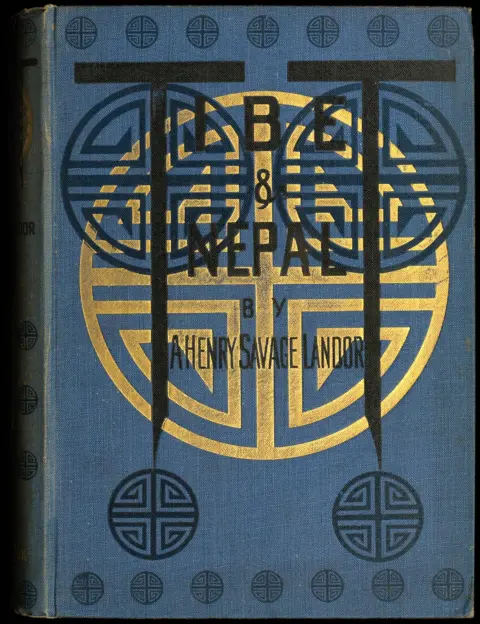
Tibet & Nepal
Arnold Henry Savage Landor
THE CLASSIC COLLECTION · 1893
"Alone with the Hairy Ainu" by A. H. Savage Landor is a travel memoir written in the late 19th century. This engaging narrative chronicles the author's extraordinary journey across Hokkaido, Japan, delving into the customs and lifestyle of the Ainu people, who are described as "hairy men." Landor's observations and experiences aim to contribute to the fields of anthropology and ethnology, offering a unique perspective on a culture that was little understood at the time. At the start of the memoir, the author reflects on his motivations for undertaking the arduous journey alone, which combined a desire for adventure and personal insight. After arriving in Hakodate, he quickly learns of the challenges that await him, including difficult terrain and minimal accommodations. As he encounters the Ainu in their villages, he describes their living conditions, customs, and practices—often with a mix of fascination and repulsion. His initial interactions with the Ainu are marked by cultural misunderstandings, particularly surrounding his artistic endeavors, which lead to humorous and sometimes dangerous situations. This opening portion sets the stage for a deeper exploration of Ainu culture, as Landor embarks on a journey filled with personal anecdotes, vivid descriptions, and insightful commentary.
Introduction adapted from the source catalogue; source summaries may be automatically generated.
Free to read · English · 109,525 words · No account needed
MAKE TIME FOR A GOOD BOOK
On by default. Untick to stop anonymous reading totals. Each page counts after 10 seconds in view. How this works.
Anonymous counting is on unless you have switched it off.
Very few travellers have seen the real Ainu, or studied them accurately, while many, partly owing to their inability to differentiate one race from another, have given us highly imaginative descriptions, and even photographs, of Japanese half-castes and actual Japanese, describing them as Ainu. If such worthy ethnologists as have visited the "civilised part only" of the Ainu country, have been unable to distinguish types of the hairy Ainu race from those of the hairless Japanese, or from mixtures of the two, undoubtedly racial characteristics have been but imperfectly recorded.
It is more particularly in music and poetry, as I have already explained, that temperamental characteristics are shown, and one ought to be careful to clearly define what is native music and poetry--in which I include legends, traditions, and folk-lore--and what has been transmitted by neighbouring and conquering races. Loud music is not appreciated by the Ainu, and makes them grin with more scorn than enjoyment. I could only try experiments in this direction by singing to them, as I had no European musical instruments with me; but I found that singing con brio at the top of my voice was not so pleasing to them as when I sang piano con passione. For instance, the song "Toreador," in the opera Carmen, created fits of merriment from a crowd at Frishikobets, while the same crowd, a few minutes later, listened attentively and silently to Gounod's "Ave Maria," sung in a kind of "miaoling" voice.
I may here mention incidentally, to show the different musical tastes of Ainu and Japanese, that some months previous to this I was at a concert at Tokio in which the same "Ave Maria" was performed by some distinguished European musicians. The large Japanese audience, who had been attentive and well-composed till then, went into fits of laughter when Gounod's masterpiece was played, and all through it the noise of people laughing was so great as to drown entirely the orchestra and singers. Some of the women in the audience nearly went into hysterics at the long legato notes at the beginning of the piece. Louder melodies and of a livelier character did not affect them so. I wish to draw attention to this fact, that amongst all primitive peoples the native music is sad and slow--the livelier melodies coming later; and also, that with both wild and domestic animals the most noteworthy effects are produced by slow and simple music. We all know how dogs will remain quiet and calm when a soft and gentle air is played, but get furious to the point of savageness under the "plan-plan-rataplan" of a merry noisy tune. As for the last item connected with Ainu music, viz., dancing, it is rarely practised, even by the Ainu women, to whom alone it pertains. At the best it is of a very rude form. In the Piratori festival (Chapter IV.) we have seen that their dancing is accompanied by rhythmical sounds imitating the noises produced by implements in everyday use, as the squeaking of a paddle by the friction on the canoe, the cry which accompanies the pounding of millet, blowing alight the fire, and similar sounds. Time is kept by clapping the hands and by vociferations which tell the partners what position or action to assume, each action being accompanied by a different sound, but all performed while the hopping is kept up. I have not felt justified in classifying these rhythmical sounds, which accompany the dancing, as choruses, for there is not enough in them to constitute either a tune or a melody. They are suggested more by the action of the arms and upper part of the body than by the steps; in fact, if it were not for the continuous hopping it would be more accurate to describe Ainu dancing as "posturing." The dancers form a circle, with sometimes one or two children in the centre. As there are no professional musicians, there are no professional dancers; but though each man may be his own composer of music, the women never alter their dances, which are handed down unchanged from one generation to another. It is only at festivals that the dance is performed, and never inside the huts, but in the open air. It is not for the amusement of spectators, for besides one or two of the older women, spectators there are none; but it is for the enjoyment of the dancers themselves. The men do not seem to take the slightest interest in the dancing, and apparently regard it as unmanly. They remain in the hut drinking while the girls enjoy themselves in this way outside, and should one of them by chance come out, he would stop and look on no more than men in civilised countries would stop and watch little children at play. On the other hand, on such occasions Ainu matrons squat in a semicircle not far from the dancers, and keep up a lament-like or sometimes quarrelsome conversation among themselves, and occasionally encourage the girls in their hopping, and suggesting encores of this figure or that, which, between one quarrel and another, has taken their fancy.
Your reading position is saved on this browser. Take it to another device with a library code. Reading pages adapt to text, rather than matching a printed edition.
Arnold Henry Savage Landor
Arnold Henry Savage Landor
Arnold Henry Savage Landor
Arnold Henry Savage Landor
BEHIND THE BOOK
This eBook is for the use of anyone anywhere in the United States and most other parts of the world at no cost and with almost no restrictions whatsoever. You may copy it, give it away or re-use it under the terms of the Project Gutenberg License included with this eBook or online at www.gutenberg.org. If you are not located in the United States, you will have to check the laws of the country where you are located before using this eBook. Read the source licence.
The original source file, including credits and licence, is retained by this library. Request an original-format copy at no charge. Please include the book title and Project Gutenberg identifier #37873.
KEEP YOUR CURIOSITY GOING
Wilfrid Scawen Blunt
Wilfrid Scawen Blunt

E. W. (Edgar Watson) Howe
Francis Greenleaf Allinson & Anne C. E. (Anne Crosby Emery) Allinson
Cyrenus Cole

John Martineau