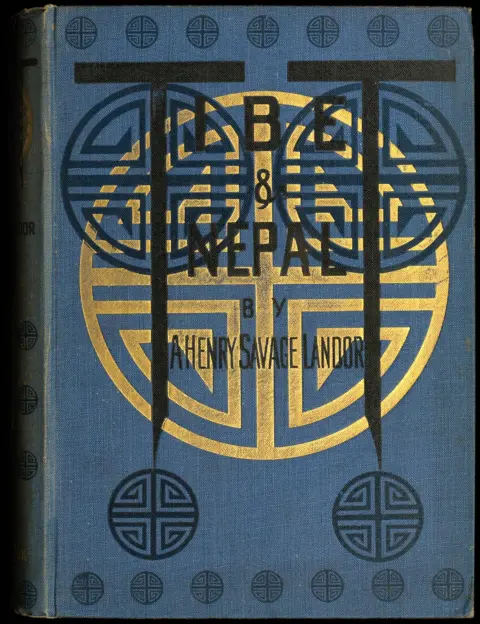
Tibet & Nepal
Arnold Henry Savage Landor
THE CLASSIC COLLECTION · 1893
"Alone with the Hairy Ainu" by A. H. Savage Landor is a travel memoir written in the late 19th century. This engaging narrative chronicles the author's extraordinary journey across Hokkaido, Japan, delving into the customs and lifestyle of the Ainu people, who are described as "hairy men." Landor's observations and experiences aim to contribute to the fields of anthropology and ethnology, offering a unique perspective on a culture that was little understood at the time. At the start of the memoir, the author reflects on his motivations for undertaking the arduous journey alone, which combined a desire for adventure and personal insight. After arriving in Hakodate, he quickly learns of the challenges that await him, including difficult terrain and minimal accommodations. As he encounters the Ainu in their villages, he describes their living conditions, customs, and practices—often with a mix of fascination and repulsion. His initial interactions with the Ainu are marked by cultural misunderstandings, particularly surrounding his artistic endeavors, which lead to humorous and sometimes dangerous situations. This opening portion sets the stage for a deeper exploration of Ainu culture, as Landor embarks on a journey filled with personal anecdotes, vivid descriptions, and insightful commentary.
Introduction adapted from the source catalogue; source summaries may be automatically generated.
Free to read · English · 109,525 words · No account needed
MAKE TIME FOR A GOOD BOOK
On by default. Untick to stop anonymous reading totals. Each page counts after 10 seconds in view. How this works.
Anonymous counting is on unless you have switched it off.
Late at night, as I had almost given up all hope of finding a shelter, I came upon a shed on the Furembets River, where I put up for the night.
My wretched pony was nearly dead with fatigue, and I let him loose so that he might get a feed of grass. The next morning, after the inmates of the hut had volunteered to go and bring him back to me, I heard them on the distant hills calling, "Pop, pop, pop, pop!" the Ainu way of approaching and calling horses. After a time they came back hopeless, saying that the brute had bolted, and there was no hope of getting him again. He could not be found anywhere! I was in the most awful dilemma, for had that been the case I would have been forced to abandon all my impedimenta, consisting of sketches and painting materials, and proceed as best I could on foot. Under other circumstances I could have carried the baggage on my back easily; but as I was half-starved, and had my feet badly cut, I was hardly able to carry my own weight; therefore this was not possible now.
As incredulity is one of the useful qualities I possess, I went to look after my pony myself. The shed was protected by a sand-mound at the back, and a small space was left between the mound and the wall of the shed. I do not know what made me go and look there, but sure enough there was my pony lying flat, and almost too weak to get up again. This was no horse-stealing ruse on the part of the Ainu; simply the wretched animal's own idea of good stabling and likely fodder. I dragged him out of his involuntary prison, and after having done what I could for his comfort and well-being, we set out once more on our melancholy travels. This may sound cruel to some who in the course of their life have never travelled in out-of-the-way places, and who are ready to condemn anyone who is the means of letting an animal suffer. It may sound cruel in our humane country, where animals are protected and prize-fights tolerated and enjoyed; so to avoid misunderstandings it might be as well for me to say, that as regards this tired pony it was simply the matter to push on with him as far as I could or lose all the valuable materials I had collected during months of sufferings and privations. No ponies were to be got for any money along that deserted coast, for there were none in existence. I did my best to alleviate the poor animal's sufferings by undergoing myself a considerable amount of pain, walking most of the way with my feet a mass of sores; and as winter was rapidly coming on, I was more than anxious to make my way south with all the speed I could, to prevent being blocked up with snow and ice and forced to spend the winter on this inhospitable coast. Consequently, I was, as a matter of fact, more cruel to myself than to my animals; to the others, those who will still cast the first stone at me, I can wish no better punishment than to be placed in the same position I was then. The trail became somewhat better, as it led over the cliffs for about three miles; then again it was on the beach. The high cliffs varied from a very rich burnt sienna colour to a nice warm grey, and in some places they are perfectly white, like the cliffs at Dover. Conical mounds frequently occur, and give a curious aspect to this deserted shore. Ten miles further on, at Chukbets, I found a couple of huts; then I walked and dragged the pony on the cliffs for about four miles; then again I resorted to the beach; and finally I entered Hamboro, a small village, or rather a picturesque group of sheds and huts, and a capital fishing-station. Shake, salmon, mashe, and herrings are caught in abundance at the mouth of this river. A short distance from here hundreds of carcasses of seals were scattered on the beach, whence emanated pestilential odours. On account of the slowness of my pony I had to-night a modified repetition of last night's experience, but neither was the sea so rough nor the trail so narrow at the bottom of the cliffs; and though my wretched animal was naturally in a worse condition than before, I was able to push on to Tomamai that same night, where I arrived at a small hour of the morning.
Your reading position is saved on this browser. Take it to another device with a library code. Reading pages adapt to text, rather than matching a printed edition.
Arnold Henry Savage Landor
Arnold Henry Savage Landor
Arnold Henry Savage Landor
Arnold Henry Savage Landor
BEHIND THE BOOK
This eBook is for the use of anyone anywhere in the United States and most other parts of the world at no cost and with almost no restrictions whatsoever. You may copy it, give it away or re-use it under the terms of the Project Gutenberg License included with this eBook or online at www.gutenberg.org. If you are not located in the United States, you will have to check the laws of the country where you are located before using this eBook. Read the source licence.
The original source file, including credits and licence, is retained by this library. Request an original-format copy at no charge. Please include the book title and Project Gutenberg identifier #37873.
KEEP YOUR CURIOSITY GOING
Wilfrid Scawen Blunt
Wilfrid Scawen Blunt

E. W. (Edgar Watson) Howe
Francis Greenleaf Allinson & Anne C. E. (Anne Crosby Emery) Allinson
Cyrenus Cole

John Martineau