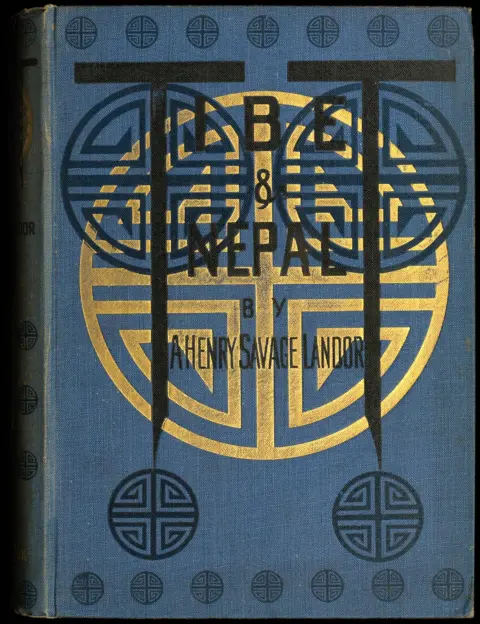
Tibet & Nepal
Arnold Henry Savage Landor
THE CLASSIC COLLECTION · 1893
"Alone with the Hairy Ainu" by A. H. Savage Landor is a travel memoir written in the late 19th century. This engaging narrative chronicles the author's extraordinary journey across Hokkaido, Japan, delving into the customs and lifestyle of the Ainu people, who are described as "hairy men." Landor's observations and experiences aim to contribute to the fields of anthropology and ethnology, offering a unique perspective on a culture that was little understood at the time. At the start of the memoir, the author reflects on his motivations for undertaking the arduous journey alone, which combined a desire for adventure and personal insight. After arriving in Hakodate, he quickly learns of the challenges that await him, including difficult terrain and minimal accommodations. As he encounters the Ainu in their villages, he describes their living conditions, customs, and practices—often with a mix of fascination and repulsion. His initial interactions with the Ainu are marked by cultural misunderstandings, particularly surrounding his artistic endeavors, which lead to humorous and sometimes dangerous situations. This opening portion sets the stage for a deeper exploration of Ainu culture, as Landor embarks on a journey filled with personal anecdotes, vivid descriptions, and insightful commentary.
Introduction adapted from the source catalogue; source summaries may be automatically generated.
Free to read · English · 109,525 words · No account needed
MAKE TIME FOR A GOOD BOOK
On by default. Untick to stop anonymous reading totals. Each page counts after 10 seconds in view. How this works.
Anonymous counting is on unless you have switched it off.
It is, indeed, difficult to describe how and what one feels when, to all appearance, one is going to be murdered--for painting a fish! My first thought, of course, went to my parents. My next was, what a nuisance it was to be murdered with the sun shining in my eyes, so that I could not even see who would give me the "finishing touch." All the events of my life, the bad ones first, flashed across my mind in those few seconds, and then I almost began to feel as if I had made my first steps into the other world, and I could see angels and devils disputing for my company--the devils, of course, having by far the largest claims. The bitterness of death had in some sense passed, when, to my great astonishment, and with a few, but very sound, kicks I was made to understand that I could get up and go.
The sensation of being brought back to life, when one has made up one's mind to be dead, notwithstanding the abrupt manner in which it was produced, was indeed a pleasant one. I did get up, and pretty quick, I can tell you; but only to see my poor wooden paint-box floating half-smashed in the sea, my brushes stuck here and there in the sand, and the sketch utterly destroyed.
My assailants were about fifteen or twenty, and I was alone. Stupidly enough, and relying on the Christianity of the people, I had not burdened myself with the extra weight of my revolver; I had left it with my heavy luggage in the small Japanese tea-house where I had put up, nearly a mile away. The Japanese police-station was at Washibets, another village some miles off. Nothing was left for me but to pick up the few unbroken brushes which were within easy reach and retire; but I was neither frightened nor conquered, and I swore to myself that I would have my revenge. I hurried to the tea-house, took my revolver, and filled my pocket with cartridges, then I ran back to the spot where I had sketched and been assaulted. There they all were as I had left them, one of them mimicking me with the broken palette, which he had fished out of the sea. I had kept well behind some thick brushwood, so that they should not see me, and for some time watched them unobserved. The imitation was perfect. The impromptu Raphael's hair was long enough to give him the look of an artist, and he was sufficiently brave to carry on his imitation sketching under a shower of missiles and sand thrown at him by his friends and companions. As he turned his head I recognised in my brother-artist the man who had been holding the knife over my head about an hour before, and also the very person who had given me the soundest kick. Just like a brother-artist! If my sketching had not lasted long, his parody was even shorter. I sprang out from the brushwood screen and caught him by the throat, pointing my revolver at his head, and telling him in Japanese to follow me to the police-station. Another man, attacking me from behind, stabbed me in my left arm, but not very severely, as I saw him just in time to avoid his blow. The sight of my revolver had a salutary effect on my hairy friends, and they were done out of their fun when, keeping them at bay, I told them that if they did not follow me they would all be dead men before they knew where they were. They had seen guns of the Japanese, and they knew the effects of them, so the saucy gentlemen stroked their hair and beard and made signs of submission and obedience. However, I was not to be easily appeased, as it was necessary to give them a lesson to prevent the same thing happening to future travellers; so I made them march in front of me, not caring to have them at my back, and thus took them all to the Japanese police-station, where they were duly arrested. The Japanese are very severe with recalcitrant Ainu, and my assailants would have been unmercifully dealt with had it not been for their wives and children, who came to me begging me to forgive their husbands and fathers for what they had done. I willingly did so, on condition that they should all come and prostrate themselves at my feet, imploring pardon and forgiveness and offering submission, as well as confessing their sorrow. This penitential function was reluctantly fixed by the Japanese policeman--the only one in the place--at a late hour in the afternoon. During the interval, as I fortunately had a large supply of painting materials, I managed to repaint from memory the scene represented in the sketch destroyed. The evening came, and the little Japanese policeman brought the resigned and humbled Ainu to the inn. Their wives and relatives followed, and they all looked supremely mournful and sad. I sat, Japanese fashion, on the small verandah on the ground-floor, and the policeman placed the Ainu on a line in front of me, and then came to sit by my side. He then addressed them, partly in the Ainu language, partly in Japanese, and bestowed on them names which went well to the point. He scolded them harshly, and asked them why they had assaulted me.
Your reading position is saved on this browser. Take it to another device with a library code. Reading pages adapt to text, rather than matching a printed edition.
Arnold Henry Savage Landor
Arnold Henry Savage Landor
Arnold Henry Savage Landor
Arnold Henry Savage Landor
BEHIND THE BOOK
This eBook is for the use of anyone anywhere in the United States and most other parts of the world at no cost and with almost no restrictions whatsoever. You may copy it, give it away or re-use it under the terms of the Project Gutenberg License included with this eBook or online at www.gutenberg.org. If you are not located in the United States, you will have to check the laws of the country where you are located before using this eBook. Read the source licence.
The original source file, including credits and licence, is retained by this library. Request an original-format copy at no charge. Please include the book title and Project Gutenberg identifier #37873.
KEEP YOUR CURIOSITY GOING
Wilfrid Scawen Blunt
Wilfrid Scawen Blunt

E. W. (Edgar Watson) Howe
Francis Greenleaf Allinson & Anne C. E. (Anne Crosby Emery) Allinson
Cyrenus Cole

John Martineau