Where the Twain Meet
Mary Gaunt
THE CLASSIC COLLECTION · 1912
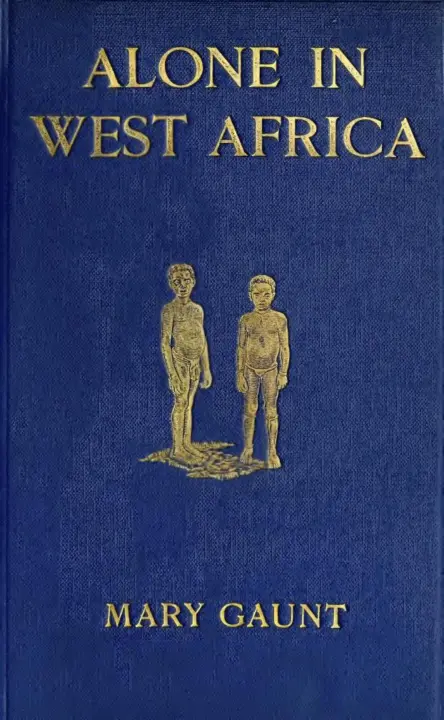
"Alone in West Africa" by Mary Gaunt is a travel narrative written in the early 20th century. The book chronicles the author's adventures and experiences as she ventures into West Africa, exploring its culture, landscapes, and the unique challenges she faces. The narrative sets the stage for Gaunt's journey of self-discovery, driven by a lifelong yearning for travel and adventure sparked by her childhood. The opening of the narrative establishes Gaunt's motivations for traveling to West Africa, tracing back to her family's history and her childhood fascination with adventure tales, particularly one about a boy named Carlo who was captured by savages. After facing personal tragedy and financial struggle as a widow, Gaunt decides to fulfill her long-held dream of exploring Africa. She describes the preparation for her journey, her excitement about the trip as she boards the ship bound for the Gambia, and her first encounters with the unfamiliar land, which she approaches with both enthusiasm and a sense of trepidation. The beginning sets the tone for her adventures by blending her past with her aspirations, introducing readers to her spirited quest for knowledge and exploration.
Introduction adapted from the source catalogue; source summaries may be automatically generated.
Free to read · English · 119,823 words · No account needed
MAKE TIME FOR A GOOD BOOK
On by default. Untick to stop anonymous reading totals. Each page counts after 10 seconds in view. How this works.
Anonymous counting is on unless you have switched it off.
Money is spent in Accra as it is spent nowhere else in the Colony. Of course I do not know much about these matters, therefore I suppose I should not judge, but I may say that after I had seen German results, I came to the conclusion that money was not always exactly wisely spent. Most certainly the people who had the beautifying of the town were not very artistic, and sometimes I cannot but feel they have lacked the saving grace of a sense of humour.
The landing here was shockingly bad; it is so still, I think, for the last time I left I was drenched to the skin, so the powers that be set to work at enormous cost to build a breakwater behind which the boats might land in comparative safety. Only comparative, for still the moment the boat touches the shore the boatmen seize the passenger and carry him as swiftly as possible, and quite regardless of his dignity, beyond the reach of the next breaking wave.
“Ah,” said a high official, looking with pride at the breakwater, “how I have watched that go up. Every day I have said to myself, 'something accomplished, something done'”; and he said it with such heartfelt pride that I had not the heart to point out the sand pump, working at the rate of sixty tons a minute, that this same costly breakwater had necessitated, for the harbour without it would fill up behind the breakwater; not exactly, I fancy, what the authorities intended. The breakwater isn't finished yet, but the harbour is filling fast; by the time it is finished I should doubt whether there will be any water at all behind it.
I did Accra thoroughly. I lived in that little bungalow beside the fort, and I went up and down the streets in my cart and I saw all I think there was to be seen. But for one good friend, a medical officer I had known before, the lady who was head of the girls' school, a thoroughly capable, practical young woman, and the one or two friends they brought to see me, I knew nobody, and so I was enabled to form my opinions untrammelled, and I'm afraid I had the audacity to sit in judgment on that little tropical capital and say to myself that things might really be very much better done. The Club may be a cheerful place if you know anyone, but it is very doleful and depressing if the only other women look sidelong at you over the tops of their papers as if you were some curious specimen that it might perhaps be safer to avoid, and I found the outside of the bungalows, with their untidy, forlorn gardens, the houses of sojourners who are not dwellers in the land, anything but promising. Yet money is spent too--witness the breakwater--and in my wanderings I came across a tombstone-like erection close to James Fort, which I stopped and inspected. Indeed it is in a conspicuous place, with an inscription which he who runs may read. At least he might have read a little while ago, but the climate is taking it in hand. The stone is of polished granite, which must have cost a considerable amount of money, and by the aid of that inscription I discovered that it was a fountain erected to commemorate the opening of the waterworks in Accra. Oh Africa! Already it is difficult to read that inscription; the unfinished fountain is falling into decay, and the water has not yet been brought to the town! When future generations dig on the site of the old Gold Coast town, I am dreadfully afraid that tombstone will give quite a wrong impression. Now it is one of the most desolate things I know, more desolate even than the forlorn Danish graveyard which lies, overgrown and forgotten, but a stone's throw from my bungalow at Christiansborg. A heavy brick wall had been built round it once, but it was broken down in places so that the people of Christiansborg might pasture their goats and sheep upon it, and I climbed through the gap, risking the snakes, and read the inscriptions. They had died, apparently most of them, in the early years of the nineteenth century, men and women, victims probably to their want of knowledge, and all so pitifully young. I could wish that the Government that makes so much fuss about educating the young negro in the way he should go, could spare, say ten shillings a year to keep these graves just with a little respect. It would want so little, so very little. Those Danes of ninety years ago I dare say sleep sound enough lulled by the surf, but it would be a graceful act to keep their graves in order, and would not be a bad object-lesson for the Africans we are so bent on improving.
Your reading position is saved on this browser. Take it to another device with a library code. Reading pages adapt to text, rather than matching a printed edition.
Mary Gaunt
Mary Gaunt
Mary Gaunt
BEHIND THE BOOK
This eBook is for the use of anyone anywhere in the United States and most other parts of the world at no cost and with almost no restrictions whatsoever. You may copy it, give it away or re-use it under the terms of the Project Gutenberg License included with this eBook or online at www.gutenberg.org. If you are not located in the United States, you will have to check the laws of the country where you are located before using this eBook. Read the source licence.
The original source file, including credits and licence, is retained by this library. Request an original-format copy at no charge. Please include the book title and Project Gutenberg identifier #54400.
KEEP YOUR CURIOSITY GOING
Wilfrid Scawen Blunt
Wilfrid Scawen Blunt

E. W. (Edgar Watson) Howe
Francis Greenleaf Allinson & Anne C. E. (Anne Crosby Emery) Allinson
Cyrenus Cole

John Martineau