READ · DISCOVER · ENJOYClassic literature · Always free
All Things are Possible — digital edition cover

THE CLASSIC COLLECTION · 1920

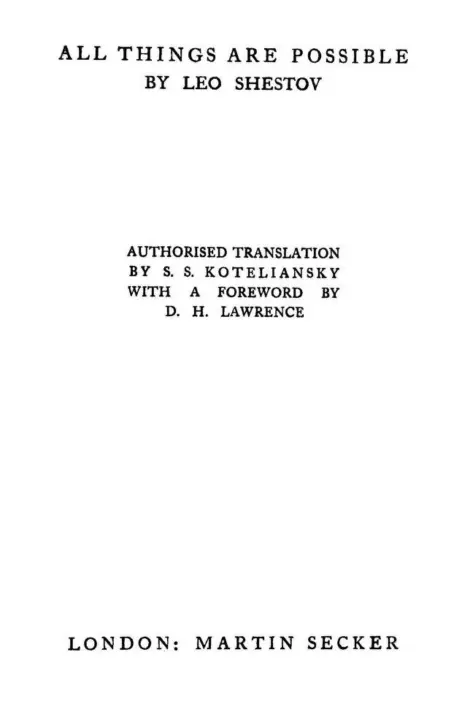
All Things are Possible

"All Things are Possible" by Lev Shestov is a philosophical work written in the early 20th century. The text presents Shestov's viewpoint on the nature of existence, exploring the limitations of human understanding and the conflict between established ideas and individual freedom. Through a dense and reflective prose style, Shestov embarks on a critique of European rationalism and its impact on Russian thought, suggesting a more subjective exploration of existence. The opening of the book establishes a rich philosophical landscape that examines the human experience of life and the quest for meaning. Shestov uses vivid metaphors to illustrate the obscure and chaotic nature of existence, where individuals must navigate through uncertainty and pain to find clarity. He critiques the reliance on logical reasoning and established truths, arguing that such constructs may hinder true understanding of the self. At the same time, he emphasizes a fundamental freedom in the human psyche, suggesting that true liberation arises from embracing uncertainty rather than conforming to societal ideals.

Introduction adapted from the source catalogue; source summaries may be automatically generated.

Start reading ↓

Free to read · English · 45,193 words · No account needed

MAKE TIME FOR A GOOD BOOK

All Things are Possible

On by default. Untick to stop anonymous reading totals. Each page counts after 10 seconds in view. How this works.

Anonymous counting is on unless you have switched it off.

All Things are Possible

44

Experience and Science.--As we are well aware, science does not, nay cannot, admit experience in all its extent. She throws overboard an enormous quantity of individual facts, regarding them as the ballast of our human vessel. She takes note only of such phenomena as alternate constantly and with a certain regularity. Best of all she likes those phenomena which can be artificially provoked, when, so to speak, experiment is possible. She explains the rotation of the earth and succession of the seasons since a regular recurrence is observable, and she demonstrates thunder and lightning with a spark from an electric machine. In a word, in so far as a regular alternation of phenomena is observable, so far extends the realm of science. But what about those individual phenomena which do not recur, and which cannot be artificially provoked? If all men were blind, and one for a moment recovered his sight and opened his eyes on God's world, science would reject his evidence. Yet the evidence of one seeing man is worth that of a million blind. Sudden enlightenments are possible in our life--even if they endure only for a few seconds. Must they be passed over in silence because they are not normal and cannot be provoked?--or treated poetically, as beautiful fictions? Science insists on it. She declares that no judgments are true except such as can be verified by all and everyone. She exceeds her bounds. Experience is wider than scientific experiment, and individual phenomena mean much more to us than the constantly recurrent.

Science is useful--but she need not pretend to truth. She cannot know what truth is, she can only accumulate universal laws. Whereas there are, and always have been, non-scientific ways of searching for truth, ways which lead, if not to the innermost secrets, yet to the threshold. These roads, however, we have let fall into ruin whilst we followed our modern methodologies, so now we dare not even think of them. What gives us the right to assert that astrologers, alchemists, diviners, and sorcerers who passed the long nights alone with their thoughts, wasted their time in vain? As for the philosopher's stone, that was merely a plausible excuse invented to satisfy the uninitiated. Could an alchemist dare to confess openly that all his efforts were towards no useful or utilitarian end? He had to guard against importunate curiosity and impertinent authority in outsiders. So he lied, now frightening, now alluring the mob through its cupidity. But certainly he had his own important work to do: and it had only one fault, that it was purely personal to him. And about personal matters it is considered correct to keep silent.... Astonishing fact! As a rule a man hesitates over trifles. But it does sometimes occur that a moment arrives when he is filled with unheard-of courage and resolution in his judgments. He is ready to stand up for his opinions against all the world, dead or living. Whence such sudden surety, what does it mean? Rationally we can discover no foundation for it. If a lover has got into his head that his beloved is the fairest woman on earth, worth the whole of life to him; if one who has been insulted feels that his offender is the basest wretch, deserving torture and death; if a would-be Columbus persuades himself that America is the only goal for his ambition--who will convince such men that their opinions, shared by none but themselves, are false or unjustifiable? And for whose sake will they renounce their tenets? For the sake of objective truth? that is, for the pleasure of the assurance that all men after them will repeat their judgment for truth? They don't care. Let Don Quixote run broadcast with drawn sword, proving the beauty of Dulcinea or the impending horror of windmills. As a matter of fact, he and the German philosophers with him have a vague idea, a kind of presentiment, that their giants are but mill-sails, and that their ideal on the whole is but a common girl driving swine to pasture. To defy such deadly doubt they take to the sword or to argument, and do not rest until they have succeeded in stopping the mouth of everybody. When from all lips they hear the praise of Dulcinea they say: yes, she is beautiful, and she never drove pigs. When the world beholds their windmilling exploits with amazement they are filled with triumph; sheep are not sheep, mills are not mills, as you might imagine; they are knights and cyclops. This is called a proven, all-binding, universal truth. The support of the mob is a necessary condition of the existence of modern philosophy and its knights of the woful countenance. Scientific philosophy wearies for a new Cervantes who will put a stop to its paving the way to truth by dint of argument. All opinions have a right to exist, and if we speak of privilege, then preference should be given to such as are most run down to-day; namely, to such opinions as cannot be verified and which are, for that self-same reason, universal. Once, long ago "man invented speech in order to express his real relation to the universe." So he may be heard, even though the relation he wishes to express be unique, not to verified by any other individual. To attempt to verify it by observations and experiments is strictly forbidden. If the habit of "objective verification" has destroyed your native receptivity to such an extent that your eyes and ears are gone, and you must rely only on the evidence of instruments or objects not subject to your will, then, of course, nothing is left you but to stick to the belief that science is perfect knowledge. But if your eyes live and your ear is sensitive--throw away instruments and apparatuses, forget methodology and scientific Don-Quixotism, and try to trust yourself. What harm is there in not having universal judgments or truths? How will it hurt you to see sheep as sheep? It is a step forward. You will learn not to see with everybody's eyes, but to see as none other sees. You will learn not to meditate, but to conjure up and call forth with words alien to all but yourself an unknown beauty and an unheard-of power. Not for nothing, I repeat, did astrologers and alchemists scorn the experimental method--which, by the way, far from being anything new or particularly modern, is as old as the hills. Animals experiment, though they do not compose treatises on inductive logic or pride themselves on their reasoning powers. A cow who has burnt her mouth in her trough will come up cautiously next time to feed. Every experimenter is the same--only he systematises. But animals can often trust to instinct when experience is lacking. And have we humans got sufficient experience? Can experience give us what we want most? If so, let science and craftsmanship serve our everyday need, let even philosophy, also eager to serve, go on finding universal truths. But beyond craft, science, and philosophy there is another region of knowledge. Through all the ages men, each one at his own risk, have sought to penetrate into this region. Shall we, men of the twentieth century, voluntarily renounce our supreme powers and rights, and because public opinion demands it, occupy ourselves exclusively with discovering useful information? Or, in order not to appear mean or poverty-stricken in our own eyes, shall we accept in place of the philosopher's stone our modern metaphysics, which muffles her dread of actuality in postulates, absolutes, and such-like apparently transcendental paraphernalia?

Your reading position is saved on this browser. Take it to another device with a library code. Reading pages adapt to text, rather than matching a printed edition.

BEHIND THE WORDS

About Lev Shestov

Lev Shestov (1866–1938). Explore All Things are Possible in this collection. These books span history, philosophy.

Explore this author’s books →

THE READERS’ VERDICT

How did this story stay with you?

Not rated yet
Your rating for All Things are Possible

Be the first to share your verdict.

One rating per browser, which you can change or remove. A necessary browser identifier remembers your vote. How ratings work

A GOOD STORY DESERVES COMPANY

Pass this book along.

A great read is even better when it’s shared.

SEND A LITTLE INSPIRATION

Share this book

BEHIND THE BOOK

Edition & source details.

Title
All Things are Possible
Author
Lev Shestov
First publication (Open Library catalogue match)
1920
Digital edition publisher
Project Gutenberg
Gutenberg release date
2018-06-21
Language
English
Source edition imprint
Not stated in source catalogue
Source identifier
Project Gutenberg #57369
Contributors
D. H. (David Herbert) Lawrence (aui); S. S. (Samuel Solomonovitch) Koteliansky (trl)

Public-domain source & licence

This eBook is for the use of anyone anywhere in the United States and most other parts of the world at no cost and with almost no restrictions whatsoever. You may copy it, give it away or re-use it under the terms of the Project Gutenberg License included with this eBook or online at www.gutenberg.org. If you are not located in the United States, you will have to check the laws of the country where you are located before using this eBook. Read the source licence.

Full source licence and obtaining an original copy

The original source file, including credits and licence, is retained by this library. Request an original-format copy at no charge. Please include the book title and Project Gutenberg identifier #57369.

the full Project Gutenberg License must appear
prominently whenever any copy of a Project Gutenberg work (any work
on which the phrase “Project Gutenberg” appears, or with which the
phrase “Project Gutenberg” is associated) is accessed, displayed,
performed, viewed, copied or distributed:

This eBook is for the use of anyone anywhere in the United States and most
other parts of the world at no cost and with almost no restrictions
whatsoever. You may copy it, give it away or re-use it under the terms
of the Project Gutenberg™ License included with this eBook or online
at www.gutenberg.org. If you
are not located in the United States, you will have to check the laws
of the country where you are located before using this eBook.

1.E.2. If an individual Project Gutenberg electronic work is
derived from texts not protected by U.S. copyright law (does not
contain a notice indicating that it is posted with permission of the
copyright holder), the work can be copied and distributed to anyone in
the United States without paying any fees or charges. If you are
redistributing or providing access to a work with the phrase “Project
Gutenberg” associated with or appearing on the work, you must comply
either with the requirements of paragraphs 1.E.1 through 1.E.7 or
obtain permission for the use of the work and the Project Gutenberg
trademark as set forth in paragraphs 1.E.8 or 1.E.9.

1.E.3. If an individual Project Gutenberg electronic work is posted
with the permission of the copyright holder, your use and distribution
must comply with both paragraphs 1.E.1 through 1.E.7 and any
additional terms imposed by the copyright holder. Additional terms
will be linked to the Project Gutenberg License for all works
posted with the permission of the copyright holder found at the
beginning of this work.

1.E.4. Do not unlink or detach or remove the full Project Gutenberg
License terms from this work, or any files containing a part of this
work or any other work associated with Project Gutenberg.

1.E.5. Do not copy, display, perform, distribute or redistribute this
electronic work, or any part of this electronic work, without
prominently displaying the sentence set forth in paragraph 1.E.1 with
active links or immediate access to the full terms of the Project
Gutenberg License.

1.E.6. You may convert to and distribute this work in any binary,
compressed, marked up, nonproprietary or proprietary form, including
any word processing or hypertext form. However, if you provide access
to or distribute copies of a Project Gutenberg work in a format
other than “Plain Vanilla ASCII” or other format used in the official
version posted on the official Project Gutenberg website
(www.gutenberg.org), you must, at no additional cost, fee or expense
to the user, provide a copy, a means of exporting a copy, or a means
of obtaining a copy upon request, of the work in its original “Plain
Vanilla ASCII” or other form. Any alternate format must include the
full Project Gutenberg License as specified in paragraph 1.E.1.

1.E.7. Do not charge a fee for access to, viewing, displaying,
performing, copying or distributing any Project Gutenberg works
unless you comply with paragraph 1.E.8 or 1.E.9.

1.E.8. You may charge a reasonable fee for copies of or providing
access to or distributing Project Gutenberg electronic works
provided that:

• You pay a royalty fee of 20% of the gross profits you derive from
the use of Project Gutenberg works calculated using the method
you already use to calculate your applicable taxes. The fee is owed
to the owner of the Project Gutenberg trademark, but he has
agreed to donate royalties under this paragraph to the Project
Gutenberg Literary Archive Foundation. Royalty payments must be paid
within 60 days following each date on which you prepare (or are
legally required to prepare) your periodic tax returns. Royalty
payments should be clearly marked as such and sent to the Project
Gutenberg Literary Archive Foundation at the address specified in
Section 4, “Information about donations to the Project Gutenberg
Literary Archive Foundation.”

• You provide a full refund of any money paid by a user who notifies
you in writing (or by e-mail) within 30 days of receipt that s/he
does not agree to the terms of the full Project Gutenberg™
License. You must require such a user to return or destroy all
copies of the works possessed in a physical medium and discontinue
all use of and all access to other copies of Project Gutenberg™
works.

• You provide, in accordance with paragraph 1.F.3, a full refund of
any money paid for a work or a replacement copy, if a defect in the
electronic work is discovered and reported to you within 90 days of
receipt of the work.

• You comply with all other terms of this agreement for free
distribution of Project Gutenberg™ works.


1.E.9. If you wish to charge a fee or distribute a Project
Gutenberg™ electronic work or group of works on different terms than
are set forth in this agreement, you must obtain permission in writing
from the Project Gutenberg Literary Archive Foundation, the manager of
the Project Gutenberg™ trademark. Contact the Foundation as set
forth in Section 3 below.

1.F.

1.F.1. Project Gutenberg volunteers and employees expend considerable
effort to identify, do copyright research on, transcribe and proofread
works not protected by U.S. copyright law in creating the Project
Gutenberg™ collection. Despite these efforts, Project Gutenberg™
electronic works, and the medium on which they may be stored, may
contain “Defects,” such as, but not limited to, incomplete, inaccurate
or corrupt data, transcription errors, a copyright or other
intellectual property infringement, a defective or damaged disk or
other medium, a computer virus, or computer codes that damage or
cannot be read by your equipment.

1.F.2. LIMITED WARRANTY, DISCLAIMER OF DAMAGES - Except for the “Right
of Replacement or Refund” described in paragraph 1.F.3, the Project
Gutenberg Literary Archive Foundation, the owner of the Project
Gutenberg™ trademark, and any other party distributing a Project
Gutenberg™ electronic work under this agreement, disclaim all
liability to you for damages, costs and expenses, including legal
fees. YOU AGREE THAT YOU HAVE NO REMEDIES FOR NEGLIGENCE, STRICT
LIABILITY, BREACH OF WARRANTY OR BREACH OF CONTRACT EXCEPT THOSE
PROVIDED IN PARAGRAPH 1.F.3. YOU AGREE THAT THE FOUNDATION, THE
TRADEMARK OWNER, AND ANY DISTRIBUTOR UNDER THIS AGREEMENT WILL NOT BE
LIABLE TO YOU FOR ACTUAL, DIRECT, INDIRECT, CONSEQUENTIAL, PUNITIVE OR
INCIDENTAL DAMAGES EVEN IF YOU GIVE NOTICE OF THE POSSIBILITY OF SUCH
DAMAGE.

1.F.3. LIMITED RIGHT OF REPLACEMENT OR REFUND - If you discover a
defect in this electronic work within 90 days of receiving it, you can
receive a refund of the money (if any) you paid for it by sending a
written explanation to the person you received the work from. If you
received the work on a physical medium, you must return the medium
with your written explanation. The person or entity that provided you
with the defective work may elect to provide a replacement copy in
lieu of a refund. If you received the work electronically, the person
or entity providing it to you may choose to give you a second
opportunity to receive the work electronically in lieu of a refund. If
the second copy is also defective, you may demand a refund in writing
without further opportunities to fix the problem.

1.F.4. Except for the limited right of replacement or refund set forth
in paragraph 1.F.3, this work is provided to you ‘AS-IS’, WITH NO
OTHER WARRANTIES OF ANY KIND, EXPRESS OR IMPLIED, INCLUDING BUT NOT
LIMITED TO WARRANTIES OF MERCHANTABILITY OR FITNESS FOR ANY PURPOSE.

1.F.5. Some states do not allow disclaimers of certain implied
warranties or the exclusion or limitation of certain types of
damages. If any disclaimer or limitation set forth in this agreement
violates the law of the state applicable to this agreement, the
agreement shall be interpreted to make the maximum disclaimer or
limitation permitted by the applicable state law. The invalidity or
unenforceability of any provision of this agreement shall not void the
remaining provisions.

1.F.6. INDEMNITY - You agree to indemnify and hold the Foundation, the
trademark owner, any agent or employee of the Foundation, anyone
providing copies of Project Gutenberg™ electronic works in
accordance with this agreement, and any volunteers associated with the
production, promotion and distribution of Project Gutenberg™
electronic works, harmless from all liability, costs and expenses,
including legal fees, that arise directly or indirectly from any of
the following which you do or cause to occur: (a) distribution of this
or any Project Gutenberg work, (b) alteration, modification, or
additions or deletions to any Project Gutenberg work, and (c) any
Defect you cause.

Section 2. Information about the Mission of Project Gutenberg

Project Gutenberg is synonymous with the free distribution of
electronic works in formats readable by the widest variety of
computers including obsolete, old, middle-aged and new computers. It
exists because of the efforts of hundreds of volunteers and donations
from people in all walks of life.

Volunteers and financial support to provide volunteers with the
assistance they need are critical to reaching Project Gutenberg’s
goals and ensuring that the Project Gutenberg collection will
remain freely available for generations to come. In 2001, the Project
Gutenberg Literary Archive Foundation was created to provide a secure
and permanent future for Project Gutenberg and future
generations. To learn more about the Project Gutenberg Literary
Archive Foundation and how your efforts and donations can help, see
Sections 3 and 4 and the Foundation information page at www.gutenberg.org.

Section 3. Information about the Project Gutenberg Literary Archive Foundation

The Project Gutenberg Literary Archive Foundation is a non-profit
501(c)(3) educational corporation organized under the laws of the
state of Mississippi and granted tax exempt status by the Internal
Revenue Service. The Foundation’s EIN or federal tax identification
number is 64-6221541. Contributions to the Project Gutenberg Literary
Archive Foundation are tax deductible to the full extent permitted by
U.S. federal laws and your state’s laws.

The Foundation’s business office is located at 41 Watchung Plaza #516,
Montclair NJ 07042, USA, +1 (862) 621-9288. Email contact links and up
to date contact information can be found at the Foundation’s website
and official page at www.gutenberg.org/contact

Section 4. Information about Donations to the Project Gutenberg
Literary Archive Foundation

Project Gutenberg™ depends upon and cannot survive without widespread
public support and donations to carry out its mission of
increasing the number of public domain and licensed works that can be
freely distributed in machine-readable form accessible by the widest
array of equipment including outdated equipment. Many small donations
($1 to $5,000) are particularly important to maintaining tax exempt
status with the IRS.

The Foundation is committed to complying with the laws regulating
charities and charitable donations in all 50 states of the United
States. Compliance requirements are not uniform and it takes a
considerable effort, much paperwork and many fees to meet and keep up
with these requirements. We do not solicit donations in locations
where we have not received written confirmation of compliance. To SEND
DONATIONS or determine the status of compliance for any particular state
visit www.gutenberg.org/donate.

While we cannot and do not solicit contributions from states where we
have not met the solicitation requirements, we know of no prohibition
against accepting unsolicited donations from donors in such states who
approach us with offers to donate.

International donations are gratefully accepted, but we cannot make
any statements concerning tax treatment of donations received from
outside the United States. U.S. laws alone swamp our small staff.

Please check the Project Gutenberg web pages for current donation
methods and addresses. Donations are accepted in a number of other
ways including checks, online payments and credit card donations. To
donate, please visit: www.gutenberg.org/donate.

Section 5. General Information About Project Gutenberg electronic works

Professor Michael S. Hart was the originator of the Project
Gutenberg concept of a library of electronic works that could be
freely shared with anyone. For forty years, he produced and
distributed Project Gutenberg eBooks with only a loose network of
volunteer support.

Project Gutenberg eBooks are often created from several printed
editions, all of which are confirmed as not protected by copyright in
the U.S. unless a copyright notice is included. Thus, we do not
necessarily keep eBooks in compliance with any particular paper
edition.

Most people start at our website which has the main PG search
facility: www.gutenberg.org.

This website includes information about Project Gutenberg,
including how to make donations to the Project Gutenberg Literary
Archive Foundation, how to help produce our new eBooks, and how to
subscribe to our email newsletter to hear about new eBooks.


KEEP YOUR CURIOSITY GOING

Your next chapter awaits.