
Last letters from the living dead man
David Patterson (Spirit) Hatch
THE CLASSIC COLLECTION · 1920
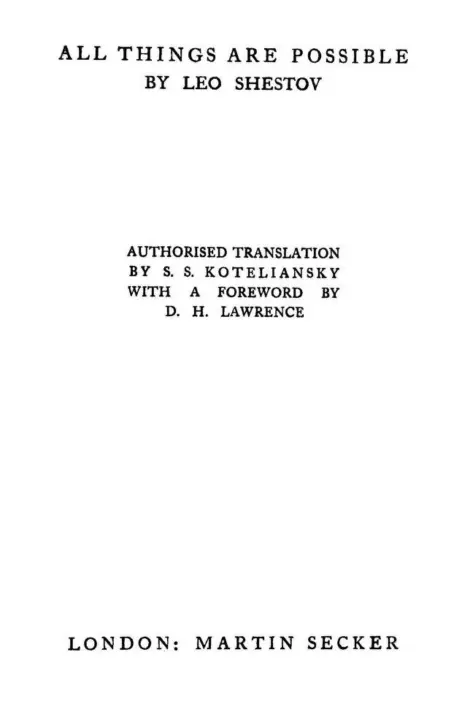
"All Things are Possible" by Lev Shestov is a philosophical work written in the early 20th century. The text presents Shestov's viewpoint on the nature of existence, exploring the limitations of human understanding and the conflict between established ideas and individual freedom. Through a dense and reflective prose style, Shestov embarks on a critique of European rationalism and its impact on Russian thought, suggesting a more subjective exploration of existence. The opening of the book establishes a rich philosophical landscape that examines the human experience of life and the quest for meaning. Shestov uses vivid metaphors to illustrate the obscure and chaotic nature of existence, where individuals must navigate through uncertainty and pain to find clarity. He critiques the reliance on logical reasoning and established truths, arguing that such constructs may hinder true understanding of the self. At the same time, he emphasizes a fundamental freedom in the human psyche, suggesting that true liberation arises from embracing uncertainty rather than conforming to societal ideals.
Introduction adapted from the source catalogue; source summaries may be automatically generated.
Free to read · English · 45,193 words · No account needed
MAKE TIME FOR A GOOD BOOK
On by default. Untick to stop anonymous reading totals. Each page counts after 10 seconds in view. How this works.
Anonymous counting is on unless you have switched it off.
Dostoevsky--advocatus diaboli.--Dostoevsky, like Nietzsche, disliked Protestantism, and tried every means of degrading it in the eyes of the world. As normally he was not over scrupulous, it is probable he never took the trouble to acquaint himself with Luther's teaching. His flair did not deceive him: the Protestant religion and morality was most unsuitable to him and his kind. But does this mean that it was to be calumniated, and judged, as Dostoevsky judged it, merely by the etymological meaning of a word? Protestant--a protester, one who only protests and has no positive content. A child's text-book of history will show the absurdity of the definition. Protestantism is, on the whole, the most positive, assertive creed of all the Christian religions. It certainly protested against Catholicism, but against the destructive tendencies in the latter, and in the name of positive ideals. Catholicism relied too much on its power and its spell, and most of all on the infallibility of its dogmas to which it offered millions of victims. To maim and mutilate a man ad majorem gloriam Dei was considered a perfectly proper thing in the Middle Ages, the period of bloom for Catholicism. At the risk of appearing paradoxical, I venture to assert that ideas have been invented only for the purpose of giving the right to mutilate people. The Middle Ages nourished a mysterious, incomprehensible hatred for everything normal, self-satisfied, complete. A young, healthy, handsome man, at peace with himself, aroused suspicion and hostility in a believing Catholic. His very appearance offended religion and confuted dogma. It was not necessary to examine him. Even though he went to church, and gave no sign of doubt, either in deed or word, yet he must be a heretic, to be converted at all cost. And we know the Catholic cost: privation, asceticism, mortification of the flesh. The most normal person, kept on a monastic regime, will lose his spiritual balance, and all those virtues which belong to a healthy spirit and a healthy body. This was all Catholicism needed. It tried to obtain from people the extreme endeavour of their whole being. Ordinary, natural love, which found its satisfaction--this was sinful. Monks and priests were condemned to celibacy--hence monstrous and abnormal passions developed. Poverty was preached, and the most unheard-of greed appeared in the world, the more secret the stronger it became. Humility was essential--and out of bare-footed monks sprang despots who had no limits to their ambitions. Luther was the last man to understand the meaning and value of the tasks which Catholicism had set itself. What he saw in Rome was not the accidental outcome of this or the other historical circumstance, but a result of the age-long effort of generations that had striven to attribute to life as alarming and dangerous a nature as possible. The sincere, direct, rustic German monk was too simple-minded to make out what was going on in Rome. He thought there existed one truth, and that the essence of Catholicism lay in what seemed to him an exemplary, virtuous life. He went direct to his aim? What meaning can monasticism have? Why deprive a priest of family happiness? How accept the licentiousness of the pope's capital? The common sense of the normal German revolted against the absurdity of such a state of things--and Luther neither could nor would see any good where common sense was utterly forgotten. The violent oscillation of life resulting from the continuous quick passage from asceticism and blind faith to unbelief and freedom of the passions aroused a mystic horror in the honest monk and released the enormous powers in him necessary to start the great struggle. How could he help protesting? And who was the denier, Luther, or the Rome which passed on from the keeping of the Divine Word to the arbitrary ordaining of all the mysteries of life? Luther might have forgiven the monks had they confined themselves to sophistries. But mediaeval monks had nothing in common with our philosophers. They did not look for world-conceptions in books, and logical tournaments amused them only moderately. They threw themselves into the deeps of life, they experimented on themselves and their neighbours. They passed from mortification to licentious bacchanalia. They feared nothing, spared nothing. In a word, the Rome against which Luther arose had undertaken to build Babylon again, not with stones, but with human souls. Luther, horrified, withdrew, and with him half Europe was withdrawn. That is his positive merit. And Dostoevsky attacked Lutheranism, and pitied the old Catholicism and the breathless heights to which its "spiritual" children had risen. Wholesome morality and its support is not enough for Dostoevsky. All this is not "positive," it is only "protest." Whether I am believed or not, I will repeat that Vladimir Soloviov, who held that Dostoevsky was a prophet, is wrong, and that N. K. Mikhailovsky, who calls him a cruel talent and a grubber after buried treasure, is right. Dostoevsky grubs after buried treasure--no doubt about that. And, therefore, it would be more becoming in the younger generation that still marches under the flag of pious idealism if, instead of choosing him as a spiritual leader, they avoided the old sorcerer, in whom only those gifted with great shortsightedness or lack of experience in life could fail to see the dangerous man.
Your reading position is saved on this browser. Take it to another device with a library code. Reading pages adapt to text, rather than matching a printed edition.
BEHIND THE BOOK
This eBook is for the use of anyone anywhere in the United States and most other parts of the world at no cost and with almost no restrictions whatsoever. You may copy it, give it away or re-use it under the terms of the Project Gutenberg License included with this eBook or online at www.gutenberg.org. If you are not located in the United States, you will have to check the laws of the country where you are located before using this eBook. Read the source licence.
The original source file, including credits and licence, is retained by this library. Request an original-format copy at no charge. Please include the book title and Project Gutenberg identifier #57369.
KEEP YOUR CURIOSITY GOING
David Patterson (Spirit) Hatch
Cécile Tormay

Moritz Busch
Coulson Kernahan
John L. Ransom

Ralph Waldo Emerson