
Last letters from the living dead man
David Patterson (Spirit) Hatch
THE CLASSIC COLLECTION · 1920
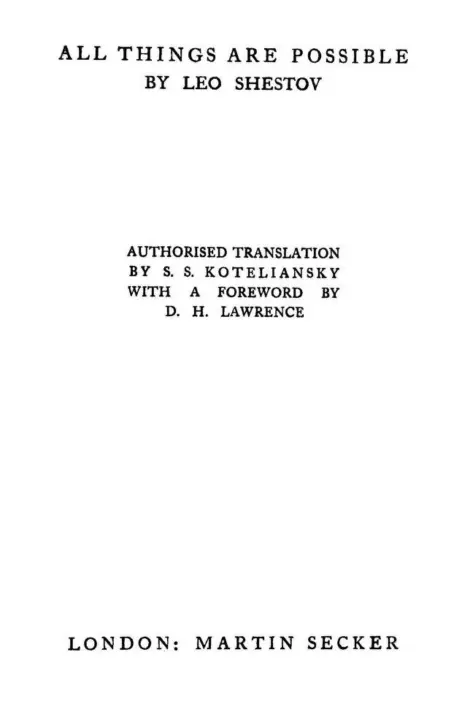
"All Things are Possible" by Lev Shestov is a philosophical work written in the early 20th century. The text presents Shestov's viewpoint on the nature of existence, exploring the limitations of human understanding and the conflict between established ideas and individual freedom. Through a dense and reflective prose style, Shestov embarks on a critique of European rationalism and its impact on Russian thought, suggesting a more subjective exploration of existence. The opening of the book establishes a rich philosophical landscape that examines the human experience of life and the quest for meaning. Shestov uses vivid metaphors to illustrate the obscure and chaotic nature of existence, where individuals must navigate through uncertainty and pain to find clarity. He critiques the reliance on logical reasoning and established truths, arguing that such constructs may hinder true understanding of the self. At the same time, he emphasizes a fundamental freedom in the human psyche, suggesting that true liberation arises from embracing uncertainty rather than conforming to societal ideals.
Introduction adapted from the source catalogue; source summaries may be automatically generated.
Free to read · English · 45,193 words · No account needed
MAKE TIME FOR A GOOD BOOK
On by default. Untick to stop anonymous reading totals. Each page counts after 10 seconds in view. How this works.
Anonymous counting is on unless you have switched it off.
Metaphysics against their will.--It often occurs to us that evil is not altogether so, unnecessary, after all. Diseases, humiliations, miseries, deformity, failure, and all the rest of those plants which flourish with such truly tropical luxuriance on our planet, are probably essential to man. Poets sing plentifully of sorrow.
"Nous sommes les apprentis, la douleur est notre maître," said de Musset. On this subject everybody can bring forth a quotation, not only from the philosophers, who are a cold, heartless tribe, but from tender, gentle, or sentimental poets. Doubtless one knows many instances where suffering has profited a man. True also, one knows many cases of the direct opposite. And these are all cases of profound, earnest, outrageous, incredibly outrageous suffering. Look at Tchekhov's men and women--plainly drawn from life, or at any rate, exceedingly life-' like. Uncle Vanya, an old man of fifty, cries beside himself all over the stage, "My life is done for, my life is done for," and senselessly shoots at a harmless professor. The hero in A Tedious Story was a quiet, happy man engaged in work of real importance, when suddenly a horrible disease stole upon him, not killing him, but taking him between its loathsome jaws. But what for? Then Tchekhov's girls and women! They are mostly young, innocent, fascinating. And always there lies in wait for them round every corner a meaningless, rude, ugly misery which murders even the most modest hopes. They sob bitterly, but fate takes no notice. How explain such horrors? Tchekhov is silent. He does not weep himself--he left off long ago, and besides it is a humiliating thing for a grown-up person to do. Setting one's teeth, it is necessary either to keep silent or--to explain. Well, metaphysics under takes the explanation. Where common sense stops, metaphysics must take another stride. "We have seen," it says, "many instances where at first glance suffering seemed absurd and needless, but where later on a profound significance was revealed. Thus it may be that what we cannot explain may find its explanation in time. 'Life is lost,' cries Uncle Vanya, 'Life is done for,' repeat the voices of girls innocently perishing--yet nothing is lost. The very horror which a drowning man experiences goes to show that the drowning is nothing final. It is only the beginning of greater events. The less a man has fulfilled in experience, the more in him remains of unsatisfied passion and desire, the greater are the grounds for thinking that his essence cannot be destroyed, but must manifest itself somehow or other in the universe. Voluntary asceticism and self-denial, such common human phenomena, help to solve the riddle. Nobody compels a man, he imposes suffering and abstinence on himself. It is an incomprehensible instinct, but still an instinct which, rooted in the depths of our nature, prompts us to a decision repugnant to reason: renounce life, save yourself. The majority of men do not hear or do not heed the prompting. And then nature, which cannot rely on our sensibility, has recourse to violence. She shows glimpses of Paradise to us in our youth, awakens hopes and impossible desires, and at the moment of our supreme expectation she shows us the hollowness of our hope. Nearly every life can be summed up in a few words: man was shown heaven--and thrown into the mud. We are all ascetics--voluntary or involuntary. Here on earth dreams and hopes are only awakened, not fulfilled. And he who has endured most suffering, most privation, will awaken in the afterwards most keenly alive." Such long speeches metaphysics whispers to us. And we repeat them, often leaving out the "it may be." Sometimes we believe them, and forge our philosophies from them. Even we go so far as to assert that had we the power we would change nothing, absolutely nothing in the world. And yet, if by some miracle such power came into our hands, how triumphantly we would send to the devil all philosophies and lofty world-conceptions, all ideals and metaphysics, and plainly and simply, without reflection, abolish sufferings, deformities, failures, all those things to which we attach such a high educational value, abolish them from the face of the earth. We are fed up, oh, how fed up we are with carrying on our studies. But it can't be helped. Faute de mieux, let us keep on inventing systems, thinking them out. But let us agree not to be cross with those who don't want to have anything to do with our systems. Really, they have a perfect right.
Your reading position is saved on this browser. Take it to another device with a library code. Reading pages adapt to text, rather than matching a printed edition.
BEHIND THE BOOK
This eBook is for the use of anyone anywhere in the United States and most other parts of the world at no cost and with almost no restrictions whatsoever. You may copy it, give it away or re-use it under the terms of the Project Gutenberg License included with this eBook or online at www.gutenberg.org. If you are not located in the United States, you will have to check the laws of the country where you are located before using this eBook. Read the source licence.
The original source file, including credits and licence, is retained by this library. Request an original-format copy at no charge. Please include the book title and Project Gutenberg identifier #57369.
KEEP YOUR CURIOSITY GOING
David Patterson (Spirit) Hatch
Cécile Tormay

Moritz Busch
Coulson Kernahan
John L. Ransom

Ralph Waldo Emerson