
Last letters from the living dead man
David Patterson (Spirit) Hatch
THE CLASSIC COLLECTION · 1920
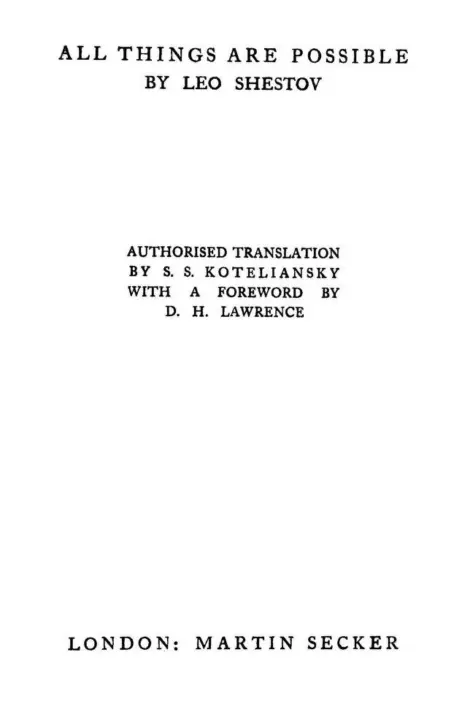
"All Things are Possible" by Lev Shestov is a philosophical work written in the early 20th century. The text presents Shestov's viewpoint on the nature of existence, exploring the limitations of human understanding and the conflict between established ideas and individual freedom. Through a dense and reflective prose style, Shestov embarks on a critique of European rationalism and its impact on Russian thought, suggesting a more subjective exploration of existence. The opening of the book establishes a rich philosophical landscape that examines the human experience of life and the quest for meaning. Shestov uses vivid metaphors to illustrate the obscure and chaotic nature of existence, where individuals must navigate through uncertainty and pain to find clarity. He critiques the reliance on logical reasoning and established truths, arguing that such constructs may hinder true understanding of the self. At the same time, he emphasizes a fundamental freedom in the human psyche, suggesting that true liberation arises from embracing uncertainty rather than conforming to societal ideals.
Introduction adapted from the source catalogue; source summaries may be automatically generated.
Free to read · English · 45,193 words · No account needed
MAKE TIME FOR A GOOD BOOK
On by default. Untick to stop anonymous reading totals. Each page counts after 10 seconds in view. How this works.
Anonymous counting is on unless you have switched it off.
Ever since Kant succeeded in convincing the learned that the world of phenomena is quite other than the world of true reality, and that even our own existence is not our real existence, but only the visible manifestation of a mysterious, unknown substance (substantia)--philosophy has been stuck in a new rut, and cannot move a single millimetre out of the track laid out by the great Königsbergian. Backward or forward it can go, but necessarily in the Kantian rut. For how can you get out of the counterposing of the phenomenon against the thing-in-itself? This proposition, this counterposing seems inalterable, so there is nothing left but to stick your head in the heavy draught-collar of the theory of knowledge. Which most philosophers do, even with a glad smile, which inevitably rouses a suspicion that they have got what they wanted, and their "metaphysical need" was nothing more than a need for a harness. Otherwise they would have kicked at the sight of the collar. Surely the contraposition between the world of phenomena and the thing-in-itself is an invention of the reasoning mind, as is the theory of knowledge deduced from this contraposing. Therefore the freedom-loving spirit could reject it in the very beginning--and basta! With the devil one must be very cautious. We know quite well that if he only gets hold of the tip of your ear he will carry off your whole body. So it is with Reason. Grant it one single assumption, admit but one proposition--and finita la commedia. You are in the toils. Metaphysics cannot exist side-by-side with reason. Everything metaphysical is absurd, everything reasonable is--positive. So we come upon a dilemma. The fundamental predicate of metaphysics is absurdity: and yet surely many positive assertions can lay legitimate claim to that self-same, highly-respectable predicate. What then? Is there means of distinguishing a metaphysical absurdity from a perfectly ordinary one? May one have recourse to criteria? Will not the very criterion prove a pitfall wherein cunning reason will catch the poor man who was rushing out to freedom? There can be no two answers to this question. All services rendered by reason must be paid for sooner or later at the exorbitant price of self-renunciation. Whether you accept the assistance in the noble form of the theory of knowledge, or merely as a humble criterion, at last you will be driven forth into the streets of positivism. This happens all the time to young, inexperienced minds. They break the bridle and dash forward into space, to find themselves rushing into the same old Rome, whither, as we know, all roads lead: or, to use more lofty language, rushing into the stable whither also all roads lead. The only way to guard against positivism--granting, of course, that positivism no longer attracts your sympathies--is to cease to fear any absurdities, whether rational or metaphysical, and systematically to reject all the services of reason. Such behaviour has been known in philosophy; and I make bold to recommend it. Credo, quia absurdum comes from the Middle Ages. Modern instances are Nietzsche and Schopenhauer. Both present noble examples of indifference to logic and common-sense: particularly Schopenhauer, who, a Kantian, even in the name of Kant made such daring sallies against reason, driving her into confusion and shame. That astounding Kantian even went so far, in the master's name still, as to attempt the overthrow of the space and time notions. He admitted clairvoyance--and to this day the learned are bothered whether to class that admission among the metaphysical or the ordinary absurdities. Really, I can't advise them. A very clever man insists on an enormous absurdity, so I am satisfied. Schopenhauer's whole campaign against intellect is very comforting. It is evident that, though he set out from the Kantian stable, he soon got sick of hauling along down the cart-ruts, and having broken the shafts, he trotted jauntily into a jungle of irreconcilable contradictions, without reflecting in the least where he was making for. The primate of will over reason; and music as the expression of our deepest essence; are not these assertions sufficient to show us how dexterously he wriggled out from the harness of synthetic judgments a priori which Kant had placed upon every thinker. There is indeed much more music than logic in the philosophy of Schopenhauer; Not for nothing is he excluded from the universities. But of course one may speak of him in the open; not of his ideas, naturally, but of his music. The European market is glutted with ideas. How neat and nicely-finished and logically well-turned-out those ideas are. Schopenhauer had no such goods. But what lively and splendid contradictions he boldly spreads on his stall, often even without suspicion that he ought to hide them from the police. Schopenhauer cries and laughs and gets furious or glad, without ever realising that this is forbidden to a philosopher. "Do not speak, but sing," said Zarathustra, and Schopenhauer ready fulfilled the command in great measure. Philosophy may be music--though it doesn't follow that music may be called philosophy. When a man has done his work, and gives himself up to looking and listening and pleasantly accepting everything, hiding nothing from himself, then he begins to "philosophise." What good are abstract formulae to him? Why should he ask himself, before he begins to think: "What can I think about, what are the limits of thought?" He will think, and those who like can do the summing up and the building of theories of knowledge. What is the earthly use of talking about beauty? Beautiful things must be created. Not one single aesthetic theory has so far been able to guess what direction the artists' mind will next take, or what are the limits to his creative activity. The same with the theory of knowledge. It may arrest the work of a man of learning, if he be himself afraid that he is going too far, but it is powerless to pre-determine human thought. Even Kant's counterposing of things-in-themselves to the world of phenomena cannot finally clip the wings of human curiosity. There will come a time when this unshakeable foundation of positivism will be shaken. All gnosiological disputes as to what thought can or cannot achieve will seem to our posterity just as amusing as the disputes of the schoolmen seem to us. "Why did they argue about the nature of truth, when they might have gone out and looked for truth itself?" the future historians will ask. Let us have an answer ready for them. Our contemporaries do not want to go out and seek, so they make a great deal of talk about a theory of knowledge.
Your reading position is saved on this browser. Take it to another device with a library code. Reading pages adapt to text, rather than matching a printed edition.
BEHIND THE BOOK
This eBook is for the use of anyone anywhere in the United States and most other parts of the world at no cost and with almost no restrictions whatsoever. You may copy it, give it away or re-use it under the terms of the Project Gutenberg License included with this eBook or online at www.gutenberg.org. If you are not located in the United States, you will have to check the laws of the country where you are located before using this eBook. Read the source licence.
The original source file, including credits and licence, is retained by this library. Request an original-format copy at no charge. Please include the book title and Project Gutenberg identifier #57369.
KEEP YOUR CURIOSITY GOING
David Patterson (Spirit) Hatch
Cécile Tormay

Moritz Busch
Coulson Kernahan
John L. Ransom

Ralph Waldo Emerson