
Last letters from the living dead man
David Patterson (Spirit) Hatch
THE CLASSIC COLLECTION · 1920
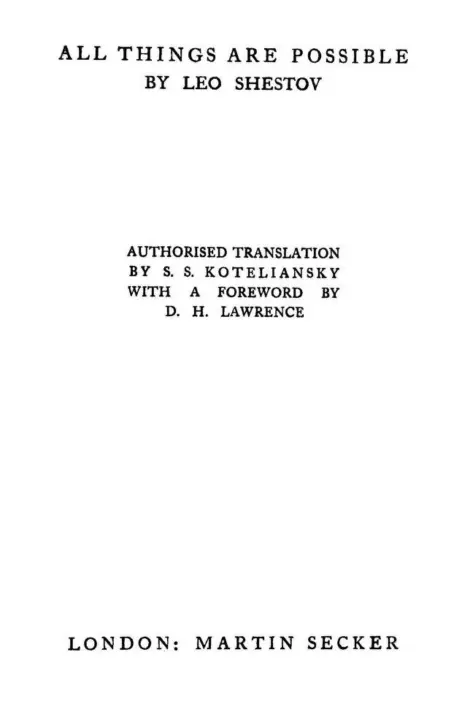
"All Things are Possible" by Lev Shestov is a philosophical work written in the early 20th century. The text presents Shestov's viewpoint on the nature of existence, exploring the limitations of human understanding and the conflict between established ideas and individual freedom. Through a dense and reflective prose style, Shestov embarks on a critique of European rationalism and its impact on Russian thought, suggesting a more subjective exploration of existence. The opening of the book establishes a rich philosophical landscape that examines the human experience of life and the quest for meaning. Shestov uses vivid metaphors to illustrate the obscure and chaotic nature of existence, where individuals must navigate through uncertainty and pain to find clarity. He critiques the reliance on logical reasoning and established truths, arguing that such constructs may hinder true understanding of the self. At the same time, he emphasizes a fundamental freedom in the human psyche, suggesting that true liberation arises from embracing uncertainty rather than conforming to societal ideals.
Introduction adapted from the source catalogue; source summaries may be automatically generated.
Free to read · English · 45,193 words · No account needed
MAKE TIME FOR A GOOD BOOK
On by default. Untick to stop anonymous reading totals. Each page counts after 10 seconds in view. How this works.
Anonymous counting is on unless you have switched it off.
Many people think we have paid too dearly--not to mention Tolstoy, who is now no longer taken quite seriously, though still accounted a great man. Any mediocre journalist enjoys greater influence than this master-writer of the Russian land. It is inevitable. Tolstoy insists on thinking about things which are nobody's concern. He has long since abandoned this world--and does he continue to exist in any other? Difficult question! "Tolstoy writes books and letters, therefore he exists." This inference, once so convincing, now has hardly any effect on us: particularly if we take into account what it is that Tolstoy writes. In several of his last letters he expresses opinions which surely have no meaning for an ordinary man. They can be summed up in a few words. Tolstoy professes an extreme egoism, sollipsism, solus-ipse-ism. That is, in his old age, after infinite attempts to love his neighbour, he comes to the conclusion that not only is it impossible to love one's neighbour, but that there is no neighbour, that in all the world Tolstoy alone exists, that there is even no world, but only Tolstoy: a view so obviously absurd, that it is not worth refuting. By the way, there is also no possibility of refuting it, unless you admit that logical inferences are non-binding. Sollipsism dogged Tolstoy already in early youth, but at that time he did not know what to do with the impertinent, oppressive idea, so he ignored it. Finally, he came to it. The older a man becomes, the more he learns how to make use of impertinent ideas. Fairly recently Tolstoy could pronounce such a dictum: "Christ taught men not to do stupid things." Who but Tolstoy could have ventured on such an interpretation of the gospels? Why have we all held--all of us but Tolstoy--that these words contained the greatest blasphemy on Christ and His teaching? But it was Tolstoy's last desperate attempt to save himself from sollipsism, without at the same time flying in the face of logic: even Christ appeared among men only to teach them common sense. Whence follows that "mad" thoughts may be rejected with an easy conscience, and the advantage, as usual, remains with the wholesome, reasonable, sensible thoughts. There is room for good and for reason. Good is self-understood; it need not be explained. If only good existed in the world, there would exist no questions, neither simple nor ultimate. This is why youth never questions. What indeed should it question: the song of the nightingale, the morning of May, happy laughter, all the predicates of youth? Do these need interpretation? On the contrary, any explanation is reduced to these The proper questions arise only on contact with evil. A hawk struck a nightingale, flowers withered, Boreas froze laughing youth--and in terror our questions arose. "That is evil. The ancients were right. Not in vain is our earth called a vale of tears and sorrow." And once questions are started, it is impossible and unseemly to hurry the answers, still less anticipate the questions. The nightingale is dead and will sing no longer, the listener is frozen to death and can hear no more songs. The situation is so palpably absurd that only with the intention of getting rid of the question at any cost will one strive for a sensible answer. The answer must be absurd--if you don't want it, don't question. But if you must question, then be ready beforehand to reconcile yourself with something like sollipsism or modern realism. Thought is in a dilemma, and dare not take the leap to get out. We laugh at philosophy, and, as long as possible, avoid evil. But nearly all men feel the intolerable cramp of such a situation, and each at his risk ventures to swim to shore on some more or less witty theory. A few courageous ones speak the truth--but they are neither understood nor respected. When a man's words show the depth of the pain through which he has passed, he is not, indeed, condemned, but the world begins to talk of his tragic state of soul, and to take on a mournful look fitting to the occasion. Others more scrupulous feel that phrases and mournful looks are unfitting, yet they cannot dwell at length on the tragedies of outsiders, so they take on an exaggeratedly stern bearing, as if to say, "We feel deeply, but we do not wish to show our feeling." They really feel nothing, only want to make others believe how sensitive and modest they are. At times this leads to curious results, even in writers of the first order of renown. Thus Anatole France, the inventor of that most charming smile which is intended to convince men that he feels everything and understands everything, but does not cry out, because that would not be fitting, in one of his novels takes upon himself the noble rôle of advocate of the victims of a crime, against the criminal. "Our time," he says, "out of pity to the criminal forgets the sufferings of his victim." This, I repeat, is one of the most curious misrepresentations of modern endeavour. It is true we in Russia talk a good deal about compassion, particularly to criminals, and Anatole France is by no means the only man who thinks that our distinguishing characteristic is extreme sensitiveness and tender-heartedness. But as a matter of fact the modern man who thinks for himself is not drawn to the criminal by a sense of compassion, which would incontestably be better applied to the victim, but by curiosity, or if you like, inquisitiveness. For thousands of years man has sought to solve the great mystery of life through a God-conception--with theodicy and metaphysical theories as a result, both of which deny the possibility of a mystery. Theodicy has long ago wearied us. The mechanistic theories, which contend that there is nothing special in life, that its appearance and disappearance depend on the same laws as those of the conservation of energy and the indestructibility of matter, these look more plausible at first sight, but people do not take to them. And no theory can survive men's reluctance to believe in it. In a word, good has not justified the expectations placed on it. Reason has done no better. So overwrought mankind has turned from its old idols and enthroned madness and evil. The smiling Anatole argues, and proves--proves excellently. But who does not know what his proofs amount to?--and who wants them? It may be our children will take fright at the task we have undertaken, will call us "squandering parents," and will set themselves again to heaping up treasures, spiritual and material. Again they will believe in ideals, progress, and such like. For my own part, I have hardly any doubt of it. Sollipsism and the cult of groundlessness are not lasting, and, most of all, they are not to be handed down. The final triumph, in life as in old comedies, rests with goodness and common sense. History has known many epochs like ours, and gone through with them. Degeneration follows on the heels of immoderate curiosity, and sweeps away all refined and exaggerately well-informed individuals. Men of genius have no posterity--or their children are idiots. Not for nothing is nature so majestically serene: she has hidden her secrets well enough. Which is not surprising, considering how unscrupulous she is. No despot, not the greatest villain on earth, has ever wielded power with the cruelty and heartlessness of nature. The least violation of her laws--and the severest punishment follows. Disease, deformity, madness, death --what has not our common mother contrived to keep us in subjection? True, certain optimists think that nature does not punish us, but educates us. So Tolstoy sees it. "Death and sufferings, like animated scarecrows, boo at man and drive him into the one way of life open to him: for life is subject to its own law of reason." Not a bad method of upbringing. Exactly like using wolves and bears. Unfortunate man, bolting from one booing monster, is not always able in time to dodge into the one correct way, and dashes straight into the maw of another beast of prey. Then what? And this often happens. Without disparagement of the optimists, we may say that sooner or later it happens to every man. After which no more running. You won't tear yourself out of the claws of madness or disease. Only one thing is left: in spite of traditions, theodicy, wiseacres, and most of all in spite of oneself, to go on praising mother nature and her great goodness. Let future generations reject us, let history stigmatise our names, as the names of traitors to the human cause--still we will compose hymns to deformity, destruction, madness, chaos, darkness. And after that--let the grass grow.
Your reading position is saved on this browser. Take it to another device with a library code. Reading pages adapt to text, rather than matching a printed edition.
BEHIND THE BOOK
This eBook is for the use of anyone anywhere in the United States and most other parts of the world at no cost and with almost no restrictions whatsoever. You may copy it, give it away or re-use it under the terms of the Project Gutenberg License included with this eBook or online at www.gutenberg.org. If you are not located in the United States, you will have to check the laws of the country where you are located before using this eBook. Read the source licence.
The original source file, including credits and licence, is retained by this library. Request an original-format copy at no charge. Please include the book title and Project Gutenberg identifier #57369.
KEEP YOUR CURIOSITY GOING
David Patterson (Spirit) Hatch
Cécile Tormay

Moritz Busch
Coulson Kernahan
John L. Ransom

Ralph Waldo Emerson