
Last letters from the living dead man
David Patterson (Spirit) Hatch
THE CLASSIC COLLECTION · 1920
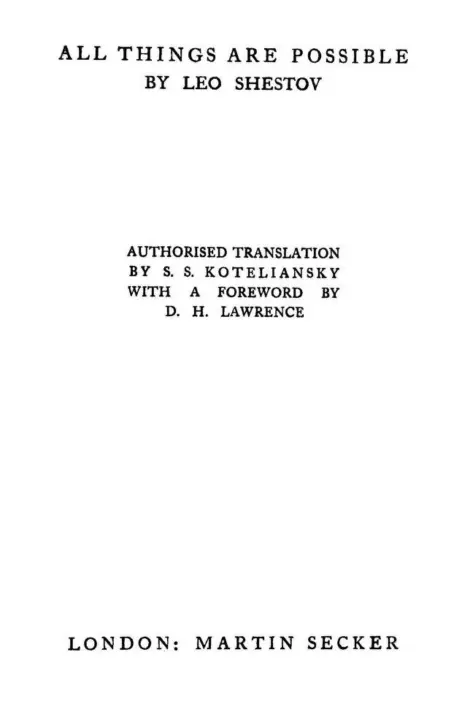
"All Things are Possible" by Lev Shestov is a philosophical work written in the early 20th century. The text presents Shestov's viewpoint on the nature of existence, exploring the limitations of human understanding and the conflict between established ideas and individual freedom. Through a dense and reflective prose style, Shestov embarks on a critique of European rationalism and its impact on Russian thought, suggesting a more subjective exploration of existence. The opening of the book establishes a rich philosophical landscape that examines the human experience of life and the quest for meaning. Shestov uses vivid metaphors to illustrate the obscure and chaotic nature of existence, where individuals must navigate through uncertainty and pain to find clarity. He critiques the reliance on logical reasoning and established truths, arguing that such constructs may hinder true understanding of the self. At the same time, he emphasizes a fundamental freedom in the human psyche, suggesting that true liberation arises from embracing uncertainty rather than conforming to societal ideals.
Introduction adapted from the source catalogue; source summaries may be automatically generated.
Free to read · English · 45,193 words · No account needed
MAKE TIME FOR A GOOD BOOK
On by default. Untick to stop anonymous reading totals. Each page counts after 10 seconds in view. How this works.
Anonymous counting is on unless you have switched it off.
It is Das Ewig Weibliche, with Russian writers. Poushkin and Lermontov loved women and were not afraid of them; Poushkin, who trusted his own nature, was often in love, and always sang his love of the moment. When infatuated with a bacchante, he glorified bacchantes. When he married, he warbled of a modest, nun-like beauty, his wife. A synthesising mind would probably not know what to do with all Poushkin's sorts of love. Nor is Lermontov any better. He abused women, but, as Byelinsky observed after meeting him, he loved women more than anything in the world. And again, not women of one mould only: any and all attractive females: the wild Bella, the lovely Mary, Thamar; one and all, no matter of what race or condition. Every time Lermontov is in love, he assures us his love is so deep and ardent and even moral, that we cannot judge him without conpunction. Vladimir Soloviov alone was not afraid to condemn him. He brought Poushkin as well as Lermontov to account for their moral irregularities, and he even went so far as to say that it was not he himself who judged them, but Fate, in whose service he acted as public denouncer. Lermontov and Poushkin, both dying young, had deserved death for their frivolities. But there was nobody else besides Vladimir Soloviov to darken the memories of the two poets. It is true Tolstoy cannot forgive Poushkin's dissolute life, but he does not apply to Fate for a verdict. According to Tolstoy morality can cope even with a Titan like Poushkin. In Tolstoy's view morality grows stronger the harder the job it has to tackle. It pardons the weak offenders without waste of words, but it never forgives pride and self-confidence. If Tolstoy's edicts had been executed, all memorials to Poushkin would have disappeared; chiefly because of the poet's addiction to the eternal female. In such a case Tolstoy is implacable. He admits the the kind of love whose object is the establishing of a family, but no more. Don Juan is a hateful transgressor. Think of Levin, and his attitude to prostitutes. He is exasperated, indignant, even forgets the need for compassion, and calls them "beasts." In the eternal female Tolstoy sees temptation, seduction, sin, great danger. Therefore it is necessary to keep quite away from the danger. But surely danger is the dragon which guards every treasure on earth. And again, no matter what his precautions, a man will meet his fate sooner or later, and come into conflict with the dragon. Surely this is an axiom. Poushkin and Lermontov loved danger, and therefore sought women. They paid a heavy price, but while they lived they lived freely and lightly. If they had cared to peep in the book of destinies, they might have averted or avoided their sad end. But they preferred to trust their star--lucky or unlucky. Tolstoy was the first among us--we cannot speak of Gogol--who began to fear life. He was the first to start open moralising. In so far as public opinion and personal dignity demand it, he did go to meet his dangers: but not a step further. So he avoided women, art, and philosophy. Love per se, that is, love which does not lead to a family, like wisdom per se, which is wisdom that has no utilitarian motive, and like art for art's sake, seemed to him the worst of temptations, leading to the destruction of the soul. When he plunged too deep in thinking, he was seized with panic. "It seemed to me I was going mad, so I went away to the Bashkirs for koumiss." Such confessions are common in his works. And surely there is no other way with temptations, than to cut short, at once, before it is too late. Tolstoy preserved himself on account of his inborn instinct for departing betimes from a dangerous situation. Save for this cautious prompting he would probably have ended like Lermontov or Poushkin. True, he might have gone deeper into nature, and revealed us rare secrets, instead of preaching at us abstinence, humility, simplicity and so on. But such luck fell to the fate of Dostoevsky. Dostoevsky had very muddled relations with morality. He was too racked by disease and circumstance to get much profit out of the rules of morality. The hygiene of the soul, like that of the body, is beneficial only to healthy men. To the sick it is simply harmful. The more Dostoevsky engaged himself with high morality, the more inextricably entangled he became. He wanted to respect the personality in a woman, and only the personality, and so he came to the point where he could not look on any woman, however ugly, with indifference. The elder Karamazov and his affair with Elizabeth Smerdyascha (Stinking Lizzie)--in what other imagination could such a union have been contemplated? Dostoevsky, of course, reprimands Karamazov, and thanks to the standards of modern criticism, such a reprimand is accounted sufficient to exonerate our author. But there are other standards. If a writer sets out to tell you that no drab could be so loathsome that her ugliness would make you forget she was woman; and if for illustration of this novel idea we are told the history of Fiodov Karamazov with the deformed, repulsive idiot, Stinking Lizzie; then, in face of such "imaginative art" it is surely out of place to preserve the usual confidence in that writer. We do not speak of the interest and appreciation of Dostoevsky's tastes and ideas. Not for one moment will I assert that those who with Poushkin and Lermontov can see the Eternal Female only in young and charming women, have any advantage over Dostoevsky. Of course, we are not forbidden to live according to our tastes, and we may, like Tolstoy, call certain women "beasts." But who has given us the right to assert that we are higher or better than Dostoevsky? Judging "objectively," all the points go to show that Dostoevsky is better--at any rate he saw further, deeper. He could find an original interest, he could discover das ewig Weibliche where we should see nothing of attraction at all, where Goethe would avert his face. Stinking Lizzie is not a beast, as Levin would say, but a woman who is able, if even for a moment, to arouse a feeling of love in a man. And we thought she was worse than nothing, since she roused in us only disgust. Dostoevsky made a discovery, we with our refined feelings missed it. His distorted, abnormal sense showed a greater sensitiveness, in which our high morality was deficient.... And the road to the great truth this time, as ever, is through deformity. Idealists will not agree. They are quite justly afraid that one may not reach the truth, but may get stuck in the mud. Idealists are careful men, and not nearly so stupid as their ideals would lead us to suppose.
Your reading position is saved on this browser. Take it to another device with a library code. Reading pages adapt to text, rather than matching a printed edition.
BEHIND THE BOOK
This eBook is for the use of anyone anywhere in the United States and most other parts of the world at no cost and with almost no restrictions whatsoever. You may copy it, give it away or re-use it under the terms of the Project Gutenberg License included with this eBook or online at www.gutenberg.org. If you are not located in the United States, you will have to check the laws of the country where you are located before using this eBook. Read the source licence.
The original source file, including credits and licence, is retained by this library. Request an original-format copy at no charge. Please include the book title and Project Gutenberg identifier #57369.
KEEP YOUR CURIOSITY GOING
David Patterson (Spirit) Hatch
Cécile Tormay

Moritz Busch
Coulson Kernahan
John L. Ransom

Ralph Waldo Emerson