READ · DISCOVER · ENJOYClassic literature · Always free
All Things are Possible — digital edition cover

THE CLASSIC COLLECTION · 1920

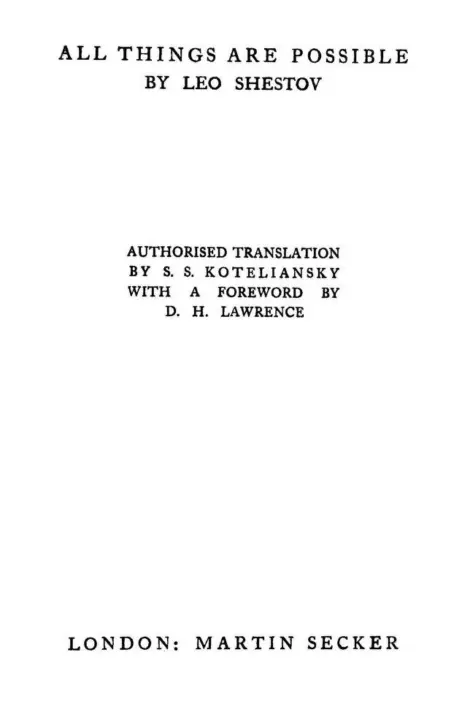
All Things are Possible

"All Things are Possible" by Lev Shestov is a philosophical work written in the early 20th century. The text presents Shestov's viewpoint on the nature of existence, exploring the limitations of human understanding and the conflict between established ideas and individual freedom. Through a dense and reflective prose style, Shestov embarks on a critique of European rationalism and its impact on Russian thought, suggesting a more subjective exploration of existence. The opening of the book establishes a rich philosophical landscape that examines the human experience of life and the quest for meaning. Shestov uses vivid metaphors to illustrate the obscure and chaotic nature of existence, where individuals must navigate through uncertainty and pain to find clarity. He critiques the reliance on logical reasoning and established truths, arguing that such constructs may hinder true understanding of the self. At the same time, he emphasizes a fundamental freedom in the human psyche, suggesting that true liberation arises from embracing uncertainty rather than conforming to societal ideals.

Introduction adapted from the source catalogue; source summaries may be automatically generated.

Start reading ↓

Free to read · English · 45,193 words · No account needed

MAKE TIME FOR A GOOD BOOK

All Things are Possible

On by default. Untick to stop anonymous reading totals. Each page counts after 10 seconds in view. How this works.

Anonymous counting is on unless you have switched it off.

All Things are Possible

The first assumption of all metaphysics is, that by dialectic development of any concept a whole system can be evolved. Of course the initial concept, the a priori, is generally unsound, so there is no need to mention the deductions. But since it is very difficult in the realm of abstract thought to distinguish a lie from truth, metaphysical systems often have a very convincing appearance. The chief defect only appears incidentally, when the taste for dialectic play becomes blunted in man, as it did in Turgenev towards the end of his life, so that he realises the uselessness of philosophical systems. It is related that a famous mathematician, after hearing a musical symphony to the end, inquired, "What does it prove?" Of course, it proves nothing, except that the mathematician had no taste for music. And to him who has no taste for dialectics, metaphysics can prove nothing, either. Therefore, those who are interested in the success of metaphysics must always encourage the opinion that a taste for dialectics is a high distinction in a man, proving the loftiness of his soul.

24

Man is used to having convictions, so there we are. We can none of us do without our hangers-on, though we despise them at the bottom of our souls.

25

Socrates and Plato tried to determine under the shifting change of appearance the immutable, unchanging reality. In the Platonic "ideas" the attempt was incarnated. The visible reality, never true to itself, assuming numberless varying forms, this is not the genuine reality. That which is real must be constant. Hence the ideas of objects are real, and the objects themselves are fictitious. Thus the root of the Platonic philosophy appears to be a fundamental defect in human reasoning--a defect regarded as the highest merit. It is difficult for the philosopher to get a good grasp of this agitated, capricious life, and so he decides that it is not life at all, but a figment. Dialectics is supreme only over general concepts--and the general concepts are promoted to an ideal. Since Plato and Socrates, only such philosophers have succeeded largely who have taught that the unchangeable is preferable to the changeable, the eternal to the temporal. The ordinary individual, who lives unconsciously, never reckoning his spiritual credit against his spiritual debit, naturally regards the philosopher as his legitimate book-keeper, keeper of the soul's accounts. Already in Greece the Athenian youth watched with passionate interest the dexterity which Socrates displayed in his endeavour to restore by means of dialectics the lost "ultimate foundations" of human conduct. Now in book-keeping, as we are aware, not a single farthing must disappear untraceably. Socrates was trying to come up to expectations. The balance between man's spiritual assets and liabilities was with him ideally established. Perhaps in this lies the secret of that strange attraction he exerted even over such volatile and unsteady natures as that of Alcibiades, drawing the young men to him so that they were attached to him with all their soul. Alcibiades had long since lost all count of his spiritual estate, and therefore from time to time he had need to recourse to Socrates, who by speeches and dissertations could bring order into chaos and harmony into the spiritual confusion of his young friend. Alcibiades turned to Socrates to be relieved. Of course, he sought relief in order that he might begin again his riotous living: rest is so sweet to a tired man. But to conclude that because Alcibiades exhausted himself, and because rest is sweet, therefore all men must rest, this is absurd. Yet Socrates dictated this conclusion, in all his ideas. He wished that all men should rest, rest through eternity, that they should see their highest fulfilment in this resting. It is easier to judge of Socrates since we have Count Tolstoy with us. Probably the physiognomist Topir would say of Tolstoy as he said of Socrates, that there are many evil propensities lurking in him. Topir is not here to speak, but Tolstoy has told us himself how wicked he found his own nature, how he had to struggle with it. Tolstoy is not naturally over-courageous; by long effort he has trained himself to be bold. How afraid of death he was in his youth And how cleverly he could conceal that fear. Later on, in mature age, it was still the fear of death which inspired him to write his confession. He was conquering that fear, and with it all other fears. For he felt that, since fear is very difficult to master in oneself, man must be a much higher being when he has learned not to be afraid any more. Meanwhile, who knows? Perhaps "cowardice," that miserable, despicable, much-abused weakness of the underworld, is not such a vice after all. Perhaps it is even a virtue. Think of Dostoevsky and his heroes, think of Hamlet. If the underworld man in us were afraid of nothing, if Hamlet was naturally a gladiator, then we should have neither tragic poetry nor philosophy. It is a platitude, that fear of death has been the inspiration of philosophers. Numberless quotations could be drawn from ancient and modern writers, if they were necessary. Maybe the poetic daimon of Socrates, which made him wise, was only fear personified. Or perhaps it was his dark dreams. That which troubled him by day did not quit him by night. Even after the sentence of death Socrates dreamed that he ought to engage in the arts, so in order not to provoke the gods he began to compose verses, at the age of seventy. Tolstoy also at the age of fifty began to perform good deeds, to which performance he had previously given not the slightest attention. If it were our custom nowadays to express ourselves mythologically, we should no doubt hear Tolstoy telling us about his daimon or his dreams. Instead he squares his accounts with science and morality, in place of gods or demons. Many a present-day Alcibiades, who laves all the week in the muddy waters of life, comes on Sundays to cleanse himself in the pure stream of Tolstoyian ideas. Book-keeping is satisfied with this modest success, and assumes that if it commands universal attention one day in the week, then obviously it is the sum and essence of life, beyond which man needs nothing. On the same grounds the keepers of public baths could argue that, since so many people come to them on Saturdays, therefore cleanliness is the highest ambition of man, and during the week no one should stir at all, lest he sweat or soil himself.

Your reading position is saved on this browser. Take it to another device with a library code. Reading pages adapt to text, rather than matching a printed edition.

BEHIND THE WORDS

About Lev Shestov

Lev Shestov (1866–1938). Explore All Things are Possible in this collection. These books span history, philosophy.

Explore this author’s books →

THE READERS’ VERDICT

How did this story stay with you?

Not rated yet
Your rating for All Things are Possible

Be the first to share your verdict.

One rating per browser, which you can change or remove. A necessary browser identifier remembers your vote. How ratings work

A GOOD STORY DESERVES COMPANY

Pass this book along.

A great read is even better when it’s shared.

SEND A LITTLE INSPIRATION

Share this book

BEHIND THE BOOK

Edition & source details.

Title
All Things are Possible
Author
Lev Shestov
First publication (Open Library catalogue match)
1920
Digital edition publisher
Project Gutenberg
Gutenberg release date
2018-06-21
Language
English
Source edition imprint
Not stated in source catalogue
Source identifier
Project Gutenberg #57369
Contributors
D. H. (David Herbert) Lawrence (aui); S. S. (Samuel Solomonovitch) Koteliansky (trl)

Public-domain source & licence

This eBook is for the use of anyone anywhere in the United States and most other parts of the world at no cost and with almost no restrictions whatsoever. You may copy it, give it away or re-use it under the terms of the Project Gutenberg License included with this eBook or online at www.gutenberg.org. If you are not located in the United States, you will have to check the laws of the country where you are located before using this eBook. Read the source licence.

Full source licence and obtaining an original copy

The original source file, including credits and licence, is retained by this library. Request an original-format copy at no charge. Please include the book title and Project Gutenberg identifier #57369.

the full Project Gutenberg License must appear
prominently whenever any copy of a Project Gutenberg work (any work
on which the phrase “Project Gutenberg” appears, or with which the
phrase “Project Gutenberg” is associated) is accessed, displayed,
performed, viewed, copied or distributed:

This eBook is for the use of anyone anywhere in the United States and most
other parts of the world at no cost and with almost no restrictions
whatsoever. You may copy it, give it away or re-use it under the terms
of the Project Gutenberg™ License included with this eBook or online
at www.gutenberg.org. If you
are not located in the United States, you will have to check the laws
of the country where you are located before using this eBook.

1.E.2. If an individual Project Gutenberg electronic work is
derived from texts not protected by U.S. copyright law (does not
contain a notice indicating that it is posted with permission of the
copyright holder), the work can be copied and distributed to anyone in
the United States without paying any fees or charges. If you are
redistributing or providing access to a work with the phrase “Project
Gutenberg” associated with or appearing on the work, you must comply
either with the requirements of paragraphs 1.E.1 through 1.E.7 or
obtain permission for the use of the work and the Project Gutenberg
trademark as set forth in paragraphs 1.E.8 or 1.E.9.

1.E.3. If an individual Project Gutenberg electronic work is posted
with the permission of the copyright holder, your use and distribution
must comply with both paragraphs 1.E.1 through 1.E.7 and any
additional terms imposed by the copyright holder. Additional terms
will be linked to the Project Gutenberg License for all works
posted with the permission of the copyright holder found at the
beginning of this work.

1.E.4. Do not unlink or detach or remove the full Project Gutenberg
License terms from this work, or any files containing a part of this
work or any other work associated with Project Gutenberg.

1.E.5. Do not copy, display, perform, distribute or redistribute this
electronic work, or any part of this electronic work, without
prominently displaying the sentence set forth in paragraph 1.E.1 with
active links or immediate access to the full terms of the Project
Gutenberg License.

1.E.6. You may convert to and distribute this work in any binary,
compressed, marked up, nonproprietary or proprietary form, including
any word processing or hypertext form. However, if you provide access
to or distribute copies of a Project Gutenberg work in a format
other than “Plain Vanilla ASCII” or other format used in the official
version posted on the official Project Gutenberg website
(www.gutenberg.org), you must, at no additional cost, fee or expense
to the user, provide a copy, a means of exporting a copy, or a means
of obtaining a copy upon request, of the work in its original “Plain
Vanilla ASCII” or other form. Any alternate format must include the
full Project Gutenberg License as specified in paragraph 1.E.1.

1.E.7. Do not charge a fee for access to, viewing, displaying,
performing, copying or distributing any Project Gutenberg works
unless you comply with paragraph 1.E.8 or 1.E.9.

1.E.8. You may charge a reasonable fee for copies of or providing
access to or distributing Project Gutenberg electronic works
provided that:

• You pay a royalty fee of 20% of the gross profits you derive from
the use of Project Gutenberg works calculated using the method
you already use to calculate your applicable taxes. The fee is owed
to the owner of the Project Gutenberg trademark, but he has
agreed to donate royalties under this paragraph to the Project
Gutenberg Literary Archive Foundation. Royalty payments must be paid
within 60 days following each date on which you prepare (or are
legally required to prepare) your periodic tax returns. Royalty
payments should be clearly marked as such and sent to the Project
Gutenberg Literary Archive Foundation at the address specified in
Section 4, “Information about donations to the Project Gutenberg
Literary Archive Foundation.”

• You provide a full refund of any money paid by a user who notifies
you in writing (or by e-mail) within 30 days of receipt that s/he
does not agree to the terms of the full Project Gutenberg™
License. You must require such a user to return or destroy all
copies of the works possessed in a physical medium and discontinue
all use of and all access to other copies of Project Gutenberg™
works.

• You provide, in accordance with paragraph 1.F.3, a full refund of
any money paid for a work or a replacement copy, if a defect in the
electronic work is discovered and reported to you within 90 days of
receipt of the work.

• You comply with all other terms of this agreement for free
distribution of Project Gutenberg™ works.


1.E.9. If you wish to charge a fee or distribute a Project
Gutenberg™ electronic work or group of works on different terms than
are set forth in this agreement, you must obtain permission in writing
from the Project Gutenberg Literary Archive Foundation, the manager of
the Project Gutenberg™ trademark. Contact the Foundation as set
forth in Section 3 below.

1.F.

1.F.1. Project Gutenberg volunteers and employees expend considerable
effort to identify, do copyright research on, transcribe and proofread
works not protected by U.S. copyright law in creating the Project
Gutenberg™ collection. Despite these efforts, Project Gutenberg™
electronic works, and the medium on which they may be stored, may
contain “Defects,” such as, but not limited to, incomplete, inaccurate
or corrupt data, transcription errors, a copyright or other
intellectual property infringement, a defective or damaged disk or
other medium, a computer virus, or computer codes that damage or
cannot be read by your equipment.

1.F.2. LIMITED WARRANTY, DISCLAIMER OF DAMAGES - Except for the “Right
of Replacement or Refund” described in paragraph 1.F.3, the Project
Gutenberg Literary Archive Foundation, the owner of the Project
Gutenberg™ trademark, and any other party distributing a Project
Gutenberg™ electronic work under this agreement, disclaim all
liability to you for damages, costs and expenses, including legal
fees. YOU AGREE THAT YOU HAVE NO REMEDIES FOR NEGLIGENCE, STRICT
LIABILITY, BREACH OF WARRANTY OR BREACH OF CONTRACT EXCEPT THOSE
PROVIDED IN PARAGRAPH 1.F.3. YOU AGREE THAT THE FOUNDATION, THE
TRADEMARK OWNER, AND ANY DISTRIBUTOR UNDER THIS AGREEMENT WILL NOT BE
LIABLE TO YOU FOR ACTUAL, DIRECT, INDIRECT, CONSEQUENTIAL, PUNITIVE OR
INCIDENTAL DAMAGES EVEN IF YOU GIVE NOTICE OF THE POSSIBILITY OF SUCH
DAMAGE.

1.F.3. LIMITED RIGHT OF REPLACEMENT OR REFUND - If you discover a
defect in this electronic work within 90 days of receiving it, you can
receive a refund of the money (if any) you paid for it by sending a
written explanation to the person you received the work from. If you
received the work on a physical medium, you must return the medium
with your written explanation. The person or entity that provided you
with the defective work may elect to provide a replacement copy in
lieu of a refund. If you received the work electronically, the person
or entity providing it to you may choose to give you a second
opportunity to receive the work electronically in lieu of a refund. If
the second copy is also defective, you may demand a refund in writing
without further opportunities to fix the problem.

1.F.4. Except for the limited right of replacement or refund set forth
in paragraph 1.F.3, this work is provided to you ‘AS-IS’, WITH NO
OTHER WARRANTIES OF ANY KIND, EXPRESS OR IMPLIED, INCLUDING BUT NOT
LIMITED TO WARRANTIES OF MERCHANTABILITY OR FITNESS FOR ANY PURPOSE.

1.F.5. Some states do not allow disclaimers of certain implied
warranties or the exclusion or limitation of certain types of
damages. If any disclaimer or limitation set forth in this agreement
violates the law of the state applicable to this agreement, the
agreement shall be interpreted to make the maximum disclaimer or
limitation permitted by the applicable state law. The invalidity or
unenforceability of any provision of this agreement shall not void the
remaining provisions.

1.F.6. INDEMNITY - You agree to indemnify and hold the Foundation, the
trademark owner, any agent or employee of the Foundation, anyone
providing copies of Project Gutenberg™ electronic works in
accordance with this agreement, and any volunteers associated with the
production, promotion and distribution of Project Gutenberg™
electronic works, harmless from all liability, costs and expenses,
including legal fees, that arise directly or indirectly from any of
the following which you do or cause to occur: (a) distribution of this
or any Project Gutenberg work, (b) alteration, modification, or
additions or deletions to any Project Gutenberg work, and (c) any
Defect you cause.

Section 2. Information about the Mission of Project Gutenberg

Project Gutenberg is synonymous with the free distribution of
electronic works in formats readable by the widest variety of
computers including obsolete, old, middle-aged and new computers. It
exists because of the efforts of hundreds of volunteers and donations
from people in all walks of life.

Volunteers and financial support to provide volunteers with the
assistance they need are critical to reaching Project Gutenberg’s
goals and ensuring that the Project Gutenberg collection will
remain freely available for generations to come. In 2001, the Project
Gutenberg Literary Archive Foundation was created to provide a secure
and permanent future for Project Gutenberg and future
generations. To learn more about the Project Gutenberg Literary
Archive Foundation and how your efforts and donations can help, see
Sections 3 and 4 and the Foundation information page at www.gutenberg.org.

Section 3. Information about the Project Gutenberg Literary Archive Foundation

The Project Gutenberg Literary Archive Foundation is a non-profit
501(c)(3) educational corporation organized under the laws of the
state of Mississippi and granted tax exempt status by the Internal
Revenue Service. The Foundation’s EIN or federal tax identification
number is 64-6221541. Contributions to the Project Gutenberg Literary
Archive Foundation are tax deductible to the full extent permitted by
U.S. federal laws and your state’s laws.

The Foundation’s business office is located at 41 Watchung Plaza #516,
Montclair NJ 07042, USA, +1 (862) 621-9288. Email contact links and up
to date contact information can be found at the Foundation’s website
and official page at www.gutenberg.org/contact

Section 4. Information about Donations to the Project Gutenberg
Literary Archive Foundation

Project Gutenberg™ depends upon and cannot survive without widespread
public support and donations to carry out its mission of
increasing the number of public domain and licensed works that can be
freely distributed in machine-readable form accessible by the widest
array of equipment including outdated equipment. Many small donations
($1 to $5,000) are particularly important to maintaining tax exempt
status with the IRS.

The Foundation is committed to complying with the laws regulating
charities and charitable donations in all 50 states of the United
States. Compliance requirements are not uniform and it takes a
considerable effort, much paperwork and many fees to meet and keep up
with these requirements. We do not solicit donations in locations
where we have not received written confirmation of compliance. To SEND
DONATIONS or determine the status of compliance for any particular state
visit www.gutenberg.org/donate.

While we cannot and do not solicit contributions from states where we
have not met the solicitation requirements, we know of no prohibition
against accepting unsolicited donations from donors in such states who
approach us with offers to donate.

International donations are gratefully accepted, but we cannot make
any statements concerning tax treatment of donations received from
outside the United States. U.S. laws alone swamp our small staff.

Please check the Project Gutenberg web pages for current donation
methods and addresses. Donations are accepted in a number of other
ways including checks, online payments and credit card donations. To
donate, please visit: www.gutenberg.org/donate.

Section 5. General Information About Project Gutenberg electronic works

Professor Michael S. Hart was the originator of the Project
Gutenberg concept of a library of electronic works that could be
freely shared with anyone. For forty years, he produced and
distributed Project Gutenberg eBooks with only a loose network of
volunteer support.

Project Gutenberg eBooks are often created from several printed
editions, all of which are confirmed as not protected by copyright in
the U.S. unless a copyright notice is included. Thus, we do not
necessarily keep eBooks in compliance with any particular paper
edition.

Most people start at our website which has the main PG search
facility: www.gutenberg.org.

This website includes information about Project Gutenberg,
including how to make donations to the Project Gutenberg Literary
Archive Foundation, how to help produce our new eBooks, and how to
subscribe to our email newsletter to hear about new eBooks.


KEEP YOUR CURIOSITY GOING

Your next chapter awaits.