THE CLASSIC COLLECTION✦A dead man’s diaryCLASSIC FREE BOOKS
A dead man’s diary
Coulson Kernahan
THE CLASSIC COLLECTION · 1874
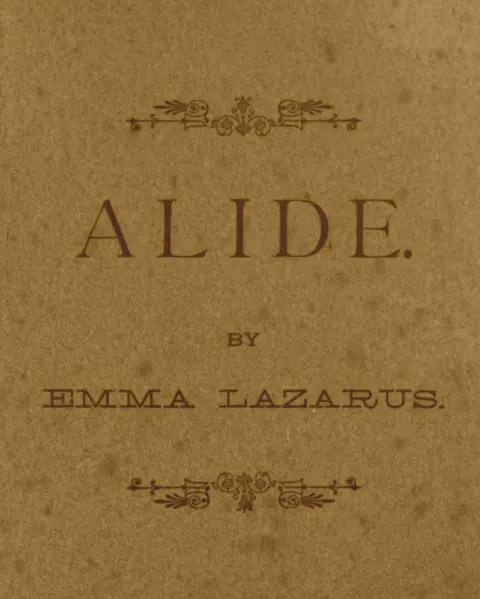
"Alide: An Episode of Goethe's Life" by Emma Lazarus is a novel written in the late 19th century. The story revolves around the young poet Johann Wolfgang von Goethe and his interactions with the Duroc family, particularly focusing on Alide, the charming younger daughter whose spirited nature captivates him. The narrative intertwines elements of Goethe's life with fictionalized accounts of his early romances and social encounters. At the start of the novel, readers are introduced to Dr. Julius Steck, a cover for Goethe, as he ventures to the Duroc household. As he arrives with his friend Max Waldstein, Goethe's vibrant and artistically inclined character is contrasted with the pastoral world of the Durocs, setting up an engaging exploration of his infatuation with Alide. Their initial interactions are filled with warmth and humor, while the family dynamics and picturesque rural setting add depth to the story. The opening sets the scene for a romantic unfolding that highlights not just the charm of young love, but also Goethe's reflective nature and desire to connect with a life beyond the academic, inviting readers into a literary journey rich with emotion and identity.
Introduction adapted from the source catalogue; source summaries may be automatically generated.
Free to read · English · 47,841 words · No account needed
MAKE TIME FOR A GOOD BOOK
On by default. Untick to stop anonymous reading totals. Each page counts after 10 seconds in view. How this works.
Anonymous counting is on unless you have switched it off.
"But her dignified mother, her kind old father," said Goethe, anxiously,--"have you betrayed me to them? Do they know what a simpleton I have been?"
"I cannot answer for that," responded Waldstein, dryly; "but if they know you are a simpleton they have discovered it through their own mother-wit, for I assure you, comrade, it is not I who would betray you."
"How did you happen to speak of me at all?" asked Goethe.
"Naturally enough," replied Max: "they questioned me about Strasburg, and I found your madcap fame had preceded you as far as Sesenheim. They had heard all sorts of preposterous stuff, and they were just begging me to tell them something about your eccentricities, when you came in with your sweetheart on your arm,--oh, no, I beg your pardon, not the Cathedral, but some heroine of a novel whom you were loftily studying for your first work of fiction."
Goethe made no reply, but paced the floor in an excited manner. Max watched him narrowly with an amused expression, and waited for him to resume the conversation. Finally he stopped, and broke out abruptly, "Is she engaged?"
"No," said Max, shortly.
"Hm! that is a relief," said Goethe, with a sigh. "Is she in love? has
she ever been in love?"
"Really, Wolfgang," cried Max, laughing, "I cannot pretend to be familiar with such a mysterious thing as the heart of a woman. As to her being in love now, however, I think I can safely answer--no, unless she was smitten this evening by that pretty gray suit of yours. And for the past,--well, as she is scarcely more than a child, I hardly think it possible that she should have had any serious passion hitherto."
"Strange! strange!" murmured Goethe, absently. "Such a cheerfulness by nature is inconceivable to me. Had she loved and lost and recovered herself, or were she now betrothed, in either case I could account for this deep, earnest serenity." And he relapsed into silence.
"Those two cousins of hers," he began, in a little while, "her aunt Catherine--no, that is not the name--her aunt Christiane's sons: has she not a sentiment for one of them?"
"For both of them, for all I know," answered Max; "but if you could see them, I hardly believe you would suspect it. I think the Durocs have monopolized the beauty of the family. And, besides, one of these cousins is some few months younger than herself, and therefore in her womanly eyes a mere child; the other is already married. Any more catechism to-night, Wolfgang?"
"Yes; who is Goetz?" asked Goethe, with great eagerness.
Your reading position is saved on this browser. Take it to another device with a library code. Reading pages adapt to text, rather than matching a printed edition.
BEHIND THE BOOK
This eBook is for the use of anyone anywhere in the United States and most other parts of the world at no cost and with almost no restrictions whatsoever. You may copy it, give it away or re-use it under the terms of the Project Gutenberg License included with this eBook or online at www.gutenberg.org. If you are not located in the United States, you will have to check the laws of the country where you are located before using this eBook. Read the source licence.
The original source file, including credits and licence, is retained by this library. Request an original-format copy at no charge. Please include the book title and Project Gutenberg identifier #69539.
KEEP YOUR CURIOSITY GOING
Coulson Kernahan

Maurice Baring
Frances Wright
Cécile Tormay

Frederic Jesup Stimson

W. H. P. (William Henry Pope) Jarvis