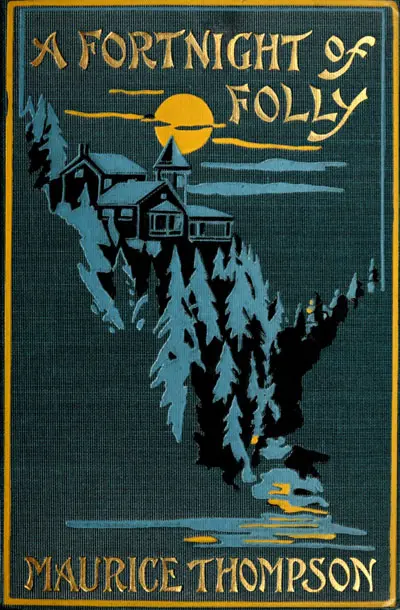
A Fortnight of Folly
Maurice Thompson & Hugh Conway
THE CLASSIC COLLECTION · 1908
"Alice of Old Vincennes" by Maurice Thompson is a historical romance written during the late 19th century. The narrative unfolds in the early days of Indiana's statehood at the settlement of Vincennes along the Wabash River, intertwining themes of adventure, community, and romance through the experiences of a young girl named Alice Roussillon. Embedded within this tale is a rich depiction of frontier life in a time that challenges both love and loyalty amidst the backdrop of historical events. The opening of the novel introduces us to Alice Roussillon as she playfully interacts with her friend, Jean, under the iconic cherry tree of her home, which represents a bygone era of the settlement. Gaspard Roussillon, Alice’s guardian, is portrayed as a man of influence and respect within the community, while the story reveals the unique challenges and societal norms of the rugged life on the American frontier. As Alice demonstrates her spirited nature, showcasing her strength and independence, we also meet Father Beret, a kind priest who wishes to guide her toward faith despite the complexities of her upbringing. The story foreshadows adventures and themes of love and duty, particularly as political tensions rise, hinting that Alice's journey will intertwine her life with significant historical events and the struggles of those around her.
Introduction adapted from the source catalogue; source summaries may be automatically generated.
Free to read · English · 106,084 words · No account needed
MAKE TIME FOR A GOOD BOOK
On by default. Untick to stop anonymous reading totals. Each page counts after 10 seconds in view. How this works.
Anonymous counting is on unless you have switched it off.
"By the way," he said, with expansive casualness in his voice, "I called upon your old-time friend and co-adjutor, Father Sebastien, while up there. A noble old man. He sent you a thousand good messages. Was mightily delighted when I told him how happy and hale you have always been here. Ah, you should have seen his dear old eyes full of loving tears. He would walk a hundred miles to see you, he said, but never expected to in this world. Blessings, blessings upon dear Father Beret, was what he murmured in my ear when we were parting. He says that he will never leave Quebec until he goes to his home above--ah!"
The way in which M. Roussillon closed his little speech, his large eyes upturned, his huge hands clasped in front of him, was very effective.
"I am under many obligations, my son," said Father Beret, "for what you tell me. It was good of you to remember my dear old friend and go to him for his loving messages to me. I am very, very thankful. Help me to another drop of wine, please."
Now the extraordinary feature of the situation was that Father Beret had known positively for nearly five years that Father Sebastien was dead and buried.
"Ah, yes," M. Roussillon continued, pouring the claret with one hand and making a pious gesture with the other; "the dear old man loves you and prays for you; his voice quavers whenever he speaks of you."
"Doubtless he made his old joke to you about the birth-mark on my shoulder," said Father Beret after a moment of apparently thoughtful silence. "He may have said something about it in a playful way, eh?"
"True, true, why yes, he surely mentioned the same," assented M. Roussillon, his face assuming an expression of confused memory; "it was something sly and humorous, I mind; but it just escapes my recollection. A right jolly old boy is Father Sebastien; indeed very amusing at times."
"At times, yes," said Father Beret, who had no birth-mark on his
shoulder, and had never had one there, or on any other part of his
person.
"How strange!" Alice remarked, "I, too, have a mark on my shoulder--a pink spot, just like a small, five-petaled flower. We must be of kin to each other, Father Beret."
The priest laughed.
"If our marks are alike, that would be some evidence of kinship," he
said.
"But what shape is yours, Father?"
"I've never seen it," he responded.
"Never seen it! Why?"
"Well, it's absolutely invisible," and he chuckled heartily, meantime glancing shrewdly at M. Roussillon out of the tail of his eye.
Your reading position is saved on this browser. Take it to another device with a library code. Reading pages adapt to text, rather than matching a printed edition.
Maurice Thompson & Hugh Conway
Maurice Thompson
Frank R. Stockton & Edgar Fawcett & Franklin Fyles & Anna Katharine Green & Henry Harland & Ingersoll Lockwood & Joaquin Miller & Kirk Munroe & Brainard Gardner Smith & Maurice Thompson & A. C. (Andrew Carpenter) Wheeler
BEHIND THE BOOK
This eBook is for the use of anyone anywhere in the United States and most other parts of the world at no cost and with almost no restrictions whatsoever. You may copy it, give it away or re-use it under the terms of the Project Gutenberg License included with this eBook or online at www.gutenberg.org. If you are not located in the United States, you will have to check the laws of the country where you are located before using this eBook. Read the source licence.
The original source file, including credits and licence, is retained by this library. Request an original-format copy at no charge. Please include the book title and Project Gutenberg identifier #4097.
KEEP YOUR CURIOSITY GOING
Cécile Tormay

Moritz Busch
Coulson Kernahan
John L. Ransom

Maurice Baring
Frances Wright