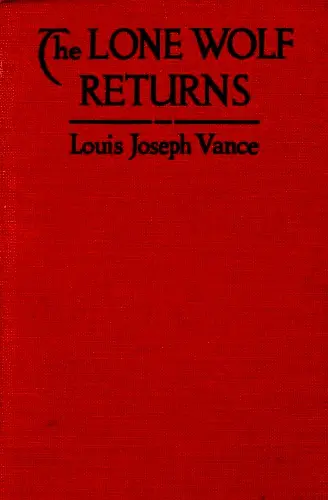
The Lone Wolf Returns
Louis Joseph Vance
THE CLASSIC COLLECTION · 1921
"Alias the Lone Wolf" by Louis Joseph Vance is a novel first published in the early 20th century. This story follows the character André Duchemin, who is secretly the infamous thief known as the Lone Wolf, as he attempts to escape the threats posed by his enemies while navigating various escapades and romantic entanglements in post-war Europe. The opening of the novel introduces Duchemin as he receives his "walking papers" from the British Secret Service, which severs his ties to England and prompts his exile. With a mix of melancholy and resolve, he embarks on a journey through the picturesque yet dangerous landscapes of France, initially seeking solitude and a reprieve from his past. However, he soon finds himself entangled in a series of unexpected events, including a violent confrontation that reveals his skills as an adventurer and protector. As he encounters characters like the young widow Eve de Montalais, who draws him into a social circle filled with intrigue, Duchemin grapples with his identity and the inescapable pull of his past as the Lone Wolf. This sets the stage for a series of adventures that intertwine with themes of loyalty, love, and the shadows of one's former life.
Introduction adapted from the source catalogue; source summaries may be automatically generated.
Free to read · English · 93,844 words · No account needed
MAKE TIME FOR A GOOD BOOK
On by default. Untick to stop anonymous reading totals. Each page counts after 10 seconds in view. How this works.
Anonymous counting is on unless you have switched it off.
"How good you are!" "It makes me glad I have so well forgotten ever meeting him. I do not believe I should know him if I found him here, in this very restaurant, even seated by my side."
"It is mademoiselle now whose heart is great and kind."
"You may believe it well."
"And does mademoiselle's forgetfulness, perhaps, extend even farther
into the so dead past?"
"But, monsieur, I was a mere child when I first came to Paris, before the War. How could anyone reasonably expect my memory of those innocent girlish days to be exact? Regard that, even then, I met people by hundreds, as a young girl studying for the stage must. Is it likely one face would stand out in my memory more than another?"
"Quite, if you ask me," said Lanyard dryly--"quite likely, if any circumstance connected with that face were at all memorable."
"But I assure you I was in those days much too self-absorbed to pay much attention to others. It is that way, you know, in maiden days."
"Mademoiselle does injustice to her memory," Lanyard insisted in polite astonishment. "In some ways it is wonderful."
The woman looked suddenly aside, so that he could not see her face; but he perceived, with an astonishment which he made no attempt to hide, that she was quaking bodily with some unconfessed emotion. And when she faced again his unbroken look of grave bewilderment, he discovered that she was really capable of tears.
"Monsieur," she gasped, "believe it or not, never before have I met one with whom I was so completely en rapport. And instantaneously! It is priceless, this! We must see more of one another."
"Much more," Lanyard assented gravely. "A great deal more," she supplemented with significance. "I am sure we shall get along together famously."
"Mademoiselle offers me great honour--"
"Nothing less than my friendship."
"I would be indeed an ingrate to refuse it. But a question: Will not
people talk?"
"What!" Amusement shook her again. "How talk? What more can they say
about Liane Delorme?"
"Ah!" said Lanyard--"but about Madame la Comtesse de Lorgnes..."
"My friend: that was a good joke once; but now you must forget that name as utterly as I have forgotten another."
"Impossible."
"What do you say?" She frowned a little. "Is it possible you misunderstood? De Lorgnes was nothing to me."
"I never thought he was."
"You had reason. Because we were thrown together, and our names were something alike in sound, it amused us--not the two of us alone, but all our party--to pretend I was madame la comtesse."
"He was really a count?"
Your reading position is saved on this browser. Take it to another device with a library code. Reading pages adapt to text, rather than matching a printed edition.
Louis Joseph Vance
Louis Joseph Vance
Louis Joseph Vance
Louis Joseph Vance
BEHIND THE BOOK
This eBook is for the use of anyone anywhere in the United States and most other parts of the world at no cost and with almost no restrictions whatsoever. You may copy it, give it away or re-use it under the terms of the Project Gutenberg License included with this eBook or online at www.gutenberg.org. If you are not located in the United States, you will have to check the laws of the country where you are located before using this eBook. Read the source licence.
The original source file, including credits and licence, is retained by this library. Request an original-format copy at no charge. Please include the book title and Project Gutenberg identifier #10327.
KEEP YOUR CURIOSITY GOING
Coulson Kernahan

Maurice Baring
Frances Wright
Cécile Tormay

Frederic Jesup Stimson

W. H. P. (William Henry Pope) Jarvis