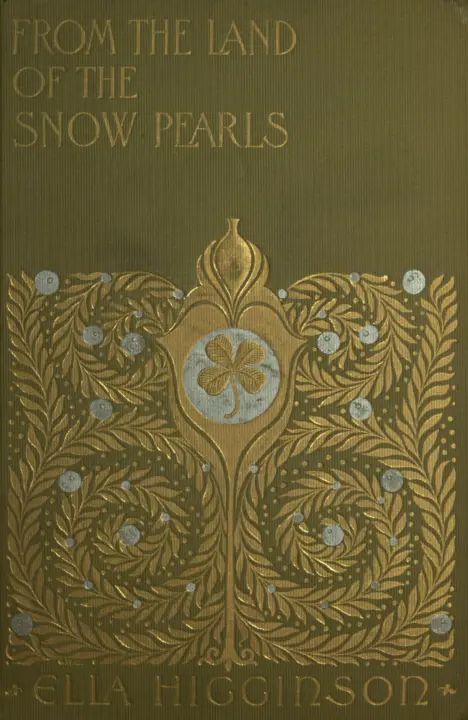
From the Land of the Snow-Pearls: Tales from Puget Sound
Ella Higginson

THE CLASSIC COLLECTION · 1908
"Alaska, the Great Country" by Ella Higginson is a descriptive travelogue written in the early 20th century. The book explores the stunning landscapes and untouched beauty of Alaska, detailing both its historical significance and its enchantment as a travel destination. Higginson’s writing encapsulates the allure of Alaska’s remote regions, offering readers a glimpse into the natural majesty that draws countless visitors each year. The opening of the work sets the stage for an immersive journey into Alaska, emphasizing that the true splendor of the region extends far beyond the typical tourist routes. Higginson describes the annual influx of travelers to places like Juneau and Sitka, but argues that these brief visits fail to convey the country's essence. Instead, she points to the breathtaking sights found west of Sitka, where mountains rise dramatically from the sea and vibrant natural beauty enchants those who venture further into the wild. Through lush imagery and poetic language, the author invites readers to appreciate Alaska not just as a destination, but as a land steeped in history and wonder that leaves a lasting impression on all who experience its charm.
Introduction adapted from the source catalogue; source summaries may be automatically generated.
Free to read · English · 159,560 words · No account needed
MAKE TIME FOR A GOOD BOOK
On by default. Untick to stop anonymous reading totals. Each page counts after 10 seconds in view. How this works.
Anonymous counting is on unless you have switched it off.
In 1906, at Coldfoot, sixty miles north of the Arctic Circle, were grown cucumbers eight inches long, nineteen-inch rhubarb, potatoes four inches long, cabbages whose matured heads weighed eight pounds, and turnips weighing sixteen pounds--all of excellent quality.
At Bear Lake, near Seward and Cook Inlet, were grown good potatoes, radishes, lettuce, carrots, beets, rhubarb, strawberries, raspberries, Logan berries, blackberries; also, roses, lilacs, and English ivy. In this locality cows and chickens thrive and are profitable investments for those who are not too indolent to take care of them.
Alaskan lettuce must be eaten to be appreciated. During the hot days and the long, light hours of the nights it grows so rapidly that its crispness and delicacy of flavor cannot be imagined.
Everything in Alaska is either the largest, the best, or most beautiful, in the world, the people who live there maintain; and this soon grows to be a joke to the traveller. But when the assertion that lettuce grown in Alaska is the most delicious in the world is made, not a dissenting voice is heard.
Along the coast, sea-weed and fish guano are used as fertilizers; and soil at the mouth of a stream where there is silt is most desirable for vegetables.
In southeastern Alaska and along the coast to Kodiak, at Fairbanks and Copper Centre, at White Horse, Dawson, Rampart, Tanana, Council City, Eagle, and other places on the Yukon, almost all kinds of vegetables, berries, and flowers grow luxuriantly and bloom and bear in abundance. One turnip, of fine flavor, has been found sufficient for several people.
In the vicinity of the various hot springs, even corn, tomatoes, and muskmelons were successful to the highest degree.
On the Yukon cabbages form fine white, solid heads; cauliflower is unusually fine and white; beets grow to a good size, are tender, sweet, and of a bright red; peas are excellent; rhubarb, parsley, and celery were in many places successful. Onions seem to prove a failure in nearly all sections of the country; and potatoes, turnips, and lettuce are the prize vegetables.
Grain growing is no longer attempted. The experiment made by the government, in the coast region, proved entirely unsatisfactory. It will usually mature, but August, September, and October are so rainy that it is not possible to save the crop. It is, however, grown as a forage crop, for which purpose it serves excellently.
The numerous small valleys, coves, and pockets afford desirable locations for gardens, berries, and some varieties of fruit trees.
Your reading position is saved on this browser. Take it to another device with a library code. Reading pages adapt to text, rather than matching a printed edition.
BEHIND THE BOOK
This eBook is for the use of anyone anywhere in the United States and most other parts of the world at no cost and with almost no restrictions whatsoever. You may copy it, give it away or re-use it under the terms of the Project Gutenberg License included with this eBook or online at www.gutenberg.org. If you are not located in the United States, you will have to check the laws of the country where you are located before using this eBook. Read the source licence.
The original source file, including credits and licence, is retained by this library. Request an original-format copy at no charge. Please include the book title and Project Gutenberg identifier #34615.
KEEP YOUR CURIOSITY GOING
Wilfrid Scawen Blunt
Wilfrid Scawen Blunt

E. W. (Edgar Watson) Howe
Francis Greenleaf Allinson & Anne C. E. (Anne Crosby Emery) Allinson
Cyrenus Cole

John Martineau