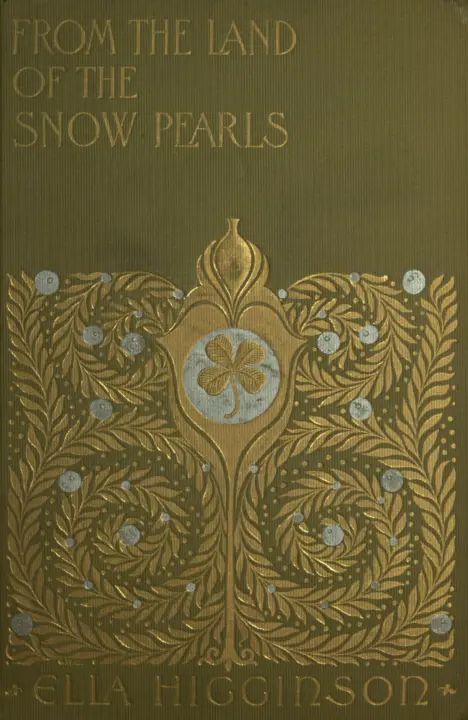
From the Land of the Snow-Pearls: Tales from Puget Sound
Ella Higginson

THE CLASSIC COLLECTION · 1908
"Alaska, the Great Country" by Ella Higginson is a descriptive travelogue written in the early 20th century. The book explores the stunning landscapes and untouched beauty of Alaska, detailing both its historical significance and its enchantment as a travel destination. Higginson’s writing encapsulates the allure of Alaska’s remote regions, offering readers a glimpse into the natural majesty that draws countless visitors each year. The opening of the work sets the stage for an immersive journey into Alaska, emphasizing that the true splendor of the region extends far beyond the typical tourist routes. Higginson describes the annual influx of travelers to places like Juneau and Sitka, but argues that these brief visits fail to convey the country's essence. Instead, she points to the breathtaking sights found west of Sitka, where mountains rise dramatically from the sea and vibrant natural beauty enchants those who venture further into the wild. Through lush imagery and poetic language, the author invites readers to appreciate Alaska not just as a destination, but as a land steeped in history and wonder that leaves a lasting impression on all who experience its charm.
Introduction adapted from the source catalogue; source summaries may be automatically generated.
Free to read · English · 159,560 words · No account needed
MAKE TIME FOR A GOOD BOOK
On by default. Untick to stop anonymous reading totals. Each page counts after 10 seconds in view. How this works.
Anonymous counting is on unless you have switched it off.
One experiences that solemn feeling which every one has known, as of standing among the dead; the shades of Baranoff, Behring, Lisiansky, Veniaminoff, Chirikoff,--all the unknown murdered ones, too,--go drifting noiselessly, with reproachful faces, through the dim wood.
It was on the beach near this grove of totems that Lisiansky's men were murdered by Koloshians in 1804, while obtaining water for the ship.
The Sitka Industrial Training School was founded nearly thirty years ago by ex-Governor Brady, who was then a missionary to the Indians of Alaska.
It was first attended by about one hundred natives, ranging from the very young to the very old. This school was continued, with varied success, by different people--including Captain Glass, of the Jamestown--until Dr. Sheldon Jackson became interested, and, with Mr. Brady and Mr. Austin, sought and obtained aid from the Board of Home Missions of the Presbyterian Church.
A building was erected for a Boys' Home, and this was followed, a year
later, by a Girls' Home.
The girls were taught to speak the English language, cook, wash, iron, sew, mend, and to become cleanly, cheerful, honest, honorable women.
The boys were taught to speak the English language; the trades of shoemaking, coopering, boat-building, carpentry, engineering, rope-making, and all kinds of agricultural work. The rudiments of bricklaying, painting, and paper-hanging are also taught.
During the year 1907 a Bible Training Department was added for those among the older boys and girls who desired to obtain knowledge along such lines, or who aspired to take up missionary work among their people.
Twelve pupils took up the work, and six continued it throughout the year. The work in this department is, of course, voluntary on the part of the student.
The Sitka Training School is not, at present, a government school. During the early nineties it received aid from the government, under the government's method of subsidizing denominational schools, where they were already established, instead of incurring the extra expense of establishing new government schools in the same localities.
When the government ceased granting such subsidies, the Sitka
School--as well as many other denominational schools--lost this
assistance.
The property of the school has always belonged to the Presbyterian Board
of Home Missions.
For many years it was customary to keep pupils at the schools from their entrance until their education was finished.
In the summer of 1905 the experiment was tried of permitting a few pupils to go to their homes during vacation. All returned in September cheerfully and willingly; and now, each summer, more than seventy boys and girls return to their homes to spend the time of vacation with their families.
Your reading position is saved on this browser. Take it to another device with a library code. Reading pages adapt to text, rather than matching a printed edition.
BEHIND THE BOOK
This eBook is for the use of anyone anywhere in the United States and most other parts of the world at no cost and with almost no restrictions whatsoever. You may copy it, give it away or re-use it under the terms of the Project Gutenberg License included with this eBook or online at www.gutenberg.org. If you are not located in the United States, you will have to check the laws of the country where you are located before using this eBook. Read the source licence.
The original source file, including credits and licence, is retained by this library. Request an original-format copy at no charge. Please include the book title and Project Gutenberg identifier #34615.
KEEP YOUR CURIOSITY GOING
Wilfrid Scawen Blunt
Wilfrid Scawen Blunt

E. W. (Edgar Watson) Howe
Francis Greenleaf Allinson & Anne C. E. (Anne Crosby Emery) Allinson
Cyrenus Cole

John Martineau