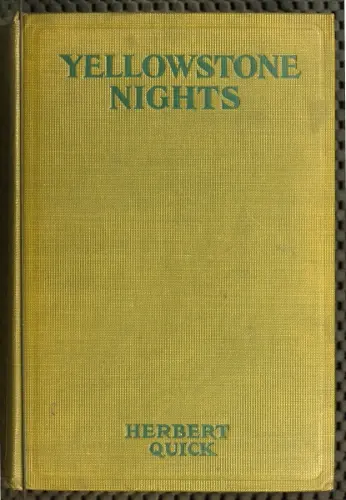
Yellowstone Nights
Herbert Quick
THE CLASSIC COLLECTION · 1904
"Aladdin & Co.: A Romance of Yankee Magic" by Herbert Quick is a novel written in the early 20th century. The story begins with an intriguing portrayal of a young delegate at a national political convention, who is unexpectedly swept away by thoughts of his newfound love, Alice. As the protagonist navigates his experiences in both personal and political realms, themes of ambition, romance, and the quest for identity seem to intertwine throughout the narrative. At the start of the novel, the central character, Albert Barslow, reflects on his role as a delegate while grappling with a sense of disconnection from the political fervor surrounding him. Struggling to find solace amid the chaos, he retreats to an art gallery, where his thoughts drift to Alice, his love interest, revealing his deeper emotional struggles. The opening chapters introduce other key figures, including Jim Elkins, who emphasizes a business-oriented vision for Lattimore, a town set to grow, alongside romantic tensions involving a young artist and her suitor. The foundation is laid for a rich exploration of dreams, relationships, and the tensions between personal aspirations and societal expectations.
Introduction adapted from the source catalogue; source summaries may be automatically generated.
Free to read · English · 86,775 words · No account needed
MAKE TIME FOR A GOOD BOOK
On by default. Untick to stop anonymous reading totals. Each page counts after 10 seconds in view. How this works.
Anonymous counting is on unless you have switched it off.
"Right this way, sir," said he. "Mr. Giddings is with him. He gave orders for you to be shown up."
Cornish sat at a little round table on which there were some bottles and glasses. The tipple was evidently ale, and Mr. Giddings was standing opposite, lifting a glass in one hand and pointing at it with the other, in evident imitation of the attitude in which the late Mr. Gough loved to have himself pictured; but the sentiments of the two speakers were quite different.
"'Turn out more ale; turn up the light!'"
Giddings glanced at the electric light-fixtures, and then looked about as if for a servant to turn them up.
"'I will not go to bed to-night!
For, of all foes that man should dread,
The first and worst one is a bed!
Friends I have had, both old and young;
Ale have we drunk, and songs we've sung.
Enough you know when this is said,
That, one and all, they died in bed!'"
Here Giddings's voice broke with grief, and he stopped to drink the rest of the glassful, and went on:
"'In bed they died, and I'll not go
Where all my friends have perished so!
Go, ye who fain would buried be;
But not to-night a bed for me!'"
"Do you often have these Horatian fits?" I inquired.
"Base groveler!" said he, "if you can't rise to the level of the
occasion, don't butt in."
"'For me to-night no bed prepare,
But set me out my oaken chair,
And bid me other guests beside
The ghosts that shall around me glide!'"
"You will, of course," said Cornish, "permit us to withdraw for the purpose of having our conference with our Eastern friends? If I take your meaning, you'll not be alone."
"Not by a jugful, I'll not be alone!" said Giddings, tossing off another
glass:
"'In curling smoke-wreaths I shall see
A fair and gentle company.
Though silent all, fair revelers they,
Who leave you not till break of day!
Go, ye who would not daylight see;
But not to-night a bed for me!
For I've been born, and I've been wed,
And all man's troubles come of bed!'"
Here Giddings sank down in his chair and began weeping.
"The divinest attribute of poetry," said he, "is that of bringing tears. Let me weep awhile, fellows, and then I'll give you the last stanza. Last stanza's the best--"
And in the midst of his critique he went to sleep, thereby breaking his rule adopted in "Dum Vivemus Vigilemus."
"Is he this way often?" said I to Cornish, as we went down to meet Jim
and the bankers.
Your reading position is saved on this browser. Take it to another device with a library code. Reading pages adapt to text, rather than matching a printed edition.
BEHIND THE BOOK
This eBook is for the use of anyone anywhere in the United States and most other parts of the world at no cost and with almost no restrictions whatsoever. You may copy it, give it away or re-use it under the terms of the Project Gutenberg License included with this eBook or online at www.gutenberg.org. If you are not located in the United States, you will have to check the laws of the country where you are located before using this eBook. Read the source licence.
The original source file, including credits and licence, is retained by this library. Request an original-format copy at no charge. Please include the book title and Project Gutenberg identifier #23745.
KEEP YOUR CURIOSITY GOING
Coulson Kernahan

Maurice Baring
Frances Wright
Cécile Tormay

Frederic Jesup Stimson

W. H. P. (William Henry Pope) Jarvis