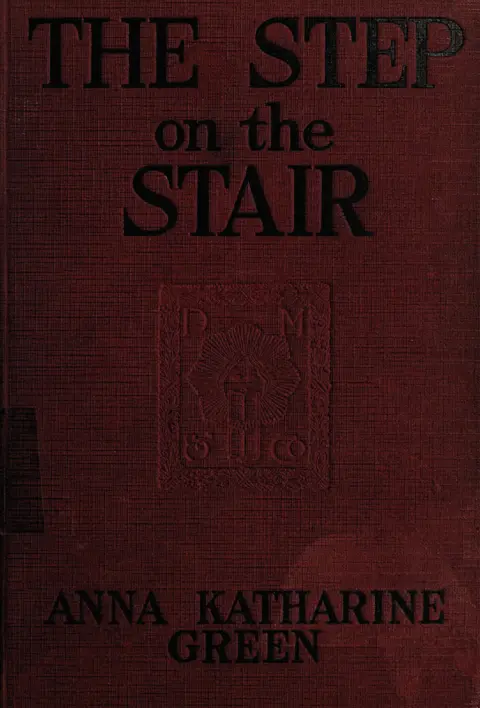
The step on the stair
Anna Katharine Green
THE CLASSIC COLLECTION · 1899
"Agatha Webb" by Anna Katharine Green is a suspenseful mystery novel written during the late 19th century. The story unfolds in the quaint seaport town of Sutherlandtown, centering around the shocking murder of Agatha Webb, a beloved figure in the community. The narrative begins with the aftermath of a dance, where events spiral into chaos with the announcement of her death, setting the stage for an exploration of secrets, motives, and the search for justice. At the start of the novel, the atmosphere is lively yet ominous as the dancers leave a party, and a figure named Frederick rushes past, muttering distressingly about a "night of horror." This foreshadows the impending tragedy when news spreads that Agatha Webb has been murdered. The chaos escalates as locals converge to comprehend the incident, leading to speculation about the circumstances surrounding her death and the involvement of her husband, Philemon Webb. The opening chapters introduce various characters, hinting at their connections and potential motives, effectively immersing the reader in a web of intrigue and suspicion that invites further exploration into the unfolding mystery.
Introduction adapted from the source catalogue; source summaries may be automatically generated.
Free to read · English · 89,127 words · No account needed
MAKE TIME FOR A GOOD BOOK
On by default. Untick to stop anonymous reading totals. Each page counts after 10 seconds in view. How this works.
Anonymous counting is on unless you have switched it off.
"Despicable!" was all that came from her lips. At which I shuddered and groped about for the handle of the door. But she would not let me go. Subduing with an unexpected grand self-restraint the emotions which had hitherto swelled too high in her breast for either speech or action, she thrust out one arm to stay me and said in short, commanding tones: "How was this thing done? You say you took the money, yet it was James who was sent to collect it--or so my father says." Here she tore her looks from me and cast one glance at her father. What she saw I cannot say, but her manner changed and henceforth she glanced his way as much as mine and with nearly as much emotion. "I am waiting to hear what you have to say," she exclaimed, laying her hand on the door over my head so as to leave me no opportunity for escape. I bowed and attempted an explanation.
"Agatha," said I, "the commission was given to James and he rode to Sutherlandtown to perform it. But it was on the day when he was accustomed to write to you, and he was not easy in his mind, for he feared he would miss sending you his usual letter. When, therefore, he came to the hotel and saw me in Philemon's room--I was often there in those days, often without Philemon's knowing it--he saw, or thought he did, a way out of his difficulties. Entering where I was, he explained to me his errand, and we being then--though never, alas! since--one in everything but the secret hopes he enjoyed, he asked me if I would go in his stead to Mr. Orr's room, present my credentials, and obtain the money while he wrote the letter with which his mind was full. Though my jealousy was aroused and I hated the letter he was about to write, I did not see how I could refuse him; so after receiving such credentials as he himself carried, and getting full instructions how to proceed, I left him writing at Philemon's table and hastened down the hall to the door he had pointed out. If Providence had been on the side of guilt, the circumstances could not have been more favourable for the deception I afterwards played. No one was in the hall, no one was with Mr. Orr to note that it was I instead of James who executed Mr. Gilchrist's commission. But I was thinking of no deception then. I proceeded quite innocently on my errand, and when the feeble voice of the invalid bade me enter, I experienced nothing but a feeling of compassion for a man dying in this desolate way, alone. Of course Mr. Orr was surprised to see a stranger, but after reading Mr. Gilchrist's letter which I handed him, he seemed quite satisfied and himself drew out the wallet at the head of his bed and handed it over. 'You will find,' said he, 'a memorandum inside of the full amount, $7758.67. I should like to have returned Mr. Gilchrist the full ten thousand which I owe him, but this is all I possess, barring a hundred dollars which I have kept for my final expenses.' 'Mr. Gilchrist will be satisfied,' I assured him. 'Shall I make you out a receipt?' He shook his head with a sad smile. 'I shall be dead in twenty-four hours. What good will a receipt do me?' But it seemed unbusinesslike not to give it, so I went over to the table, where I saw a pen and paper, and recognising the necessity of counting the money before writing a receipt, I ran my eye over the bills, which were large, and found the wallet contained just the amount he had named. Then I glanced at the memorandum. It had evidently been made out by him at some previous time, for the body of the writing was in firm characters and the ink blue, while the figures were faintly inscribed in muddy black. The 7 especially was little more than a straight line, and as I looked at it the devil that is in every man's nature whispered at first carelessly, then with deeper and deeper insistence: 'How easy it would be to change that 7 to a 2! Only a little mark at the top and the least additional stroke at the bottom and these figures would stand for five thousand less. It might be a temptation to some men.' It presently became a temptation to me; for, glancing furtively up, I discovered that Mr. Orr had fallen either into a sleep or into a condition of insensibility which made him oblivious to my movements. Five thousand dollars! just the sum of the ten five-hundred-dollar bills that made the bulk of the amount I had counted. In this village and at my age this sum would raise me at once to comparative independence. The temptation was too strong for resistance. I succumbed to it, and seizing the pen before me, I made the fatal marks. When I went back to James the wallet was in my hand, and the ten five-hundred-dollar bills in my breast pocket."
Your reading position is saved on this browser. Take it to another device with a library code. Reading pages adapt to text, rather than matching a printed edition.
Anna Katharine Green
Anna Katharine Green
Anna Katharine Green
Anna Katharine Green
BEHIND THE BOOK
This eBook is for the use of anyone anywhere in the United States and most other parts of the world at no cost and with almost no restrictions whatsoever. You may copy it, give it away or re-use it under the terms of the Project Gutenberg License included with this eBook or online at www.gutenberg.org. If you are not located in the United States, you will have to check the laws of the country where you are located before using this eBook. Read the source licence.
The original source file, including credits and licence, is retained by this library. Request an original-format copy at no charge. Please include the book title and Project Gutenberg identifier #5162.
KEEP YOUR CURIOSITY GOING
Coulson Kernahan

Maurice Baring
Frances Wright
Cécile Tormay

Frederic Jesup Stimson

W. H. P. (William Henry Pope) Jarvis