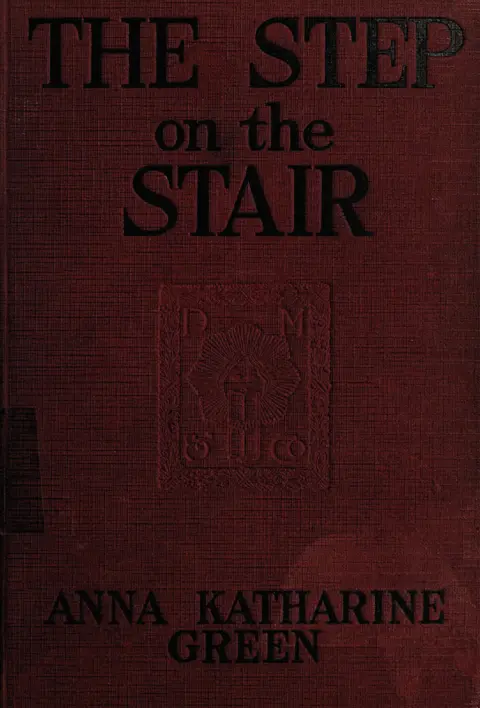
The step on the stair
Anna Katharine Green
THE CLASSIC COLLECTION · 1899
"Agatha Webb" by Anna Katharine Green is a suspenseful mystery novel written during the late 19th century. The story unfolds in the quaint seaport town of Sutherlandtown, centering around the shocking murder of Agatha Webb, a beloved figure in the community. The narrative begins with the aftermath of a dance, where events spiral into chaos with the announcement of her death, setting the stage for an exploration of secrets, motives, and the search for justice. At the start of the novel, the atmosphere is lively yet ominous as the dancers leave a party, and a figure named Frederick rushes past, muttering distressingly about a "night of horror." This foreshadows the impending tragedy when news spreads that Agatha Webb has been murdered. The chaos escalates as locals converge to comprehend the incident, leading to speculation about the circumstances surrounding her death and the involvement of her husband, Philemon Webb. The opening chapters introduce various characters, hinting at their connections and potential motives, effectively immersing the reader in a web of intrigue and suspicion that invites further exploration into the unfolding mystery.
Introduction adapted from the source catalogue; source summaries may be automatically generated.
Free to read · English · 89,127 words · No account needed
MAKE TIME FOR A GOOD BOOK
On by default. Untick to stop anonymous reading totals. Each page counts after 10 seconds in view. How this works.
Anonymous counting is on unless you have switched it off.
Her flight to the Zabel cottage, after an experience which would madden most women, can now be understood. She was still following her lover. The plan of making Agatha's old and wretched friend amenable for her death originated with Frederick and not with Amabel. It was he who first started for the Zabel cottage. It was he who left the bank bill there. This is all clear, and even the one contradictory fact of the dagger having been seen in the old man's hand was not a stumbling-block to Sweetwater. With the audacity of one confident of his own insight, he explained it to himself thus: The dagger thrown from the window by the assassin, possibly because he knew of Zabel's expected visit there that night, fell on the grass and was picked up by Amabel, only to be flung down again in the brightest part of the lawn. It was lying there then, when, a few minutes later and before either Frederick or Amabel had left the house, the old man entered the yard in a state of misery bordering on frenzy. He and his brother were starving, had been starving for days. He was too proud to own his want, and too loyal to his brother to leave him for the sake of the food prepared for them both at Agatha's house, and this was why he had hesitated over his duty till this late hour, when his own secret misery or, perhaps, the hope of relieving his brother drove him to enter the gate he had been accustomed to see open before him in glad hospitality. He finds the lights burning in the house above and below, and encouraged by the welcome they seem to hold out, he staggers up the path, ignorant of the tragedy which was at that very moment being enacted behind those lighted windows. But half-way toward the house he stops, the courage which has brought him so far suddenly fails, and in one of those quick visions which sometimes visit men in extremity, he foresees the astonishment which his emaciated figure is likely to cause in these two old friends, and burying his face in his hands he stops and bitterly communes with himself before venturing farther. Fatal stop! fatal communing! for as he stands there he sees a dagger, his own old dagger, how lost or how found he probably did not stop to ask, lying on the grass and offering in its dumb way suggestions as to how he might end this struggle without any further suffering. Dizzy with the new hope, preferring death to the humiliation he saw before him in Agatha's cottage, he dashes out of the yard, almost upsetting Mr. Crane, who was passing by on his homeward way from an errand of mercy. A little while later Amabel comes upon him lying across his own doorstep. He has made an effort to enter, but his long walk and the excitement of this last bitter hour have been too much for him. As she watches him he gains strength and struggles to his feet, while she, aghast at the sight of the dagger she had herself flung down in Agatha's yard, and dreading the encounter between this old man and the lover she had been following to this place, creeps around the house and looks into the first window she finds open. What does she expect to see? Frederick brought face to face with this desperate figure with its uplifted knife. But instead of that she beholds another old man seated at a table and--Amabel had paused when she reached that AND--and Sweetwater had not then seen how important this pause was, but now he understood it. Now he saw that if she had not had a subtle purpose in view, that if she had wished to tell the truth rather than produce false inferences in the minds of those about her calculated to save the criminal as she called him, she would have completed her sentence thus: "I saw an old man seated at a table and Frederick Sutherland standing over him." For Sweetwater had no longer a doubt that Frederick was in that room at that moment. What further she saw, whether she was witness to an encounter between this intruder and James, or whether by some lingering on the latter's part Frederick was able to leave the house without running across him, was a matter of comparative unimportance. What is of importance is that he did leave it and that Amabel, knowing it was Frederick, strove to make her auditors believe it was Zabel, who carried the remainder of the money into the woods. Yet she did not say so, and if her words on this subject could be carefully recalled, one would see that it was still her lover she was following and no old man, tottering on the verge of the grave and only surviving because of the task he was bent on performing.
Your reading position is saved on this browser. Take it to another device with a library code. Reading pages adapt to text, rather than matching a printed edition.
Anna Katharine Green

Anna Katharine Green
Anna Katharine Green
Anna Katharine Green
BEHIND THE BOOK
This eBook is for the use of anyone anywhere in the United States and most other parts of the world at no cost and with almost no restrictions whatsoever. You may copy it, give it away or re-use it under the terms of the Project Gutenberg License included with this eBook or online at www.gutenberg.org. If you are not located in the United States, you will have to check the laws of the country where you are located before using this eBook. Read the source licence.
The original source file, including credits and licence, is retained by this library. Request an original-format copy at no charge. Please include the book title and Project Gutenberg identifier #5162.
KEEP YOUR CURIOSITY GOING
Coulson Kernahan

Maurice Baring
Frances Wright
Cécile Tormay

Frederic Jesup Stimson

W. H. P. (William Henry Pope) Jarvis