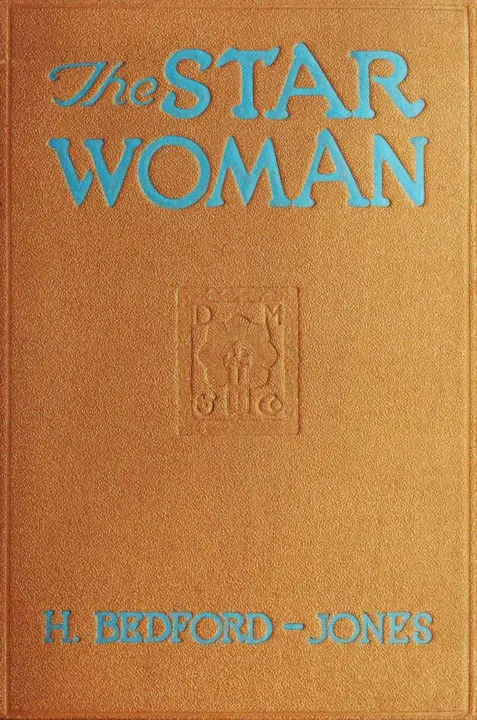
The Star Woman
H. (Henry) Bedford-Jones
THE CLASSIC COLLECTION · 1924
"Against the Tide" by H. Bedford-Jones is a novel written in the early 20th century. The book primarily revolves around the characters Dorothy Deming and Reese Armstrong as they navigate personal and financial tumult and their impending marriage, set against the backdrop of business dealings and societal expectations in early 1920s America. The narrative hints at themes of ambition, loyalty, and the moral challenges posed by business. The opening of the novel introduces the Deming mansion, alive with excitement in anticipation of Dorothy's wedding to Reese Armstrong. However, this merriment is overshadowed by a brewing storm—both literal and metaphorical—as Lawrence Macgowan, a close friend of the groom, expresses concerns about the pressures of finance on Armstrong. As the festivities progress, a telegram brings troubling news about the Deming Food Products Company, leading to the postponement of the wedding. Macgowan, aware of deeper issues at play, urges Dorothy to manage her soon-to-be husband's priorities, setting the stage for a narrative that intertwines personal relationships with the cutthroat world of business.
Introduction adapted from the source catalogue; source summaries may be automatically generated.
Free to read · English · 71,754 words · No account needed
MAKE TIME FOR A GOOD BOOK
On by default. Untick to stop anonymous reading totals. Each page counts after 10 seconds in view. How this works.
Anonymous counting is on unless you have switched it off.
"Oh, he's a part of it." Macgowan chuckled, in his odd manner of being inwardly amused over something unspoken. "You see, like every confirmed bachelor who beholds his best friend embarking on the wine-dark sea of matrimony, I have hitherto, my dear Dorothy, been ungallant enough to congratulate you--quite irrespective of your charming qualities--upon the acquisition of your husband."
He paused, regarding Dorothy with his slightly aggressive, straightforward gaze. His air was half reflective, half admiring.
"Well, where's the crime in that?" she demanded brightly. "Don't you suppose that women ever think they are fortunate? We're not all stuck-up prigs, grandly convinced of the blessings we bestow--not a bit of it!"
Macgowan waved his cigar.
"Ah, but I confess my error! It is Reese who deserves the congratulations which I now tender with all my heart, not with the lips alone! Wives are easily found, my dear fellow," turning to Armstrong, "but home-makers are rare, I assure you. So rare, indeed, that I--"
He ended with a sigh and a gesture, as though the rarity of home-makers accounted for his own single state. Then, with a sudden thrust of his cigar, he indicated the rooms beyond.
"Look at this place! Look at that burnt-ivory woodwork, those rugs, these bits of polished wood that we call furniture! Look at those bright yellow valences, those blue curtains, that pinkish splendor of a Kirman on the floor! Why, the raw fighting colors are as sweetly harmonious, as delicately blended, as the vivid hues of some old Chinese embroidery! Only an artist can blend raw colors.
"Thank the lord, there's no formality about this house. Good things in plenty, but no useless frippery made for effect and expenditure. When one comes in here, it's to find a home that's lived in, used, created for comfort and enjoyment. Reese, old man, you're to be congratulated! With the cynical egotism of one who is too largely surrounded by a world of sham, I say that I myself could have done no better with this house. It is perfection."
"And that's a huge compliment, Dot, for Lawrence Macgowan to pay!" exclaimed the beaming Armstrong. "He's a famous critic of the arts. Everybody up and down the Avenue looks to Mac to pass on worthy furniture, Serbian sculpture and all the professional forms of art! On the strength of this compliment, you can go into the house-decorating business and become rich in a month."
"Nonsense, I mean it!" protested Macgowan earnestly. "Absolutely."
"And I do thank you." Dorothy's eyes were dancing under the praise, yet the blue-steel gleam still lingered in their depths. "You make amends very pleasantly."
"Amends?" Macgowan's brows lifted. "For what, pray?"
Your reading position is saved on this browser. Take it to another device with a library code. Reading pages adapt to text, rather than matching a printed edition.
H. (Henry) Bedford-Jones
H. (Henry) Bedford-Jones
H. (Henry) Bedford-Jones
H. (Henry) Bedford-Jones
BEHIND THE BOOK
This eBook is for the use of anyone anywhere in the United States and most other parts of the world at no cost and with almost no restrictions whatsoever. You may copy it, give it away or re-use it under the terms of the Project Gutenberg License included with this eBook or online at www.gutenberg.org. If you are not located in the United States, you will have to check the laws of the country where you are located before using this eBook. Read the source licence.
The original source file, including credits and licence, is retained by this library. Request an original-format copy at no charge. Please include the book title and Project Gutenberg identifier #67269.
KEEP YOUR CURIOSITY GOING
Coulson Kernahan

Maurice Baring
Frances Wright
Cécile Tormay

Frederic Jesup Stimson

W. H. P. (William Henry Pope) Jarvis