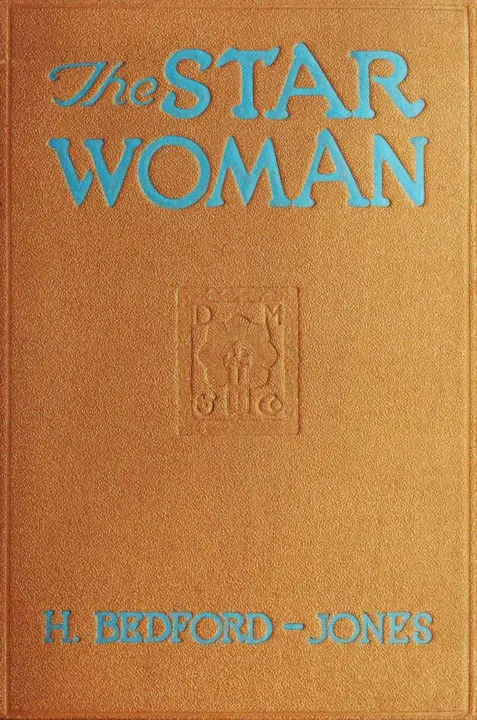
The Star Woman
H. (Henry) Bedford-Jones
THE CLASSIC COLLECTION · 1924
"Against the Tide" by H. Bedford-Jones is a novel written in the early 20th century. The book primarily revolves around the characters Dorothy Deming and Reese Armstrong as they navigate personal and financial tumult and their impending marriage, set against the backdrop of business dealings and societal expectations in early 1920s America. The narrative hints at themes of ambition, loyalty, and the moral challenges posed by business. The opening of the novel introduces the Deming mansion, alive with excitement in anticipation of Dorothy's wedding to Reese Armstrong. However, this merriment is overshadowed by a brewing storm—both literal and metaphorical—as Lawrence Macgowan, a close friend of the groom, expresses concerns about the pressures of finance on Armstrong. As the festivities progress, a telegram brings troubling news about the Deming Food Products Company, leading to the postponement of the wedding. Macgowan, aware of deeper issues at play, urges Dorothy to manage her soon-to-be husband's priorities, setting the stage for a narrative that intertwines personal relationships with the cutthroat world of business.
Introduction adapted from the source catalogue; source summaries may be automatically generated.
Free to read · English · 71,754 words · No account needed
MAKE TIME FOR A GOOD BOOK
On by default. Untick to stop anonymous reading totals. Each page counts after 10 seconds in view. How this works.
Anonymous counting is on unless you have switched it off.
"Then give in, surrender!" put in Judge Holcomb, gloomily enough. "Consider what a protracted fight will involve, Reese! It means that we'll be battling in the courts for months to come, perhaps years. It means lengthy and continuous expense--and you know what this campaign has cost us. What if we win? We get nothing out of it. Macgowan can juggle the books of Consolidated and use the investors' money to fight us--"
"That's exactly it," said Armstrong. "He's fighting us with our own money! And if we fail, he'll rob us. We must not fail."
"Besides," spoke up Doctor Bruton, "consider the effect upon the company itself, Reese! Already this fight has hurt it tremendously."
"Not as much as Macgowan has hurt it," said Armstrong. "Not as much
as he will hurt it!"
They were silent for a moment, staring at him. Then Robert Dorns moved in his chair, took his cigar from his mouth, and spoke.
"Listen here, Armstrong. Who's runnin' Consolidated now?"
"Macgowan, of course."
"If he's out o' the company, who's runnin' it?"
Armstrong was silent a space, his gaze fastened on Dorns, his lips
compressed.
"I see," he said at length. "Yes. I see."
Dorns waved his cigar, drove home his point.
"We ain't in this fight for selfish reasons, but for the good of the company. Now, at the very minute Macgowan gets into the saddle--what happens? His crowd goes back on him. Findlater is ready to ditch him. S'pose we make terms?
"Then our stock is back in control. Leave Findlater there if we have to! Believe me, when we're dealin' with Findlater and not Macgowan, we can handle him! It's Macgowan's infernal brains that have been makin' this fight, me lad; don't mistake that. Why not let Mansfield have a little talk, learn what we can do? They can't put anything over on Q. Adams, and you know it!"
Armstrong was silent again. Then he rose to his feet.
"Go ahead, Mansfield," he said. "I'm going to telephone my
wife--excuse me."
He went into the adjacent room and closed the door.
For a little he was unable to get a connection; he waited. At length he heard the maid's voice on the line, and asked for Dorothy. Another wait. Then came the voice of Dorothy, coolly speaking his name. Something in her tone startled him.
"Are you well, lady?"
"Well enough in body, Reese," she said. "Not in mind. There is
something you must do for me."
"Yes? What is it?"
"Make peace with Macgowan."
Armstrong was staggered. "What do you mean, Dorothy?"
"I can't explain over the telephone. Will you do it?"
Your reading position is saved on this browser. Take it to another device with a library code. Reading pages adapt to text, rather than matching a printed edition.
H. (Henry) Bedford-Jones
H. (Henry) Bedford-Jones
H. (Henry) Bedford-Jones
H. (Henry) Bedford-Jones
BEHIND THE BOOK
This eBook is for the use of anyone anywhere in the United States and most other parts of the world at no cost and with almost no restrictions whatsoever. You may copy it, give it away or re-use it under the terms of the Project Gutenberg License included with this eBook or online at www.gutenberg.org. If you are not located in the United States, you will have to check the laws of the country where you are located before using this eBook. Read the source licence.
The original source file, including credits and licence, is retained by this library. Request an original-format copy at no charge. Please include the book title and Project Gutenberg identifier #67269.
KEEP YOUR CURIOSITY GOING
Coulson Kernahan

Maurice Baring
Frances Wright
Cécile Tormay

Frederic Jesup Stimson

W. H. P. (William Henry Pope) Jarvis