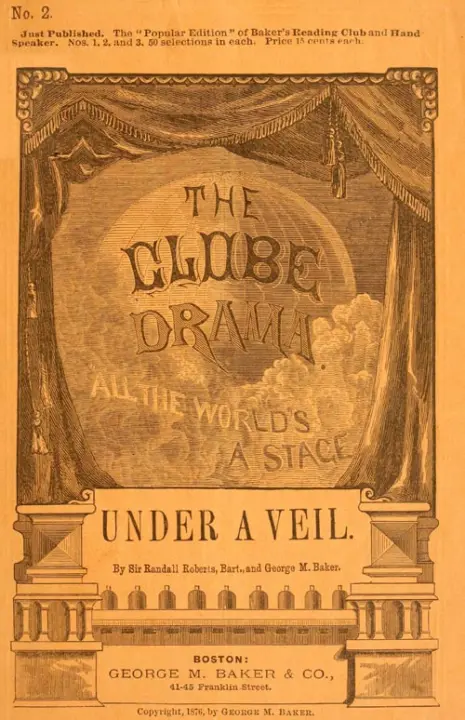
Under a Veil: A Comedietta in One Act
Randal H. (Randal Howland), Sir Roberts & George M. (George Melville) Baker
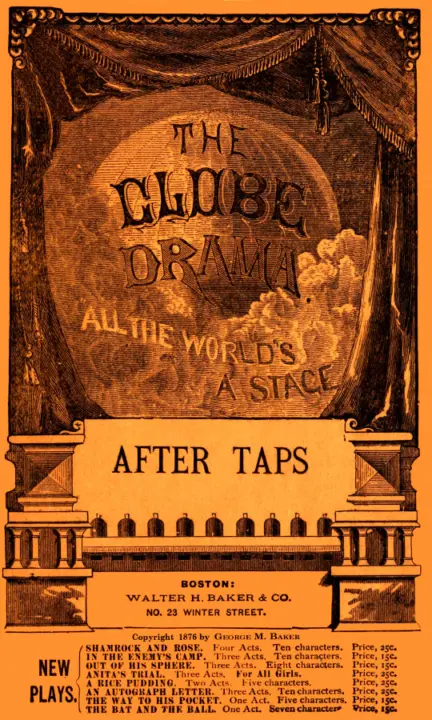
THE CLASSIC COLLECTION · 1876
"After Taps" by Rachel Baker Gale and George M. Baker is a drama in three acts written in the late 19th century. The play revolves around Colonel Gordon Graham and his family during the backdrop of the American Civil War, exploring themes of loyalty, treachery, and the effects of war on personal relationships. Central to the plot are the complex dynamics between Colonel Graham, his wife Ruth, and their allies, including the enigmatic figure of Randolph Newcomb, who poses threats to the family’s honor. At the start of the play, the scene is set in Colonel Graham's home in Baltimore as Polly Primrose, a lively character, playfully dances and muses about the soldiers leaving for battle. She is soon joined by Bijah Bright, who expresses his affections for her amidst light-hearted banter. We learn of Colonel Graham's recent injury and the mysterious circumstances surrounding it, leading to suspicions about those close to him, including Newcomb, who secretly plots against Graham. The opening dialogues introduce multiple key characters, setting the stage for the unfolding drama intertwined with themes of love, duty, and the ramifications of conflict on both personal and national levels.
Introduction adapted from the source catalogue; source summaries may be automatically generated.
Free to read · English · 17,737 words · No account needed
MAKE TIME FOR A GOOD BOOK
On by default. Untick to stop anonymous reading totals. Each page counts after 10 seconds in view. How this works.
Anonymous counting is on unless you have switched it off.
POTTS. What is this? An indignation meeting? Bijah quarrelling with a pretty woman? No, yes, it is—Polly Primrose; but who is this? (Looking at DOR.)
POLLY. That's my aunt, she came with me.
ROGER. Poor old lady; she seems tired.
POLLY. That she is; but she's never too tired to tell fortunes;
wouldn't you like to hear yours?
ROGER. Anything to kill time. (Goes to DOR.) Come, let's hear it. My time is short. (Looking about.) No danger of the colonel's appearance, is there, Potts?
POTTS. No, Roger, he is busily engaged. I've looked out for that.
ROGER. Good! Now, what is the wheel of fortune to bring me? Oh! (Crosses DOR.'S palm with silver.) I remember, no golden treasure disclosed, unless the key be silver.
DOR. (taking ROGER'S hand; disguised voice). Young man, you have had serious trouble; some cloud hangs over you. You are suspected of some crime.
ROGER (starting). What witchcraft is here?
DOR. But you are innocent. If you have patience, your name will soon be
cleared.
ROGER. I hope so with all my heart.
DOR. You have a good heart, and, let me see—yes—that line is crossed—you have given it to some one.
(Exeunt POLLY and BIJAH through trees, L.)
POTTS (slapping ROGER on back; laughs). You are hard hit, old man. Even the witches can read your heart.
DOR. (addressing POTTS). Your time is coming, sir. “He laughs best
who laughs last.”
ROGER. Ha, ha! Potts, some time that heart of yours won't stand the fire. Then I will charter a Gatling gun to return all your volleys.
DOR. (looking at ROGER'S hand). But what is this? Some danger lurks near a friend; perhaps a brother.
ROGER. I have no brother.
DOR. No; not a real brother, but—
ROGER. The colonel?
DOR. (excitedly). Yes, yes. You must save him. He shall owe his life to you. Some one calling himself friend is his foe. (Rising; forgets, and assumes natural voice.) He has done you a grievous wrong, but you will forgive that?
ROGER. That voice! (Raises DOROTHY'S veil.) Dorothy?
POTTS. Cleverly done, little maid. You actually waited eight minutes.
(Looks at watch.)
ROGER. Major! Dorothy, what does this mean?
POTTS. A well-laid scheme, Roger, to hold a stolen interview with you. Miss Dorothy, you can talk with Roger just five minutes, no longer. The colonel will return by that time.
(Exit MAJOR. ROGER sits on log; DOR. kneels at his side.)
DOR. Forgive me for coming, Roger, but I was so anxious.
ROGER. Anxious, little one? Why, what is the trouble? Is it a quarrel with “my dearest friend Mollie”?
Your reading position is saved on this browser. Take it to another device with a library code. Reading pages adapt to text, rather than matching a printed edition.
Randal H. (Randal Howland), Sir Roberts & George M. (George Melville) Baker
George M. (George Melville) Baker
George M. (George Melville) Baker
George M. (George Melville) Baker
BEHIND THE BOOK
This eBook is for the use of anyone anywhere in the United States and most other parts of the world at no cost and with almost no restrictions whatsoever. You may copy it, give it away or re-use it under the terms of the Project Gutenberg License included with this eBook or online at www.gutenberg.org. If you are not located in the United States, you will have to check the laws of the country where you are located before using this eBook. Read the source licence.
The original source file, including credits and licence, is retained by this library. Request an original-format copy at no charge. Please include the book title and Project Gutenberg identifier #49295.
KEEP YOUR CURIOSITY GOING
Cécile Tormay

Moritz Busch
John L. Ransom
Frances Wright
Cécile Tormay

Mabel Potter Daggett