Sunshine and Storm in Rhodesia Being a Narrative of Events in Matabeleland Both Before and During the Recent Native Insurrection Up to the Date of the Disbandment of the Bulawayo Field Force
Frederick Courteney Selous
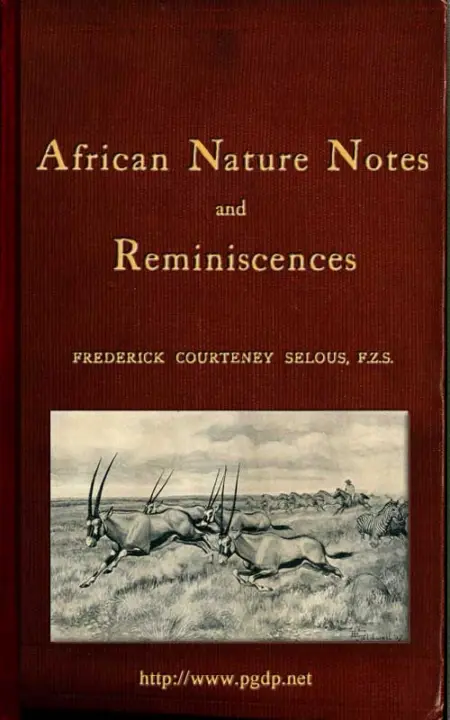
THE CLASSIC COLLECTION · 1908
"African Nature Notes and Reminiscences" by Frederick Courteney Selous is a natural history and observational account written in the early 20th century. The book documents the author's extensive experiences and insights into the wildlife of South Africa, particularly focusing on the natural behavior and characteristics of various big game animals. It blends personal anecdotes with scientific observations, offering a unique glimpse into a time when these interactions were thriving." "The opening portion of the book introduces Selous's intentions and the influence behind his writing, particularly highlighting his conversations with President Theodore Roosevelt, who encouraged him to publish his notes. It explains how the chapters consist of previously written articles and how Selous aims to broaden the understanding of African wildlife beyond mere hunting narratives. The introductory remarks focus on the importance of accurate observation in natural history and the value of firsthand experiences in recounting the lives of the majestic creatures inhabiting the African wilderness."
Introduction adapted from the source catalogue; source summaries may be automatically generated.
Free to read · English · 121,418 words · No account needed
MAKE TIME FOR A GOOD BOOK
On by default. Untick to stop anonymous reading totals. Each page counts after 10 seconds in view. How this works.
Anonymous counting is on unless you have switched it off.
In regard to wild lions, it may be said, as a general proposition, that the mane usually grows round the neck and on the chest only, with a prolongation from the back of the neck to behind the shoulder-blades. Sometimes large full-grown male lions will be practically maneless. Occasionally specimens will be met with in which the entire shoulders as well as the neck will be covered with mane. When writing of lions in 1881, I stated that I had never seen the skin of a wild lion in which the whole belly was covered with long hair, as is so often the case with lions in captivity in this country, though I had seen full-maned wild lions with large tufts of long dark hair on the elbows and in the flanks. A few years later, however, Lo Bengula, the last chief of the Matabele, gave me the skin of a lion which had been killed near the upper course of the Umzingwani river, not far from Bulawayo, with a very fine mane. In this specimen the tufts of hair in the flanks were very profuse, almost meeting across the belly, and there were a few long hairs all over the under parts of the skin. There is also, I think, good evidence to show that in the more southerly portions of South Africa lions not infrequently developed a growth of long hair all over their bellies; for not only are all the lions figured by Captain (afterwards Sir Cornwallis) Harris so adorned, but there is now in the Junior United Service Club in London a mounted specimen of a South African lion with not only an extraordinary wealth of mane covering the whole of the fore-part of the body, but also with a thick growth of long hair all over its belly. This lion is said to have been killed near the Orange river about 1830, probably, I should think, on the bontebok flats, near Colesberg, in the Cape Colony, though possibly on the plains to the north of the river. Now, personally I believe that cold has more to do with the development of a lion's mane than anything else. The winter cold of the high plateaus of the Cape Colony, the Orange Colony, and the Southern Transvaal is much more severe than in any part of Africa where lions exist to-day, and Harris's drawings and the mounted specimen of the lion I have above referred to, which was killed near the Orange river long ago, show that wild lions sometimes attained very profuse manes and had their bellies covered with long hair in that part of Africa. To-day, lions with really fine manes are never found except in countries where the nights are cold during the winter months, such as the Athi plains, the Uas N'gishu plateau, the high downs of Matabeleland and Mashunaland, and the Haud of Somaliland, as well as other elevated regions. In the Pungwe river district some few lions attain fairly good, but never, I believe, extraordinarily profuse manes. Only a certain proportion of the lions found on high and cold plateaus have, however, fine long dark manes. Many have very poor manes, but it seems to me impossible that there can be more than one species of lion in so confined an area. In the hotter parts of Africa, lying below the level of the more elevated plateaus, I think I am correct in saying that lions never get fine manes, and the hotter the climate, the poorer on the average the manes will be. The fact that the high, cold plateaus are always open grasslands free from thorn-bush, whilst the lower parts of the country are usually covered with scrubby bush and thorny thickets, has led many people to think that lions have poor manes in bush-covered countries because the thorns tear out the hair; but I think that this is quite a mistaken idea, for in the western part of Matabeleland, in the neighbourhood of the Ramokwebani and Tati rivers, where the winter nights are very cold, although the whole country is covered with forest, much of it dense thorn-bush, the lions used sometimes to grow very fine long manes. Personally, therefore, I am convinced that climate is the main factor in the production of a lion's mane, and possibly very high feeding may help to produce certain exceptionally fine animals. As the high plateaus of Southern and Eastern Africa have, before the advent of Europeans, always teemed with great multitudes of zebras and antelopes, and in some cases buffaloes as well, the lions of the high and cold plateaus have most certainly always been well fed. The lions living in the Pungwe river district too must, before the advent of Europeans, have been exceptionally well fed.
Your reading position is saved on this browser. Take it to another device with a library code. Reading pages adapt to text, rather than matching a printed edition.
BEHIND THE BOOK
This eBook is for the use of anyone anywhere in the United States and most other parts of the world at no cost and with almost no restrictions whatsoever. You may copy it, give it away or re-use it under the terms of the Project Gutenberg License included with this eBook or online at www.gutenberg.org. If you are not located in the United States, you will have to check the laws of the country where you are located before using this eBook. Read the source licence.
The original source file, including credits and licence, is retained by this library. Request an original-format copy at no charge. Please include the book title and Project Gutenberg identifier #49270.
KEEP YOUR CURIOSITY GOING
Wilfrid Scawen Blunt
Wilfrid Scawen Blunt

E. W. (Edgar Watson) Howe
Cécile Tormay

Moritz Busch
John L. Ransom