Sunshine and Storm in Rhodesia Being a Narrative of Events in Matabeleland Both Before and During the Recent Native Insurrection Up to the Date of the Disbandment of the Bulawayo Field Force
Frederick Courteney Selous
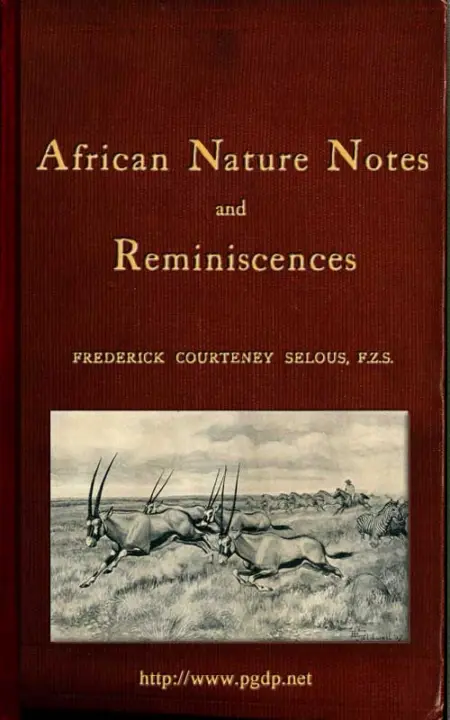
THE CLASSIC COLLECTION · 1908
"African Nature Notes and Reminiscences" by Frederick Courteney Selous is a natural history and observational account written in the early 20th century. The book documents the author's extensive experiences and insights into the wildlife of South Africa, particularly focusing on the natural behavior and characteristics of various big game animals. It blends personal anecdotes with scientific observations, offering a unique glimpse into a time when these interactions were thriving." "The opening portion of the book introduces Selous's intentions and the influence behind his writing, particularly highlighting his conversations with President Theodore Roosevelt, who encouraged him to publish his notes. It explains how the chapters consist of previously written articles and how Selous aims to broaden the understanding of African wildlife beyond mere hunting narratives. The introductory remarks focus on the importance of accurate observation in natural history and the value of firsthand experiences in recounting the lives of the majestic creatures inhabiting the African wilderness."
Introduction adapted from the source catalogue; source summaries may be automatically generated.
Free to read · English · 121,418 words · No account needed
MAKE TIME FOR A GOOD BOOK
On by default. Untick to stop anonymous reading totals. Each page counts after 10 seconds in view. How this works.
Anonymous counting is on unless you have switched it off.
PLATE SHOWING DIFFERENCES IN THE DEVELOPMENT OF THE MANE IN LIONS INHABITING A COMPARATIVELY SMALL AREA OF COUNTRY IN SOUTH AFRICA.
The skins from which these figures have been drawn are all in the
possession of the Author, and are all three those of fully adult
animals.
The African lion appears to be more gregarious than any other of the Felidae, and the male is certainly addicted to polygamy. Often a lion or a lioness may live and hunt for a time by itself, and very old animals are probably always solitary, as an old lion would be driven away from the females by younger males, and an old female would probably be badly treated by younger animals of both sexes. Sometimes two or even three males will hunt together for a time. More often a male lion may be met with accompanied by from one to four females, some of which latter may be followed by cubs of different ages and sizes. A family party consisting of one old male lion, three or four adult females, and several cubs, some of which may stand almost as high at the shoulder as their mothers, would constitute what the old Boer hunters would have called "en trop leeuws" (a troop of lions). In parts of Africa where game is, or was, very abundant, there are many authentic records of over twenty lions having been seen together. In his article on "The Lion," published in the Badminton Library Series, Mr. F. J. Jackson, C.B., has noted the fact that on August 7, 1890, he and Dr. Mackinnon came across a troop of twenty-three lions near Machakos in East Africa. This troop consisted of three male lions with splendid dark manes, five or six lionesses, and the rest cubs. I have come to the conclusion that such large assemblages of lions as this, in which there are several full-grown males, are, in all probability, only of a very temporary nature, the chance meeting and fraternisation of several families which, as a rule, live and hunt apart; since I believe that the passions of love and jealousy would not allow two or more males to live permanently in the company of lionesses without fighting. When a troop of lions is met with, in which, besides a full-grown male and some females and small cubs, there are also one or two good-sized young males with small manes, I believe that they are the offspring of the old male and one or other of the adult females, and that they have lived and hunted with the troop since cubhood. Such young males are probably not driven away to hunt by themselves until they commence to aspire to the affections of one of the females of the party. In 1879 I encountered two pairs of male lions hunting in company in the Mababi country to the north of Lake N'gami. I shot the first pair, and should certainly have killed both the others had I only had a rifle and a few cartridges with me when I first saw them, as they were right out on an open plain from which the grass had been burnt, far away from the nearest bush, and I was riding the best hunting horse I ever possessed. The two lions which I shot were large and heavy, apparently just in their prime, and the other pair also appeared to be full-grown animals. Now the Masarwa Bushmen living near the Mababi plain--and these wild people are extraordinarily acute observers--declared that they knew both these pairs of lions well, and said that each pair were the cubs of one mother, and had been hunting together since cubhood. Curiously enough, in the case of both these pairs of lions the two animals living and hunting together differed from one another very much. In each case one was of a very dark colour all over, with a dark mane, whilst the body of the other was of a pale yellow, and it had scarcely any mane at all. A few days after encountering the second pair of lions, a friend and myself came upon two lionesses on the same open plain, both of which we shot. One of these lionesses was on the point of giving birth to three cubs, which we cut out of her womb. Two of these cubs were males, and they differed very much one from another in colour even before birth. One was very dark indeed, owing to the blackish tint of the tips of the hairs of its little fluffy coat. The other was of a reddish yellow. The fur of the female cub was also of a much lighter colour than in the dark male. Now I cannot but adhere to the opinion which I wrote down in my diary at the time, that these two male lion cubs would, had they lived, have grown up into animals differing very much in appearance one from the other. The dark cub would have become a dark-skinned, dark-maned lion, the lighter coloured one a yellow lion with probably very little mane.
Your reading position is saved on this browser. Take it to another device with a library code. Reading pages adapt to text, rather than matching a printed edition.
BEHIND THE BOOK
This eBook is for the use of anyone anywhere in the United States and most other parts of the world at no cost and with almost no restrictions whatsoever. You may copy it, give it away or re-use it under the terms of the Project Gutenberg License included with this eBook or online at www.gutenberg.org. If you are not located in the United States, you will have to check the laws of the country where you are located before using this eBook. Read the source licence.
The original source file, including credits and licence, is retained by this library. Request an original-format copy at no charge. Please include the book title and Project Gutenberg identifier #49270.
KEEP YOUR CURIOSITY GOING
Wilfrid Scawen Blunt
Wilfrid Scawen Blunt

E. W. (Edgar Watson) Howe
Cécile Tormay

Moritz Busch
John L. Ransom