
Sunshine and Storm in Rhodesia Being a Narrative of Events in Matabeleland Both Before and During the Recent Native Insurrection Up to the Date of the Disbandment of the Bulawayo Field Force
Frederick Courteney Selous
THE CLASSIC COLLECTION · 1908
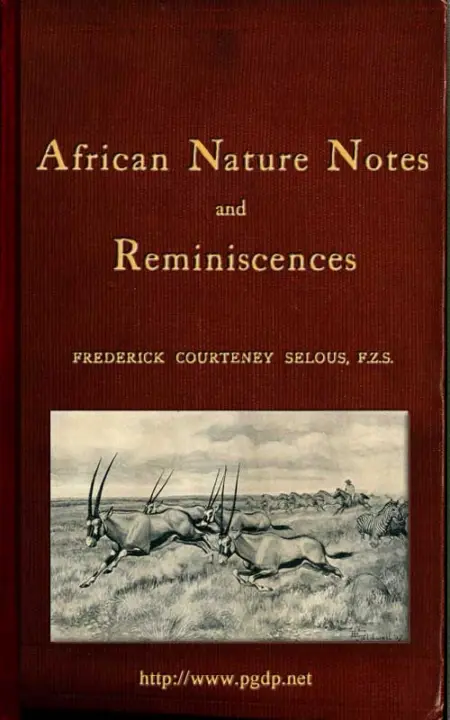
"African Nature Notes and Reminiscences" by Frederick Courteney Selous is a natural history and observational account written in the early 20th century. The book documents the author's extensive experiences and insights into the wildlife of South Africa, particularly focusing on the natural behavior and characteristics of various big game animals. It blends personal anecdotes with scientific observations, offering a unique glimpse into a time when these interactions were thriving." "The opening portion of the book introduces Selous's intentions and the influence behind his writing, particularly highlighting his conversations with President Theodore Roosevelt, who encouraged him to publish his notes. It explains how the chapters consist of previously written articles and how Selous aims to broaden the understanding of African wildlife beyond mere hunting narratives. The introductory remarks focus on the importance of accurate observation in natural history and the value of firsthand experiences in recounting the lives of the majestic creatures inhabiting the African wilderness."
Introduction adapted from the source catalogue; source summaries may be automatically generated.
Free to read · English · 121,418 words · No account needed
MAKE TIME FOR A GOOD BOOK
On by default. Untick to stop anonymous reading totals. Each page counts after 10 seconds in view. How this works.
Anonymous counting is on unless you have switched it off.
Though similar cases of lions becoming confirmed man-eaters when in the prime of life and still in the enjoyment of their full strength and vigour do from time to time occur--the celebrated Tsavo man-eaters which played such havoc amongst the construction camps on the Uganda Railway were reported to have been far from old--yet it cannot be denied that in the vast majority of cases a lion only takes to killing human beings in its declining years, and when its strength is failing.
On this subject, Dr. Livingstone wrote many years ago: "A man-eater is invariably an old lion, and when he overcomes his fear of man so far as to come to villages for goats, the people remark, 'His teeth are worn, he will soon kill men.' They at once acknowledge the necessity of instant action and turn out to kill him."
Speaking generally, nothing truer could have been written than these sentences; but there are exceptions to every rule, and when a strong and vigorous lion does take to preying upon human beings, it is naturally not so easy to hunt down and destroy as would be an old and weakly beast, whose "teeth are worn."
An adult male lion is probably possessed of greater strength in proportion to its size and weight than any other African animal. It will kill with astonishing ease and dexterity a full-grown buffalo cow or the heaviest bullock, and probably sometimes a buffalo bull or a giraffe. I never remember, however, to have seen the carcase of an old buffalo bull that had palpably been killed by a single lion, whilst I have shot several buffalo bulls that had escaped from lions after receiving very severe wounds from their teeth and claws. I once had a very good opportunity of noting the manner in which a big male lion killed a heavy ox, which would certainly have scaled more than twice its own weight. This ox was killed during the night, but as the lion was immediately driven from the carcase, it had no time to inflict any wound upon it other than those made when it first seized its victim, and the ground being soft from recent rain, every step taken by both the ox and the lion during the brief struggle was plainly visible. The lion had evidently crept close up to where the ox was lying (within forty yards of my waggon), and had either attacked it where it lay or just as it was rising to its feet. It had not jumped upon its victim, but throughout the struggle had always kept its hind-feet on the ground. The only wounds that had been inflicted on the ox were claw-marks on the nose and on the top of the left shoulder-blade, and the lion had evidently seized it by the muzzle with its left paw and on the top of the shoulder with the right, and had simply held it, pulling its head in towards its chest. The ox had plunged forward, dragging the lion with it for a few yards, and had then fallen with its head twisted right under it and its neck dislocated. Whether the lion had broken the ox's neck by its own strength, or whether the dislocation was due to the way in which it fell with its head twisted in under it, I cannot say; but my experience is that when a single lion tries to kill an ox or a buffalo, it invariably seizes it over the muzzle with one paw, and usually succeeds in either breaking its victim's neck or causing it to break it itself by its own weight in falling. When several lions attack an ox or buffalo, they will often bite and tear it all over and take a long time to kill it. Upon several occasions I have listened to the protracted bellowing of buffaloes being thus mauled to death. Upon one occasion a party of five lions stampeded my oxen as they lay round the waggon, and very soon seized and pulled down one of them. The wretched creature bellowed most fearfully, and must have been suffering terribly. Hastily lighting torches of long dry grass, several of my Kafirs and I ran to help it. The blazing grass scared the lions off, and they left the ox before the light of the torches reached them. The wounded animal immediately got up and rushed off again into the darkness, but had not gone far before its loud bellowing told us the lions had got hold of it once more. They took some time to kill it, but its agonised bellowings gradually died away in low moans, until at length all was again quiet. During the approach of these five lions to my camp, and the subsequent chase and long-drawn-out killing of the ox, not one of them made the slightest sound; and as far as my own personal experience goes, with one exception, whenever lions have reconnoitred or attacked my camp at night, and bitten or killed any of my native followers or cattle or horses, they have done all their stalking and killing without making a sound. If disturbed, however, they always growl loudly. On the occasion I have referred to as an exception to this rule, three lions--as we learnt the next morning by the spoor--came quite close up to my bivouac one night in Northern Mashunaland, and one of them gave a very loud roar which woke us all up. I was travelling at the time with a small cart and eight oxen, which were tied to the yokes, and were right in the open, unprotected either by fires or any kind of kraal or fence. My two horses were tied to one of the wheels, and my few native servants and myself were lying close to them, with a small fence of soft bush behind us. The three lions that came so near us in the night could not have been very hungry, or they would assuredly have seized one of my oxen. Perhaps the one that so suddenly roared only did so with the idea of frightening the oxen, and if one of them had broken the raw hide thong with which it was fastened to the yoke, and run off away from our camp, all three of them would very likely have pursued and killed it. Fortunately, neither my oxen nor my horses showed much fear on this occasion, and although the former pulled a bit, they did not break their thongs, and we soon quieted them and then built up some big fires. The lions passed on up the little river near which we were camped, and before long began to roar loudly, a pretty good sign, I think, that they had already dined and were not hunting. Why, when a family of four or five lions are hunting together, one of their number being an old male, they should kill an ox so much less artistically than the old male would have done, if he had been alone, I do not know. Possibly the eagerness of each member of the party renders a scientific attack by any one of them impossible, or perhaps the older lions allow the younger ones to do the killing for practice. There is no doubt, I think, that lions know that the head, throat, and the back of the neck are the most vital spots in all animals on which they prey. Human beings are nearly always seized by the head or neck; horses, donkeys, and zebras are almost invariably killed by bites in the back of the neck just behind the ears, or by bites in the throat; whilst they either dislocate the necks of heavy animals like buffaloes, or hold them in such a way that they can hardly help falling and breaking their own necks. The lion which broke the neck of one of my oxen, as I have described above, escaped punishment when it returned to the carcase the following evening owing to my rifle missing fire. It then visited a mining camp close at hand, and forcing its way into an enclosure in which there were fourteen sheep and goats and one calf, it killed every one of these unfortunate animals. I shot this lion early the following morning and then examined its victims. Every one of them, the calf as well as the sheep and goats, had been killed by a single bite in the head. In each case the upper canine teeth had been driven through the top of the skull or the back of the neck just behind the ears. I once came on a young elephant only a few minutes after it had been killed by a lion. The only wounds I could find were deep tooth-marks in the throat.
Your reading position is saved on this browser. Take it to another device with a library code. Reading pages adapt to text, rather than matching a printed edition.
BEHIND THE BOOK
This eBook is for the use of anyone anywhere in the United States and most other parts of the world at no cost and with almost no restrictions whatsoever. You may copy it, give it away or re-use it under the terms of the Project Gutenberg License included with this eBook or online at www.gutenberg.org. If you are not located in the United States, you will have to check the laws of the country where you are located before using this eBook. Read the source licence.
The original source file, including credits and licence, is retained by this library. Request an original-format copy at no charge. Please include the book title and Project Gutenberg identifier #49270.
KEEP YOUR CURIOSITY GOING
Wilfrid Scawen Blunt
Wilfrid Scawen Blunt

E. W. (Edgar Watson) Howe
Cécile Tormay

Moritz Busch
John L. Ransom