Sunshine and Storm in Rhodesia Being a Narrative of Events in Matabeleland Both Before and During the Recent Native Insurrection Up to the Date of the Disbandment of the Bulawayo Field Force
Frederick Courteney Selous
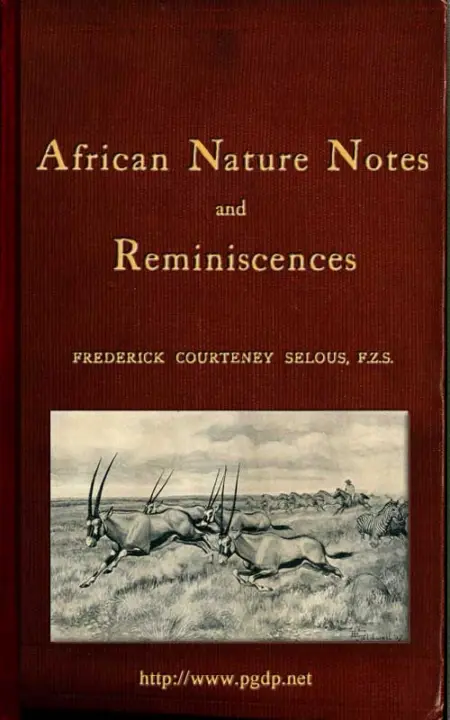
THE CLASSIC COLLECTION · 1908
"African Nature Notes and Reminiscences" by Frederick Courteney Selous is a natural history and observational account written in the early 20th century. The book documents the author's extensive experiences and insights into the wildlife of South Africa, particularly focusing on the natural behavior and characteristics of various big game animals. It blends personal anecdotes with scientific observations, offering a unique glimpse into a time when these interactions were thriving." "The opening portion of the book introduces Selous's intentions and the influence behind his writing, particularly highlighting his conversations with President Theodore Roosevelt, who encouraged him to publish his notes. It explains how the chapters consist of previously written articles and how Selous aims to broaden the understanding of African wildlife beyond mere hunting narratives. The introductory remarks focus on the importance of accurate observation in natural history and the value of firsthand experiences in recounting the lives of the majestic creatures inhabiting the African wilderness."
Introduction adapted from the source catalogue; source summaries may be automatically generated.
Free to read · English · 121,418 words · No account needed
MAKE TIME FOR A GOOD BOOK
On by default. Untick to stop anonymous reading totals. Each page counts after 10 seconds in view. How this works.
Anonymous counting is on unless you have switched it off.
Koch, Dr., and the epidemic of rinderpest, 137
Koodoo, description of a, 30;
keen sense of hearing of the, 30;
hunted by wild dogs, 121
Koranas, language of the, 336
Languages spoken in South Africa, 332, 333
Large Game and Natural History of South and South-East Africa, The, by Hon. W. H, Drummond, 224
Lebombo range, buffaloes killed off below the, 153
Leopards, hunters of antelopes, 33;
young giraffe hunted by, 219
Leshuma, water-hole at, 122;
no tse-tse flies near, 157
Le Vaillant, buffaloes seen by, on the Orange river, 1783, 136
Libèbè's, road from Denukani to, 162
Limpopo valley, Burchell's zebras plentiful in, 21;
tse-tse flies in, 1871, 152, 166
Linquasi river, 112
Linyanti, chief town of the Makololo, 164
Lion, demeanour of a watching, 17;
hunting strategy of the, 20, 60, 69;
African names of the, 45;
his usual way of catching his prey, 48, 70;
poisonous nature of his bite, 49, 71, 263;
death of Mr. Ryall, killed by a man-eater, 50;
the Majili man-eater, 54-59;
his favourite food, 64;
his manner of entering a cattle kraal, 68;
colour of his eyes, 73;
likeness of a stalking, to a stalking cat, 75;
mane of a, 78;
length of hair of a, 80;
first evolved in a cold climate, 83;
his cleverness as a butcher, 85;
his roar, 89
"Lion, The," Jackson's article on the trouping of lions, 77
Lions, Colonel Patterson and the man-eaters, 49;
classification of, 78;
killed with poisoned arrows by Bushmen, 94;
the author's ill-luck with the two, 279 f.;
last of the thirty-one killed by the author, 307 ff.
Livingstone, Dr., his opinion on man-eaters, 60;
his visit to Sebitwane, 1853, 163;
his remarks on the tse-tse fly, 167;
on the Bushmen, 338
Livingstone search expedition, commanded by Lieutenant Young, 1866,
227
Lo Bengula, his account of the tse-tse fly's disappearance, 163;
King of the Matabele, 270
Locusts in Matuta, 231;
in South Central Africa, 1890, 234
Lo Magondi's kraal, 48
Longman, Zulu guide of the author, 233
Lotchi, head Enduna of Induba, convicted of witchcraft, 105
Lourenço Marques, Delagoa Bay, 253
Lydekker, R., his classification of lions, 78
Mababi plain, 78;
river, 136
Machabi river, an overflow from the Okavango, 136
Mackinnon, Dr., and the troop of lions, 77
Maclear, Cape, inyala shot near, by Capt. Faulkner, 1866, 227
Macloutsie river, buffaloes plentiful along the, 152
Maghaliquain river, game found along the, 1886, 152
Majili river, a tributary of the Zambesi, 54
Makari-kari, rock salt found at, 264
Makololo, Mission sent to, 164
Mammals of India, by Jerdon, on hunting chetahs, 128
Mandy, Frank, and the old slave given to the hyænas, 104
Man-Eaters of Tsavo, The, by Colonel Patterson, 49
Manes, lions', differences between, 78
Manicaland, rock-paintings in, 336
Maputa river, formed by the Pongolo and the Usutu, 230
Marico river, 136
Masarwa, or Maseroa, name given by Khama's people to Bushmen, 330
Mashunaland, troubles caused by lions in, 1890, 67;
rock-paintings in, 336
Matabele, courage of the, in attacking lions, 93;
Umziligazi, founder of the nation, 162
Matabeleland, fate of witches in, 107;
Lo Bengula, King of, 270
Matuta, locusts in, 231
Meat, hyæna flesh considered a choice, by Khama's people, 117
Your reading position is saved on this browser. Take it to another device with a library code. Reading pages adapt to text, rather than matching a printed edition.
BEHIND THE BOOK
This eBook is for the use of anyone anywhere in the United States and most other parts of the world at no cost and with almost no restrictions whatsoever. You may copy it, give it away or re-use it under the terms of the Project Gutenberg License included with this eBook or online at www.gutenberg.org. If you are not located in the United States, you will have to check the laws of the country where you are located before using this eBook. Read the source licence.
The original source file, including credits and licence, is retained by this library. Request an original-format copy at no charge. Please include the book title and Project Gutenberg identifier #49270.
KEEP YOUR CURIOSITY GOING
Wilfrid Scawen Blunt
Wilfrid Scawen Blunt

E. W. (Edgar Watson) Howe
Cécile Tormay

Moritz Busch
John L. Ransom