Sunshine and Storm in Rhodesia Being a Narrative of Events in Matabeleland Both Before and During the Recent Native Insurrection Up to the Date of the Disbandment of the Bulawayo Field Force
Frederick Courteney Selous
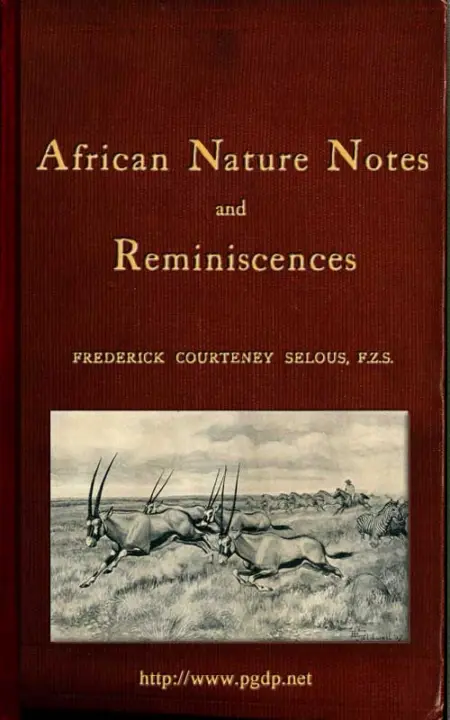
THE CLASSIC COLLECTION · 1908
"African Nature Notes and Reminiscences" by Frederick Courteney Selous is a natural history and observational account written in the early 20th century. The book documents the author's extensive experiences and insights into the wildlife of South Africa, particularly focusing on the natural behavior and characteristics of various big game animals. It blends personal anecdotes with scientific observations, offering a unique glimpse into a time when these interactions were thriving." "The opening portion of the book introduces Selous's intentions and the influence behind his writing, particularly highlighting his conversations with President Theodore Roosevelt, who encouraged him to publish his notes. It explains how the chapters consist of previously written articles and how Selous aims to broaden the understanding of African wildlife beyond mere hunting narratives. The introductory remarks focus on the importance of accurate observation in natural history and the value of firsthand experiences in recounting the lives of the majestic creatures inhabiting the African wilderness."
Introduction adapted from the source catalogue; source summaries may be automatically generated.
Free to read · English · 121,418 words · No account needed
MAKE TIME FOR A GOOD BOOK
On by default. Untick to stop anonymous reading totals. Each page counts after 10 seconds in view. How this works.
Anonymous counting is on unless you have switched it off.
My gaunt and hungry guides seemed greatly excited over their find, and each of them in turn held it up and shook it close to his ear. Then I saw they were going to break it, so I moved to one side, as I expected it would go off with a loud explosion. It was, however, long past that stage, all the contents of the egg having solidified into a thick brown-coloured paste at the one end. I never would have believed, if I had not experienced it, that so much smell could have been given off by so small an amount of matter. As I once heard an American lady remark of the atmosphere of a small mosque in which we had been watching some dancing Dervishes at Constantinople, it gave off "a poor odour"--one of the poorest, I think, I have ever encountered, in her sense of the word, though by many people it might have been thought too rich.
With the Bushmen, however, an egg in the hand was evidently considered to be worth more than a problematical animal in the bush, and they at once sat down, and taking turn and turn about, slowly and with evident relish licked up the fœtid contents of the treasure which fortune had thrown in their way. Up to this time we had not even seen the fresh track of a giraffe, but not long afterwards we sighted a magnificent old bull, which I managed to kill for them after a hard gallop through some very thick and thorny bush.
When I met with the first Bushmen I ever saw on the banks of the Orange river, in 1872, I was a very young man, and regarding them with some repugnance, wrote in my diary that they appeared to be very few steps removed from the brute creation. That was a very foolish and ignorant remark to make, and I have since found out that though Bushmen may possibly be to-day in the same backward state of material development and knowledge as once were the palæolithic ancestors of the most highly cultured European races in prehistoric times, yet fundamentally there is very little difference between the natures of primitive and civilised men, so that it is quite possible for a member of one of the more cultured races to live for a time quite happily and contentedly amongst beings who are often described as degraded savages, and from whom he is separated by thousands of years in all that is implied by the word "civilisation." I have hunted a great deal with Bushmen, and during 1884 I lived amongst these people continuously for several months together. On many and many a night I have slept in their encampments without even any Kafir attendants, and though I was entirely in their power, I always felt perfectly safe amongst them. As most of the men spoke Sechwana, I was able to converse with them, and found them very intelligent companions, full of knowledge concerning the habits of all the wild animals inhabiting the country in which they lived. I found the Bushmen very good-tempered people, and they are undoubtedly the best of all the natives of South Africa to have with one when in pursuit of game, as they are such wonderful trackers, and so intimately acquainted with the habits of every kind of wild animal. To be seen at their best they must be hungry, but not starving. They will then be capable of marvellous feats of endurance. I have known a Bushman run on elephant spoor in front of my horse for five hours, only very occasionally slowing down to a walk for a few minutes. He ran till it got dark, and as we had neither blankets nor food, which had been left with the Kafirs far behind, we lit a big fire, beside which we sat all night, not daring to lie down and sleep, for fear lest lions should kill my horse, which we had to watch whilst it fed round near the fire. When we took up the elephant tracks again the next morning, we had been twenty-four hours without food, and it was late in the afternoon before we were making a meal off elephant's heart. During the two days this Bushman must have walked and run for at least eighty miles without food or sleep, and he never showed the least sign of exhaustion. Living as they do in families or small communities, Bushmen have not developed any warlike qualities, and I cannot imagine any of them I have known being anxious "to seek the bubble glory at the cannon's mouth"; but for all that they are certainly more courageous with dangerous game than the generality of Kafirs. A friend of mine was once out looking for game on horseback, accompanied by a single Bushman. The Bushman, who was walking in front of the horse, suddenly spied a lion lying flat on the ground watching them, and less than fifty yards away. Raising his left hand as a sign to my friend to stop, he pointed at the crouching animal with his spear, at the same time retiring slowly backwards until he stood beside the horse. "Tauw ki-o" ("There is a lion"), he quietly said; but my friend for the life of him could not see it. The Bushman then again advanced, and taking the horse by the bridle, led it a few paces forwards, when his master at last saw the lion, and firing from the saddle, disabled it with the first shot, and finished it with a second. It was a fine big animal, but without much mane. My friend said it was the lion's eyes that he first saw, and then the twitching of its tail. He was very much pleased with the coolness and staunchness of the Bushman, quite a young man. Oh, if I had only had that Bushman for a gun-carrier on a certain day in 1877, when the most magnificently maned lion I ever saw in my life suddenly showed himself within twenty yards of me, and the wretched Makalaka who was carrying my rifle and was just behind me, instead of putting it into my outstretched hand, turned and ran off with it! Had I killed that lion, its skin would have been my trophy of trophies, but--kismet! it was not to be.
Your reading position is saved on this browser. Take it to another device with a library code. Reading pages adapt to text, rather than matching a printed edition.
BEHIND THE BOOK
This eBook is for the use of anyone anywhere in the United States and most other parts of the world at no cost and with almost no restrictions whatsoever. You may copy it, give it away or re-use it under the terms of the Project Gutenberg License included with this eBook or online at www.gutenberg.org. If you are not located in the United States, you will have to check the laws of the country where you are located before using this eBook. Read the source licence.
The original source file, including credits and licence, is retained by this library. Request an original-format copy at no charge. Please include the book title and Project Gutenberg identifier #49270.
KEEP YOUR CURIOSITY GOING
Wilfrid Scawen Blunt
Wilfrid Scawen Blunt

E. W. (Edgar Watson) Howe
Cécile Tormay

Moritz Busch
John L. Ransom