Sunshine and Storm in Rhodesia Being a Narrative of Events in Matabeleland Both Before and During the Recent Native Insurrection Up to the Date of the Disbandment of the Bulawayo Field Force
Frederick Courteney Selous
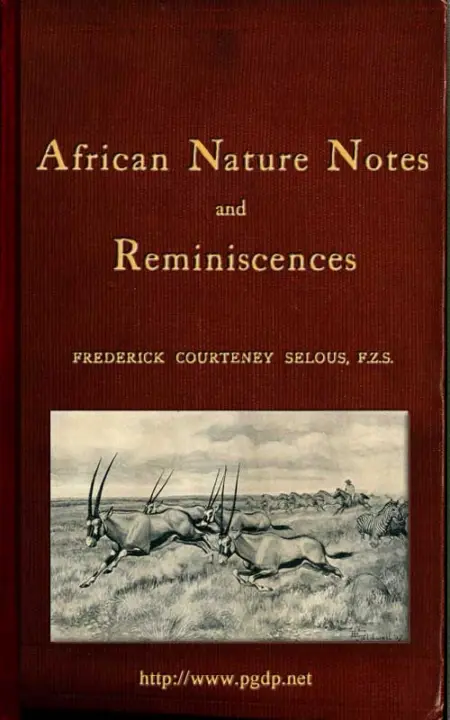
THE CLASSIC COLLECTION · 1908
"African Nature Notes and Reminiscences" by Frederick Courteney Selous is a natural history and observational account written in the early 20th century. The book documents the author's extensive experiences and insights into the wildlife of South Africa, particularly focusing on the natural behavior and characteristics of various big game animals. It blends personal anecdotes with scientific observations, offering a unique glimpse into a time when these interactions were thriving." "The opening portion of the book introduces Selous's intentions and the influence behind his writing, particularly highlighting his conversations with President Theodore Roosevelt, who encouraged him to publish his notes. It explains how the chapters consist of previously written articles and how Selous aims to broaden the understanding of African wildlife beyond mere hunting narratives. The introductory remarks focus on the importance of accurate observation in natural history and the value of firsthand experiences in recounting the lives of the majestic creatures inhabiting the African wilderness."
Introduction adapted from the source catalogue; source summaries may be automatically generated.
Free to read · English · 121,418 words · No account needed
MAKE TIME FOR A GOOD BOOK
On by default. Untick to stop anonymous reading totals. Each page counts after 10 seconds in view. How this works.
Anonymous counting is on unless you have switched it off.
As the report of the rifle sounded, he plunged madly forward, and was instantly lost to sight in the thick scrub. But I felt sure he carried death with him; and so it proved, for we found him lying dead not twenty yards from where he had stood when the bullet struck him. The fatal missile had passed right through his shoulders, and having expanded on impact, had torn his heart to pieces. I had the dead female brought to where the male had fallen, and laid them side by side; then stood admiring them for a long time before I could bring myself to skin them. To thus secure a very handsome pair of inyala antelopes--whose excellently mounted skins are now safe in the Mammalian Gallery of the Natural History Museum at South Kensington--on the very first day I had ever hunted for them, and after little more than an hour's search--was indeed a most glorious and exceptional piece of good fortune, which, however, has been balanced by many and many a day that I can remember of unrequited labour in search of game.
I think I had here better give Mr. Angas's very careful descriptions of the inyala antelope, male and female, as they are so detailed and precise that they cannot be improved upon--except that, for a reason which I shall refer to presently, I imagine that the male whose skin he described could not have been fully adult.
Mr. Angas tells us that his notes "were drawn up from recently killed specimens which he in vain attempted to purchase from the Boers who possessed them," and are as follows: "The adult male is about 7 feet 6 inches in total length, and 3 feet 4 inches high at the shoulder. Though elegant in form, and with much of the grace of the solitary koodoo, the robust and shaggy aspect of the male bears considerable resemblance to that of the goat. Legs clean, hoofs pointed and black, with two oval cream-coloured spots in front of each fetlock, immediately above the hoof. Horns of the specimen in question, 1 foot 10 inches long,[18] twisted and sublyrate, very similar to those of the bushbuck, but rather more spiral; very sharp polished extremities of a pale straw colour, rest of horns brownish black, deeply ridged from the forehead to about half the length of the horn. Prevailing colour, greyish black, tinged with purplish brown and ochre; on the neck, flanks, and cheeks marked with several white stripes like the koodoo. Forehead brilliant sienna brown, almost approaching to orange; mane black down the neck, and white from the withers to the insertion of the tail; ears, 8 inches long, oval, rufous, tipped with black, and fringed inside with white hairs. A pale ochreous circle round the eyes, which are connected by two white spots, forming an arrow-shaped mark on a black ground; nose black; a white spot on each side of the upper lip; chin and gullet white; and three white marks under each eye; neck covered with long shaggy hair, extending also under the belly and fringing the haunches to the knees; two white spots on the flanks, and a patch of long white hair on the interior portion of the thigh; a white tuft under the belly, and another on the dewlap. On the outer side of the forelegs is a black patch above the knee surrounded by three white spots; legs below the knee bright rufous colour; tail, 1 foot 8 inches long, black above, with tip and inside white." This most detailed description is, I think, that of an animal not fully adult, as in the three full-grown male inyalas which I saw in the flesh all the buff, ochreous, and orange tints described by Mr. Angas had turned to greyish black, except to a slight extent below the knees, whilst none of them had any white stripes on the cheeks or neck; and, as the general ground colour of the young male is reddish brown, and that of a full-grown male greyish black, it goes without saying that, as the young animal grows from kidhood to maturity, the former colour gradually gives place to the latter--till, in a very old male, there is no buff or ochre left except on the legs below the knees. Of the female, Mr. Angas's description is as follows: "Smaller than the male, and without horns; total length, 6 feet; nose, to insertion of ear, 10 inches; length of ear, 6-1/2 inches; height from forefoot to shoulder, 2 feet 9 inches; tail, 1 foot 3 inches in length; becoming very pale on the belly and lower parts and white inside the thighs; a black dorsal ridge of bristly hair extends from the back of the crown to the tail; nose black; the white spots on various parts of the body nearly resembling those of the male, only the white stripes on both sides are more numerous and clearly defined, amounting to twelve or thirteen in number; tail, rufous above and white below, tipped with black."
Your reading position is saved on this browser. Take it to another device with a library code. Reading pages adapt to text, rather than matching a printed edition.
BEHIND THE BOOK
This eBook is for the use of anyone anywhere in the United States and most other parts of the world at no cost and with almost no restrictions whatsoever. You may copy it, give it away or re-use it under the terms of the Project Gutenberg License included with this eBook or online at www.gutenberg.org. If you are not located in the United States, you will have to check the laws of the country where you are located before using this eBook. Read the source licence.
The original source file, including credits and licence, is retained by this library. Request an original-format copy at no charge. Please include the book title and Project Gutenberg identifier #49270.
KEEP YOUR CURIOSITY GOING
Wilfrid Scawen Blunt
Wilfrid Scawen Blunt

E. W. (Edgar Watson) Howe
Cécile Tormay

Moritz Busch
John L. Ransom