
The Dance of Life
Havelock Ellis
THE CLASSIC COLLECTION · 1898
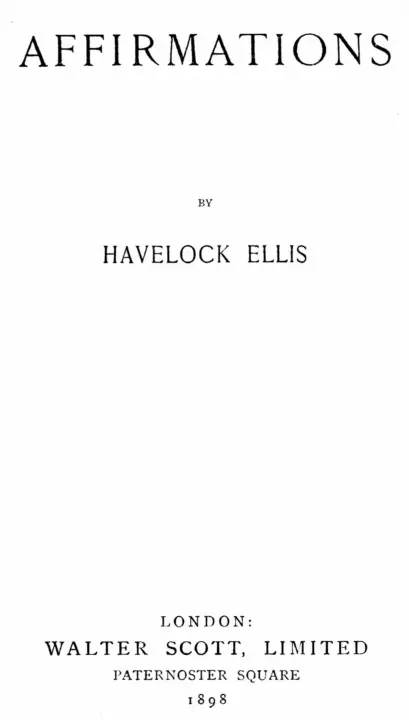
"Affirmations" by Havelock Ellis is a collection of literary-critical essays written in the late 19th century. It uses writers and saints as occasions for probing the “literature of life,” testing moral ideas and cultural assumptions rather than judging art for art’s sake. The pieces engage the most questionable aspects of conduct and belief to state a few enduring “affirmations,” while pressing readers to form their own. The opening of the work presents a preface and a long study of Nietzsche. Ellis contrasts a pure art-literature that raises no ethical questions with a literature close to life where morality must be examined, and he announces his intent to offer personal affirmations against the era’s self-congratulation. He then traces Nietzsche’s career—ancestry and austere youth, Pforta training, early devotion to Schopenhauer and Wagner, rise as a philologist, The Birth of Tragedy, the Bayreuth crisis and break with Wagner amid worsening health, the freethinking aphoristic middle period, the later “immoralist” doctrines, and the final mental collapse. Along the way he distils Nietzsche’s key ideas: Dionysian affirmation, the attack on Christianity and pity, conscience as tradition, the call to hardness and self-mastery, and the contrast between “slave” and “master” moralities, set against sharp national judgments and admiration for French clarity. He closes this opening section by valuing the middle Nietzsche most, proposing the dancer as his guiding image, and treating philosophy as personal psychology rather than a universal system.
Introduction adapted from the source catalogue; source summaries may be automatically generated.
Free to read · English · 61,622 words · No account needed
MAKE TIME FOR A GOOD BOOK
On by default. Untick to stop anonymous reading totals. Each page counts after 10 seconds in view. How this works.
Anonymous counting is on unless you have switched it off.
So far we have been developing the modern applications of that spirit of simplicity--of sincere and natural asceticism--which was a chief part of the secret of the Umbrian saint’s charm. Francis--as in an earlier age the great Cynics of Greece, and in a later age the New England transcendentalists--enables us to see that asceticism is a natural instinct; he knew that so far from being an effort to crush the body it was an effort to give elation and freedom to the body--Gaude, frater corpus!--and that so far from being an appeal to sorrow it was a perpetual appeal to joy. Let us throw aside the useless burdens of life, he seems to say, the things that oppress body and mind,--care and wealth and learning and books,--that thus we may become free to concentrate ourselves on the natural things of the world, attaining therein the joy of living. That was the simplicity of Francis. There is another vaguer and subtler aspect of his personality which may be expressed by the allied word purity. I mean that clearness and perfect crystalline transparency symbolised by water, in which it has its source. That Francis, with all his fine natural instincts, fully realised all the implications of purity, either on its physical or its spiritual sides, one may well doubt. Purity has never been a great Christian virtue, though ever greatly talked about in Christendom; and while the reliance of Francis on instinct carried him far beyond the age and the faith in which he lived, his indifference to the intellectual grip of things which was part of that natural instinct caused him to be often swayed by the conventions and traditions around him.
It has been well said that purity--which in the last analysis is physical cleanness--is the final result of evolution after which Nature is ever striving. When she had attained to the production of naked savage man, a creature no longer encumbered with the care of his fur but freely and constantly bathed by the elements, the perfection of purity was attained. With the wearing of clothes dirt was again brought into the world; and so-called civilised man--except when he possesses leisure for prolonged attention to his person and his clothes--is once more brought to the level of the lower animals, indeed below them, for few animals spend so little time and trouble in attaining cleanliness as garmented man. Pagan classic times, no doubt, cherished a cult of the body which involved a high regard for physical purity. That is the very reason why such purity has never been a Christian or modern virtue. The early Church, feeling profound antagonism to the vices which in classic times were associated with the bath, from the outset frequently denied that there was any need for cleanliness at all. Even so cultured a Christian as Clement of Alexandria would only admit that women should be clean; it was not necessary for men; “the bath is to be taken by women for cleanliness and health, by men for health alone;” in later days the hatred of cleanliness often became quite whole-hearted. Thus it happens that throughout Europe and wherever the influence of Christianity has spread there has been on the whole an indifference to dirt, which is indeed not uncommonly found among degraded peoples untouched by Christianity, but is certainly nowhere else found in association with a grade of culture in most other matters so high. To the Roman the rites of the bath formed one of the very chief occupations of life, and to this race it has happened, as probably to no other ancient race, that their baths have often survived their temples; Rome holds no more memorable relic than the Baths of Caracalla. For the Mohammedan the love of water is part of religion, and the energy and skill with which in its prime Islamic civilisation exploited the free and beautiful use of water, are still to be traced throughout southern Spain. In the fine civilisation of Japan, again, the pursuit of physical purity has ever been a simple and unashamed public duty, and “a Japanese crowd,” says Professor Chamberlain, “is the sweetest in the world.” How different things are in Christendom one need not insist.
Your reading position is saved on this browser. Take it to another device with a library code. Reading pages adapt to text, rather than matching a printed edition.
Havelock Ellis
Havelock Ellis
Havelock Ellis

Havelock Ellis
BEHIND THE BOOK
This eBook is for the use of anyone anywhere in the United States and most other parts of the world at no cost and with almost no restrictions whatsoever. You may copy it, give it away or re-use it under the terms of the Project Gutenberg License included with this eBook or online at www.gutenberg.org. If you are not located in the United States, you will have to check the laws of the country where you are located before using this eBook. Read the source licence.
The original source file, including credits and licence, is retained by this library. Request an original-format copy at no charge. Please include the book title and Project Gutenberg identifier #76076.
KEEP YOUR CURIOSITY GOING

David Patterson (Spirit) Hatch

David Patterson (Spirit) Hatch

David Patterson (Spirit) Hatch
Coulson Kernahan

Ralph Waldo Emerson

Maurice Baring