Verdi: Man and Musician His Biography with Especial Reference to His English Experiences
Frederick James Crowest
THE CLASSIC COLLECTION · 1880
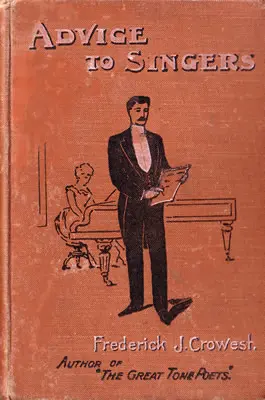
"Advice to Singers" by Frederick James Crowest is a guidebook for vocal training written in the early 20th century. The work focuses on the art and science of singing, emphasizing the importance of a teacher's guidance, healthy habits, and the nuances of vocal technique. The book aims to clear up misconceptions about singing, providing practical advice for both amateur and professional singers. At the start of the book, the author outlines the challenges present in learning to sing, asserting that proper training cannot be achieved solely through self-study or books. Crowest introduces the necessity for consistent practice and strong vocal habits, as well as the significance of addressing one’s health and lifestyle choices to enhance vocal performance. He stresses that a singer is not only a performer but must also understand the physiological aspects of their instrument—the voice—while simultaneously cultivating their artistic expression. The opening sets the tone for a comprehensive manual on singing that combines technique, style, and personal development.
Introduction adapted from the source catalogue; source summaries may be automatically generated.
Free to read · English · 32,199 words · No account needed
MAKE TIME FOR A GOOD BOOK
On by default. Untick to stop anonymous reading totals. Each page counts after 10 seconds in view. How this works.
Anonymous counting is on unless you have switched it off.
Exercise 3 may be timed 76 on your metronome. It is a study to give freedom and flexibility to your voice. None of the notes should be forced, and the upper notes should be rendered with the mouth well open, and with a quality of tone as similar as possible to that of the lower notes. Breath should be taken (without losing time) at the rest-marks. There should be no break or jump in the tone, but rather it should be one unbroken stream of melody, as marked in the first phrase. The voice, in this exercise, should be constantly moving: no sooner should you be sounding the first note of the phrase than you should be moving to the second, from the second to the next, and so on. Be careful to sing the intervals exactly in time, and in descending to notes satisfy yourself that you are singing the exact tone, and that with certainty. Indecision is a grave fault in singing.
[Music: Ex. 4. Intervals of thirds.
Do Re Mi Re Do Re Mi Fa Mi Re
Mi Fa Sol Fa Mi &c.]
[Music: Ex. 5. Intervals of Fourths.
* Here take breath.]
[Music]
[Music: Ex. 6. Intervals of Fifths.]
[Music: Ex. 7. Intervals of Sixths.]
[Music: Ex. 8. Intervals of Sevenths.]
Page
Alto, 36
Bad Lessons, 50
Bad Masters, 50
Ballads, 80
Barytone, Basso-Cantante, 42
Bass, 44
Board Teachers' Laryngitis, 114
Books of Exercises, 51
Buffo, 48
Cathedral School, The, 72
Chest, Falsetto, and Head, 60
Chorus Singing, 69
Cleanliness, 13
Clearing the Throat, 59
Compass, 30
Consonants, 24
Contralto, 35
Decision, 84
Diet, 13
Dramatic Study, 27
Dress, 16
Duration of Practice, 67
Early Rising, 13
Education, General, 26
Emphasis, 25
English, 24
Execution, 105
Exercise, 15
Exercises, 115
Exercises, First, 62
" Books of, 51
" in Beating Time, 89
Expression, Facial, 54
Facial Expression, 54
Falsetto, 60
Fashion, 106
First Opinion, A, 44
Forming a Repertoire, 107
Forte, Mezzo-Voce, and Piano, 60
General Education, 26
" Musical Study, 70
German Lieder, Modern, 71
Hair, The, 14
Head, Singing in the, 58
High Notes, 59
"Holding" an Audience, 86
"How to Begin", 68
Humming, 69
Imitation, 70, 85
Individuality, 53
Institutions, 48
Larynx, The, 109
Late Hours, 19
Lessons, Bad, 50
Lips, Position of, 25
Masters, 48
Mezzo-Voce, 60
Mezzo-Contralto, 35
Mezzo-Soprano, 34
Mistakes in Public, 86
Modern German Lieder, 71
Morality, 19
Music to Suit the Voice, 103
Musical Study, General, 70
Names of Voices, 29
Nervousness, 21
Oratorio, 73
"Original Keys", 104
Opera, 79
Perseverance, 54
Physiological Surroundings, 109
Pharynx, The, 111
Position of Arms, 55
" Body, 55
" Hands, 56
" Larynx, 57
" Throat, 56
" Tongue, 57
Pronunciation, 22
Public Singing, 85
Public, Mistakes in, 86
Qualities of the Voice, 45
Recitative, 81
Repertoire, Forming a, 107
Scale, The, 60
" Practice, 62
"Schools" of Singing, 47
Self-Accompaniment, 55
Sentiment, 84
Singing in Tune, 67
Slurring, 83
Smoking, 18
Soprano, 32
Study of Songs, 20
Study of Words, 25
Styles, Traditional, 71
Teachers, Bad, 50
Teeth, The, 15
Tenore-Leggiero, 37
Tenore-Robusto, 39
Throatiness, 58
Thyroid, The, 110
Time in Singing, 87
Tone, 60
Traditional Styles, 71
Variety Indispensable, 68
Voices and their Names, 29
Voice, The; A Wind, Reed, or String Instrument, 111
Vowel-Sounds, 23
"Words," Study of, 25
Printed by BALLANTYNE, HANSON & CO.
London & Edinburgh
Transcriber's note:
Punctuation and formatting have been made consistent.
Apparent printer's errors have been retained, unless stated below.
Your reading position is saved on this browser. Take it to another device with a library code. Reading pages adapt to text, rather than matching a printed edition.
BEHIND THE BOOK
This eBook is for the use of anyone anywhere in the United States and most other parts of the world at no cost and with almost no restrictions whatsoever. You may copy it, give it away or re-use it under the terms of the Project Gutenberg License included with this eBook or online at www.gutenberg.org. If you are not located in the United States, you will have to check the laws of the country where you are located before using this eBook. Read the source licence.
The original source file, including credits and licence, is retained by this library. Request an original-format copy at no charge. Please include the book title and Project Gutenberg identifier #41013.
KEEP YOUR CURIOSITY GOING

Charles G. (Charles Griffith) Ross
Hannah Webster Foster

Emily Lawless
Edwin Hamlin Carr

Charles De Lano Hine
Andrew Ure