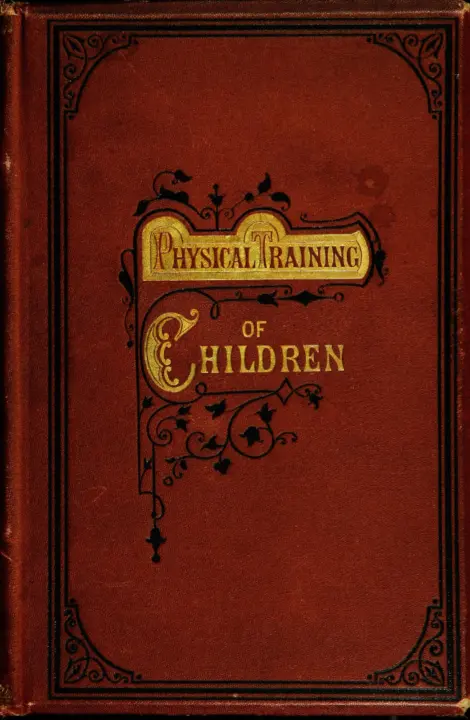
The Physical Training of Children
Pye Henry Chavasse
THE CLASSIC COLLECTION · 1881
"Advice to a Wife and Mother" by Pye Henry Chavasse is a health and wellness guide written in the late 19th century. This work addresses the physical and mental health of women, particularly focusing on the crucial roles of wives and mothers in maintaining their own well-being and that of their children. Chavasse provides practical advice on topics such as diet, exercise, abstaining from stimulants, and early rising, all aimed at fostering a healthier lifestyle conducive to motherhood. The opening of the book presents a preamble to the author's guidance, where he acknowledges the alarming number of women suffering from health issues and barrenness. Chavasse emphasizes the importance of proactive health management and outlines several critical areas needing attention, including the impact of traditional societal norms on women's health. He criticizes the fashionable lifestyle of his time and urges young wives to adopt healthier habits, proposing that many ailments can be prevented or improved through simple lifestyle changes. The introductory chapter serves as a clarion call for women to value their health in order to fulfill their roles as nurturing mothers.
Introduction adapted from the source catalogue; source summaries may be automatically generated.
Free to read · English · 186,058 words · No account needed
MAKE TIME FOR A GOOD BOOK
On by default. Untick to stop anonymous reading totals. Each page counts after 10 seconds in view. How this works.
Anonymous counting is on unless you have switched it off.
One frequent, if not the most frequent, cause of tape-worm is the eating of pork, more especially if it be underdone. Underdone pork is the most unwholesome food that can be eaten, and is the most frequent cause of tape-worm known. Underdone beef also gives tape-worm; let the meat, therefore, be well and properly cooked. These facts ought to be borne in mind, as prevention is always better than cure.
Footnote 263:
The Grocer.
Footnote 264:
Shakspeare.
Footnote 265:
Tennyson.
Footnote 266:
Every house where there are children ought to have one of these india-rubber hot water bottles. It may be procured at any respectable vulcanized india-rubber warehouse.
Footnote 267:
South’s Household Surgery.
Footnote 268:
“It has been computed that upwards of 1000 children are annually burned to death by accident in England.”
Footnote 269:
The cotton wool here recommended is that purposely made for surgeons, and is of a superior quality to that in general use.
Footnote 270:
If there be no other lard in the house but lard with salt, the salt may be readily removed by washing the lard in cold water. Prepared lard—that is to say, lard without salt—can, at any moment, be procured from the nearest druggist in the neighborhood.
Footnote 271:
See the Lancet for October 10th, 17th, and 24th, 1840.
Footnote 272:
A stick of pointed nitrate of silver, in a case, ready for use, may be procured of any respectable chemist.
Footnote 273:
Which may be instantly procured of a druggist, as he always keeps it
ready prepared.
Footnote 274:
A Bee-master. The Times, July 28, 1864.
Footnote 275:
Shaw’s Medical Remembrancer, by Hutchinson.
Footnote 276:
A tepid bath from 62 to 96 degrees of Fahrenheit.
Footnote 277:
A warm bath from 97 to 100 degrees of Fahrenheit.
Footnote 278:
Health. By John Brown, M.D. Edinburgh: Alexander Strahan & Co.
Footnote 279:
Several years ago, while prosecuting my anatomical studies in London University College Dissecting-rooms, on opening a young woman, I discovered an immense indentation of the liver large enough to admit a rolling-pin, entirely produced by tight lacing!
Footnote 280:
Dryden.
Footnote 281:
Sir W. Temple.
Footnote 282:
Goldsmith’s Essays.
Footnote 283:
Geoffry Hamlyn. By H. Kingsley.
Footnote 284:
Proverbs, xx. 29.
Footnote 285:
“I would have given him, Captain Fleming, had he been my son,” quoth old Pearson the elder, “such a good sound drubbing as he never would have forgotten—never!”
“Pooh! pooh! my good sir. Don’t tell me. Never saw flogging in the navy do good. Kept down brutes; never made a man yet.”—Dr. Norman Macleod in Good Words, May, 1861.
Footnote 286:
The Birmingham Journal.
Footnote 287:
A Woman’s Thoughts about Women.
Footnote 288:
Your reading position is saved on this browser. Take it to another device with a library code. Reading pages adapt to text, rather than matching a printed edition.
BEHIND THE BOOK
This eBook is for the use of anyone anywhere in the United States and most other parts of the world at no cost and with almost no restrictions whatsoever. You may copy it, give it away or re-use it under the terms of the Project Gutenberg License included with this eBook or online at www.gutenberg.org. If you are not located in the United States, you will have to check the laws of the country where you are located before using this eBook. Read the source licence.
The original source file, including credits and licence, is retained by this library. Request an original-format copy at no charge. Please include the book title and Project Gutenberg identifier #71887.
KEEP YOUR CURIOSITY GOING

Charles G. (Charles Griffith) Ross
Hannah Webster Foster

Emily Lawless
Edwin Hamlin Carr

Charles De Lano Hine
Andrew Ure