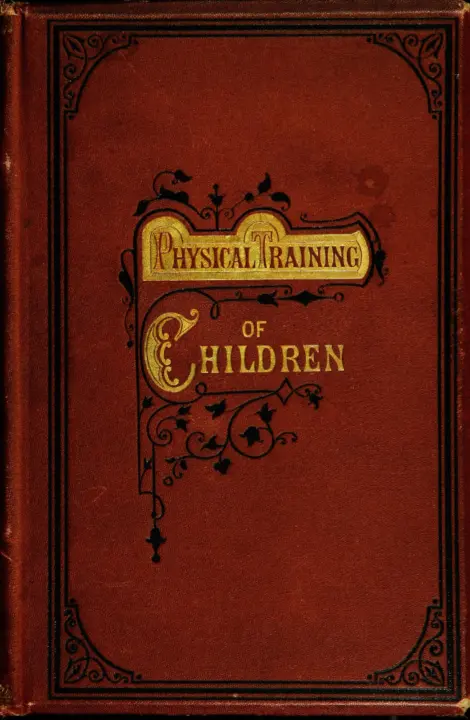
The Physical Training of Children
Pye Henry Chavasse
THE CLASSIC COLLECTION · 1881
"Advice to a Wife and Mother" by Pye Henry Chavasse is a health and wellness guide written in the late 19th century. This work addresses the physical and mental health of women, particularly focusing on the crucial roles of wives and mothers in maintaining their own well-being and that of their children. Chavasse provides practical advice on topics such as diet, exercise, abstaining from stimulants, and early rising, all aimed at fostering a healthier lifestyle conducive to motherhood. The opening of the book presents a preamble to the author's guidance, where he acknowledges the alarming number of women suffering from health issues and barrenness. Chavasse emphasizes the importance of proactive health management and outlines several critical areas needing attention, including the impact of traditional societal norms on women's health. He criticizes the fashionable lifestyle of his time and urges young wives to adopt healthier habits, proposing that many ailments can be prevented or improved through simple lifestyle changes. The introductory chapter serves as a clarion call for women to value their health in order to fulfill their roles as nurturing mothers.
Introduction adapted from the source catalogue; source summaries may be automatically generated.
Free to read · English · 186,058 words · No account needed
MAKE TIME FOR A GOOD BOOK
On by default. Untick to stop anonymous reading totals. Each page counts after 10 seconds in view. How this works.
Anonymous counting is on unless you have switched it off.
98. A wife ought not, if she feel low, to fly on every occasion to wine to raise her spirits, but should try the effects of a walk in the country, and
“Draw physic from the fields in draughts of vital air.”[21]
99. An excitable wife is a weakly wife: “excitement is the effect of weakness, not of strength.” Wine in large quantities will not strengthen, but, on the contrary, will decidedly weaken; the more the wine, the greater the debility and the greater the excitement—one follows the other as the night the day. A person who drinks much wine is always in a state of excitement, and is invariably weak, low, and nervous, and frequently barren. Alcoholic stimulants in excess are “a delusion and a snare,” and are one of the most frequent causes of excitement, and therefore both of weakness and of barrenness. Alcohol, pure and undiluted, and in excess, is a poison, and is ranked among the deadly poisons; if a person were to drink at one draught half a pint of undiluted alcohol it would be the last draught he or she would ever, in this world, drink,—it would be as surely fatal as a large dose of either arsenic or strychnine! Brandy, whisky, gin, and wine are composed of alcohol as the principal ingredient; indeed, each and all of them entirely owe their strength to the quantity of alcohol contained therein. Brandy, whisky, gin, and wine, without the alcohol, would, each one of them, be as chip in porridge—perfectly inert. Brandy and wine, the former especially, contain large proportions of alcohol, and both the one and the other, in excess, either prevents a woman from conceiving, and thus makes her barren, or if she do conceive, it poisons the unborn babe within her; and it either makes him puny and delicate, or it downright kills him in the womb, and thus causes a miscarriage. If he survive the poison, and he be born alive, he is usually, when born, delicate and undersized; if such a one be suckled by such a mother, he is subjected, if the mother can nurse him, which in such cases she rarely can, to a second course of poisoning; the mother’s milk is poisoned with the alcohol, and the poor unfortunate little wretch, having to run the gantlet in the womb and out of the womb, pines and dwindles away, until at length he finds a resting-place in the grave! If you wish to make a dog small, give him, when he is a puppy, gin; the alcohol of the gin will readily do it: this is a well-known fact, and is, by dog-fanciers, constantly practiced. If you desire, in like manner, to make a Tom Thumb of a baby, give him the milk of a mother or of a wet-nurse who imbibes, in the form of wine or of brandy or of gin, alcohol in quantities, and the deed is done! Gin-drinking nursing mothers, it is well known, have usually puny children; indeed, the mother drinking the gin is only another way of giving gin to the babe—an indirect instead of a direct route, both leading to the same terminus. Brandy was formerly sold only by the apothecary; brandy is a medicine—a powerful medicine—and ought only to be prescribed as a medicine; that is to say, but seldom, in small and in measured quantities at a time, and only when absolutely necessary: now it is resorted to on every occasion as a panacea for every ill! If taken regularly, and in quantities, as unfortunately it frequently now is, it becomes a desperate poison—a pathway leading to the grave! It is utterly impossible for any person to hold in the mouth, for five minutes at a time, a mouthful of neat brandy without experiencing intense suffering: if it has this fearful effect on the mouth, what effect must this burning fluid, when taken in quantities, have upon the stomach? Injury, most decided injury to the stomach, and, through the stomach, disease and weakness to the remainder of the body! Brandy is a wonderful and powerful agent: brandy has the effect, if taken in excess and for a length of time, of making the liver as hard as a board. Brandy in large quantities, and in the course of time, has the power of making the body marvelously big—as big again; but not with firm muscle and strong sinew, not with good blood and wholesome juices—nothing of the kind; but of filling it full, even to bursting, with water! Brandy has the power of taking away a giant’s strength, and of making him as helpless as a little child! Habitual brandy-drinking poisons the very streams of life! It would take more time and space than I have to spare to tell of the wonderful powers of brandy; but unfortunately, as a rule, its powers are more those of an angel of darkness than those of an angel of light! If the above statements be true (and they cannot be contravened), they show the folly, the utter imbecility, and the danger, both to mother and to babe, of dosing a wife, be she strong or be she delicate, and more especially if she be delicate, with large quantities either of wine or of brandy. Brandy, gin, and whisky act on the human economy very much alike; for, after all, it is the quantity of alcohol contained in each of them that gives them their real strength and danger. I have selected brandy as the type of all of them, as brandy is now the fashionable remedy for all complaints, and, unfortunately, in too many instances the habit of drinking it imperceptibly but rapidly increases, until at length, in many cases, that which was formerly a teaspoonful becomes a tablespoonful, and eventually a wineglassful, with what result I have earnestly endeavored faithfully to portray. Avoid, then, the first step in regular brandy-drinking: it is the first step that ofttimes leads to danger, and eventually to destruction!
Your reading position is saved on this browser. Take it to another device with a library code. Reading pages adapt to text, rather than matching a printed edition.
BEHIND THE BOOK
This eBook is for the use of anyone anywhere in the United States and most other parts of the world at no cost and with almost no restrictions whatsoever. You may copy it, give it away or re-use it under the terms of the Project Gutenberg License included with this eBook or online at www.gutenberg.org. If you are not located in the United States, you will have to check the laws of the country where you are located before using this eBook. Read the source licence.
The original source file, including credits and licence, is retained by this library. Request an original-format copy at no charge. Please include the book title and Project Gutenberg identifier #71887.
KEEP YOUR CURIOSITY GOING

Charles G. (Charles Griffith) Ross
Hannah Webster Foster

Emily Lawless
Edwin Hamlin Carr

Charles De Lano Hine
Andrew Ure