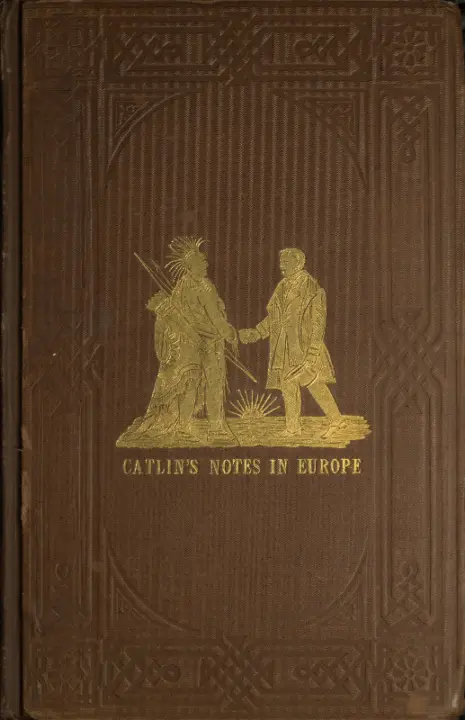
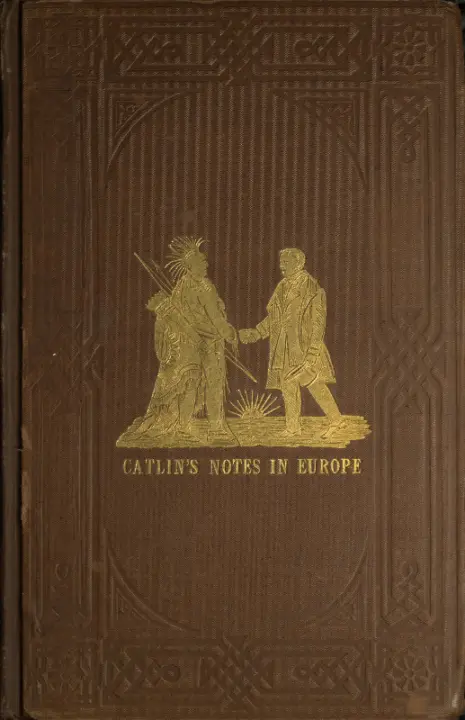
Adventures of the Ojibbeway and Ioway Indians in England, France, and Belgium; Vol. 1 (of 2) being Notes of Eight Years’ Travels and Residence in Europe with his North American Indian Collection
George Catlin
THE CLASSIC COLLECTION · 1852
"Adventures of the Ojibbeway and Ioway Indians in England, France, and Belgium" by George Catlin is a historical account written in the mid-19th century. The work chronicles the travels and experiences of North American Indian tribes, specifically the Ioway Indians, as they visit various European countries. The narrative offers a unique perspective on their cultural interactions, exhibitions, and the impressions they leave on the people of Europe during their journey. The opening of the narrative introduces the arrival of fourteen Ioway Indians in London, led by Mr. Melody, their conductor. Catlin vividly describes their first impressions of the bustling city, hinting at the culture shock they experience as they encounter the complexities of urban life. The Indians, excited yet bewildered, explore their surroundings and prepare for exhibitions of traditional dances and ceremonies, aiming to share their culture with a curious audience. Catlin emphasizes their eagerness to maintain sobriety and respect, in contrast to the previous Ojibbeway group's struggles, setting up a narrative that reflects on identity, tradition, and the cross-cultural dynamics during their time in Europe.
Introduction adapted from the source catalogue; source summaries may be automatically generated.
Free to read · English · 128,758 words · No account needed
MAKE TIME FOR A GOOD BOOK
On by default. Untick to stop anonymous reading totals. Each page counts after 10 seconds in view. How this works.
Anonymous counting is on unless you have switched it off.
SUBJECT--A Filly, three years old, coming four, and very
obstinate; quite unbroken-in.
Saturday, Feb. 12, 1842.--While the last experiments were being tried on the yearling, W. espied B., a farmer and tenant of M., with several men, at the distance of some fields, trying, most ineffectually, on the old system, to break-in a horse. W. proposed to go down and show him what effect had been produced on the yearling. The rest agreed, and W., M., and E. proceeded towards B., W. leading the yearling. On their way they had to lead her over a brook, which she passed after a little persuasion, without force. One of the fields through which she had to pass contained four horses, three of which trotted up and surrounded her, but she did not become in the least degree restive, or desirous of getting loose. When the party arrived at the spot, they found that B. and his men had tied their filly short up to a tree in the corner of a field, one side of which was walled, and the other hedged in. W. now delivered the yearling up to M., and proposed to B. to tame his horse after the new method, or (to use his own phrase) to "puff" it. B., who was aware of the character of his horse, anxiously warned W. not to approach it, cautioning him especially against the fore-feet, asserting that the horse would rear and strike him with the fore-feet, as it had "lamed" his own (B.'s) thigh just before they had come up. W. therefore proceeded very cautiously. He climbed the wall, and came at the horse through the tree, to the trunk of which he clung for some time, that he might secure a retreat in case of need. Immediately upon his touching the halter, the horse pranced about, and finally pulled away with a dogged and stubborn expression, which seemed to bid W. defiance. Taking advantage of this, W. leaned over as far as he could, clinging all the time to the tree with his right hand, and succeeded in breathing into one nostril, without, however, being able to blind the eyes. From that moment all became easy. W., who is very skilful in the management of a horse, coaxed it, and rubbed its face, and breathed from time to time into the nostrils, while the horse offered no resistance. In about ten minutes W. declared his conviction that the horse was subdued; and he then unfastened it, and, to the great and evident astonishment of B. (who had been trying all the morning in vain to gain a mastery over it), led it quietly away with a loose halter. Stopping in the middle of the field, with no one else near, W. quietly walked up to the horse, placed his arm over one eye and his hand over the other, and breathed into the nostrils. It was pleasing to observe how agreeable this operation appeared to the horse, who put up its nose continually to receive the "puff." In this manner W. led the horse through all the fields, in one of which were the four horses already mentioned, who had formerly been the companions of the one just tamed, and who surrounded it, without, however, making it in the least degree restive. At length W. and the horse reached the stable-yard, where they were joined by C. W. C. C., of S---- Hall, and J. B. son of B. the farmer. In the presence of these, M., and E., W. first examined the fore-feet, and then the hind-feet of the horse, who offered no resistance, but, while W. was examining the hind-feet, leant its neck round, and kept nosing W.'s back. He next buckled on a surcingle, and then a saddle, and finally bitted the horse with a rope. During the whole of these operations the horse did not offer the slightest resistance, nor did it flinch in the least degree. All who witnessed the transaction were astonished at the result obtained. The Communicator regrets only that he is not at liberty to publish the names at length. This experiment of bitting was the last that W. tried, since the nature of the country about M---- Park did not admit of ridings being tried with any prospect of safety. The whole experiment lasted about an hour. It should be mentioned that when J. B., to whom W. delivered up the horse, attempted to lead it away, it resisted; whereupon E. recommended J. B. to breathe into its nostrils. He did so, and the horse followed him easily. The next day, B., who is severe and obstinate, began at this horse in the old method, and belaboured it dreadfully, whereupon the horse very sensibly broke away. This result is important, since it shows that the spirit is subdued, not broken.
Your reading position is saved on this browser. Take it to another device with a library code. Reading pages adapt to text, rather than matching a printed edition.
BEHIND THE BOOK
This eBook is for the use of anyone anywhere in the United States and most other parts of the world at no cost and with almost no restrictions whatsoever. You may copy it, give it away or re-use it under the terms of the Project Gutenberg License included with this eBook or online at www.gutenberg.org. If you are not located in the United States, you will have to check the laws of the country where you are located before using this eBook. Read the source licence.
The original source file, including credits and licence, is retained by this library. Request an original-format copy at no charge. Please include the book title and Project Gutenberg identifier #44777.
KEEP YOUR CURIOSITY GOING
Wilfrid Scawen Blunt
Wilfrid Scawen Blunt

E. W. (Edgar Watson) Howe
Cécile Tormay

Moritz Busch
John L. Ransom