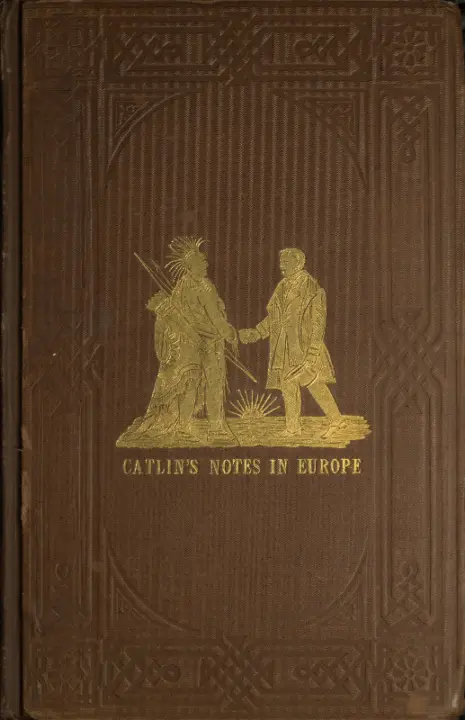
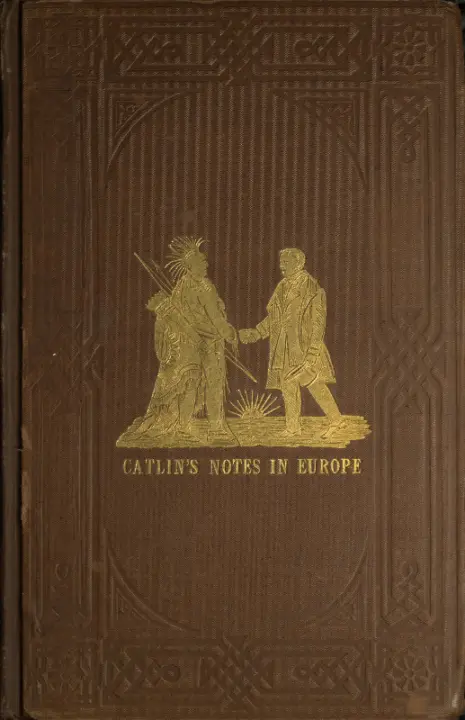
Adventures of the Ojibbeway and Ioway Indians in England, France, and Belgium; Vol. 1 (of 2) being Notes of Eight Years’ Travels and Residence in Europe with his North American Indian Collection
George Catlin
THE CLASSIC COLLECTION · 1852
"Adventures of the Ojibbeway and Ioway Indians in England, France, and Belgium" by George Catlin is a historical account written in the mid-19th century. The work chronicles the travels and experiences of North American Indian tribes, specifically the Ioway Indians, as they visit various European countries. The narrative offers a unique perspective on their cultural interactions, exhibitions, and the impressions they leave on the people of Europe during their journey. The opening of the narrative introduces the arrival of fourteen Ioway Indians in London, led by Mr. Melody, their conductor. Catlin vividly describes their first impressions of the bustling city, hinting at the culture shock they experience as they encounter the complexities of urban life. The Indians, excited yet bewildered, explore their surroundings and prepare for exhibitions of traditional dances and ceremonies, aiming to share their culture with a curious audience. Catlin emphasizes their eagerness to maintain sobriety and respect, in contrast to the previous Ojibbeway group's struggles, setting up a narrative that reflects on identity, tradition, and the cross-cultural dynamics during their time in Europe.
Introduction adapted from the source catalogue; source summaries may be automatically generated.
Free to read · English · 128,758 words · No account needed
MAKE TIME FOR A GOOD BOOK
On by default. Untick to stop anonymous reading totals. Each page counts after 10 seconds in view. How this works.
Anonymous counting is on unless you have switched it off.
This man (the Little Wolf) interfered, as he says, and doubtless he tells the truth, because he considered it treacherous and cowardly to strike a brother, after having invited them to visit their nation. Such treachery is rare indeed among the wildest North-American Indians, and never occurred with the Ioways before. I met him and Jeffrey, the Ioway interpreter, together with two other Ioways, guarding the Big Elk and his party on to my agency, in a short time after this occurrence took place.
I cannot close this communication without expressing my sincere thanks to the Little Wolf and his comrade for their good conduct; and I most respectfully beg leave to recommend them to the kind attention of their great father, the President of the United States, and all gentlemen to whom this paper may be shown.
Great Nemahaw Sub-Agency, Oct. 23, 1843.
Office of Indian Affairs, St. Louis, Missouri, April 10, 1844.
Permit me to introduce to you the bearer, No-ho-mun-ya (Roman Nose), an Ioway brave. Roman Nose, in company with Shon-ta-yi-ga, or Little Wolf, in October last defended and rescued from impending death by a party of his own nation, ten Omahaw Indians, consisting of four respected chiefs, braves, and squaws, under circumstances highly flattering to their bravery and humanity.
I would recommend that a medal be presented to No-ho-mun-ya (Roman Nose) as a testimonial of his meritorious conduct on the occasion referred to. Medals from the Government are highly esteemed by the Indians; and if bravery and humanity are merits in the Indian, then I think Roman Nose richly merits one. His character in every respect is good.
A notice by the Government of meritorious acts by the Indians has a happy tendency in making a favourable impression in reference to the act that may be the cause of the notice.
I have presented Little Wolf with a medal that was in the office. On receiving it, he very delicately replied, that "he deserved no credit for what he had done--that he had only done his duty, but was gratified that his conduct had merited the approbation of his nation and his father."
I have the honour to be, very respectfully, Sir, Your obedient servant, W. H. HARVEY, Sup. Ind. Aff.
To his Excellency John Tyler, President of the
United States, Washington City.
I concur with Mr. Harvey in thinking this Indian Chief entitled for his bravery and humanity to a medal.
June 8, 1844.
J. TYLER, Presid. U. States, Washington City.
Medal delivered accordingly to Mr. Geo. H. C. Melody, for the
Chief.
June 8, 1844.
J. HARTLEY CRAWFORD.
Your reading position is saved on this browser. Take it to another device with a library code. Reading pages adapt to text, rather than matching a printed edition.
BEHIND THE BOOK
This eBook is for the use of anyone anywhere in the United States and most other parts of the world at no cost and with almost no restrictions whatsoever. You may copy it, give it away or re-use it under the terms of the Project Gutenberg License included with this eBook or online at www.gutenberg.org. If you are not located in the United States, you will have to check the laws of the country where you are located before using this eBook. Read the source licence.
The original source file, including credits and licence, is retained by this library. Request an original-format copy at no charge. Please include the book title and Project Gutenberg identifier #44777.
KEEP YOUR CURIOSITY GOING
Wilfrid Scawen Blunt
Wilfrid Scawen Blunt

E. W. (Edgar Watson) Howe
Cécile Tormay

Moritz Busch
John L. Ransom