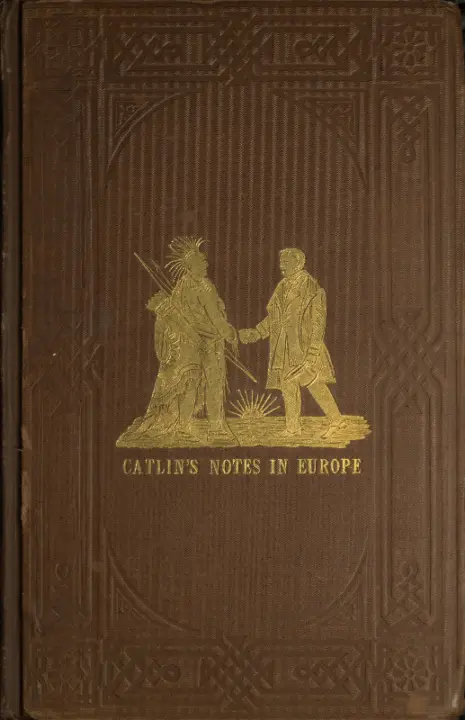
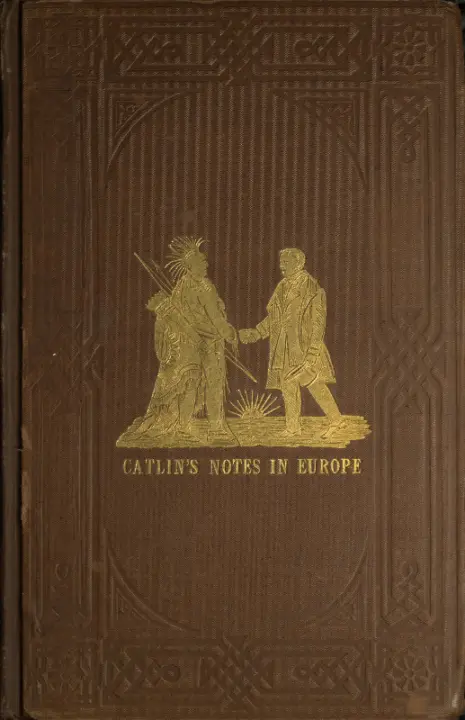
Adventures of the Ojibbeway and Ioway Indians in England, France, and Belgium; Vol. 1 (of 2) being Notes of Eight Years’ Travels and Residence in Europe with his North American Indian Collection
George Catlin
THE CLASSIC COLLECTION · 1852
"Adventures of the Ojibbeway and Ioway Indians in England, France, and Belgium" by George Catlin is a historical account written in the mid-19th century. The work chronicles the travels and experiences of North American Indian tribes, specifically the Ioway Indians, as they visit various European countries. The narrative offers a unique perspective on their cultural interactions, exhibitions, and the impressions they leave on the people of Europe during their journey. The opening of the narrative introduces the arrival of fourteen Ioway Indians in London, led by Mr. Melody, their conductor. Catlin vividly describes their first impressions of the bustling city, hinting at the culture shock they experience as they encounter the complexities of urban life. The Indians, excited yet bewildered, explore their surroundings and prepare for exhibitions of traditional dances and ceremonies, aiming to share their culture with a curious audience. Catlin emphasizes their eagerness to maintain sobriety and respect, in contrast to the previous Ojibbeway group's struggles, setting up a narrative that reflects on identity, tradition, and the cross-cultural dynamics during their time in Europe.
Introduction adapted from the source catalogue; source summaries may be automatically generated.
Free to read · English · 128,758 words · No account needed
MAKE TIME FOR A GOOD BOOK
On by default. Untick to stop anonymous reading totals. Each page counts after 10 seconds in view. How this works.
Anonymous counting is on unless you have switched it off.
This was a subject entirely new to them and unthought of by the Indians; and, knowing that English soldiers all wore red coats, they were alarmed, their first impression being that we had brought them on to hostile ground, and that this was a "war-party" in pursuit of their enemy. They were relieved and excessively amused when I told them it was merely a fox-hunt, and that the gentlemen they saw riding were mostly noblemen and men of great influence and wealth. They watched them intensely until they were out of sight, and made many amusing remarks about them after we had arrived at York. I told them they rode without guns, and the first one in at the death pulled off the tail of the fox and rode into town with it under his hatband. Their laughter was excessive at the idea of "such gentlemen hunting in open fields, and with a whip instead of a gun; and that great chiefs, as I had pronounced them, should be risking their lives, and the limbs of their fine horses, for a poor fox, the flesh of which, even if it were good to eat, was not wanted by such rich people, who had meat enough at home; and the skin of which could not be worth so much trouble, especially when, as everybody knows, it is good for nothing when the tail is pulled off."
On our arrival in York one of the first and most often repeated questions which they put was, whether there were any of the "good people," as they now called them, the Friends, living there. I told them it was a place where a great many of them lived, and no doubt many would come to see them, which seemed to please and encourage them very much. Mr. Melody having taken rooms for them near to the York Minster, of which they had a partial view from their windows, their impatience became so great that we sallied out the morning after our arrival to pay the first visit to that grand and venerable pile. The reader has doubtless seen or read of this sublime edifice, and I need not attempt to describe it here. Were it in my power to portray the feelings which agitated the breasts of these rude people when they stood before this stupendous fabric of human hands, and as they passed through its aisles, amid its huge columns, and under its grand arches, I should be glad to do it; but those feelings which they enjoyed in the awful silence, were for none but themselves to know. We all followed the guide, who showed and explained to us all that was worth seeing below, and then showed us the way by which we were to reach the summit of the grand or middle tower, where the whole party arrived after a laborious ascent of 273 steps. We had luckily selected a clear day; and the giddy height from which we gazed upon the town under our feet, and the lovely landscape in the distance all around us, afforded to the Indians a view far more wonderful than their eyes had previously beheld. Whilst we were all engaged in looking upon the various scenes that lay like the lines upon a map beneath us, the old Doctor, with his propensity which has been spoken of before, had succeeded in getting a little higher than any of the rest of the party, by climbing on to the little house erected over the gangway through which we entered upon the roof; and, upon the pinnacle of this, for a while stood smiling down upon the thousands of people who were gathering in the streets. He was at length, however, seen to assume a more conspicuous attitude by raising his head and his eyes towards the sky, and for some moments he devoutly addressed himself to the Great Spirit, whom the Indians always contemplate as "in the heavens, above the clouds." When he had finished this invocation, he slowly and carefully "descended on to the roof, and as he joined his friends he observed that when he was up there "he was nearer to the Great Spirit than he had ever been before." The War-chief excited much merriment by his sarcastic reply, that "it was a pity he did not stay there, for he would never be so near the Great Spirit again." The Doctor had no way of answering this severe retort, except by a silent smile, as, with his head turned away, he gazed on the beautiful landscape beneath him. When we descended from the tower, the Indians desired to advance again to the centre of this grand edifice, where they stood for a few minutes with their hands covering their mouths, as they gazed upon the huge columns around them and the stupendous arches over their heads, and at last came silently away, and I believe inspired with greater awe and respect for the religion of white men than they had ever felt before.
Your reading position is saved on this browser. Take it to another device with a library code. Reading pages adapt to text, rather than matching a printed edition.
BEHIND THE BOOK
This eBook is for the use of anyone anywhere in the United States and most other parts of the world at no cost and with almost no restrictions whatsoever. You may copy it, give it away or re-use it under the terms of the Project Gutenberg License included with this eBook or online at www.gutenberg.org. If you are not located in the United States, you will have to check the laws of the country where you are located before using this eBook. Read the source licence.
The original source file, including credits and licence, is retained by this library. Request an original-format copy at no charge. Please include the book title and Project Gutenberg identifier #44777.
KEEP YOUR CURIOSITY GOING
Wilfrid Scawen Blunt
Wilfrid Scawen Blunt

E. W. (Edgar Watson) Howe
Cécile Tormay

Moritz Busch
John L. Ransom