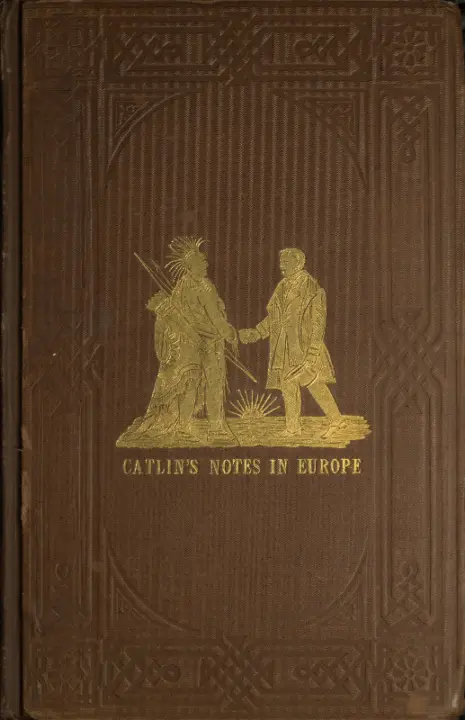
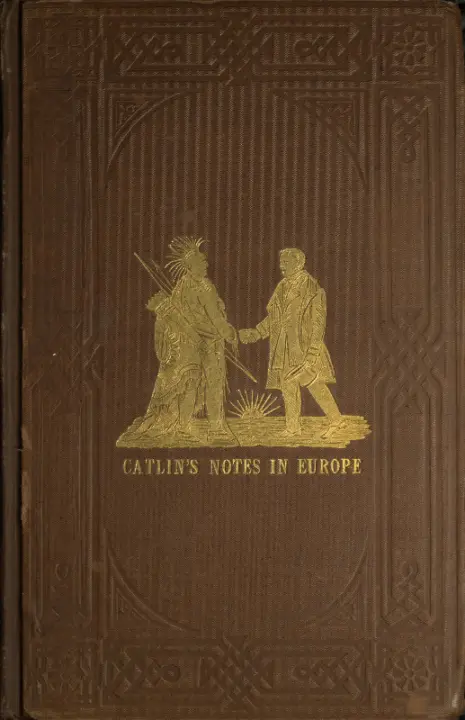
Adventures of the Ojibbeway and Ioway Indians in England, France, and Belgium; Vol. 1 (of 2) being Notes of Eight Years’ Travels and Residence in Europe with his North American Indian Collection
George Catlin
THE CLASSIC COLLECTION · 1852
"Adventures of the Ojibbeway and Ioway Indians in England, France, and Belgium" by George Catlin is a historical account written in the mid-19th century. The work chronicles the travels and experiences of North American Indian tribes, specifically the Ioway Indians, as they visit various European countries. The narrative offers a unique perspective on their cultural interactions, exhibitions, and the impressions they leave on the people of Europe during their journey. The opening of the narrative introduces the arrival of fourteen Ioway Indians in London, led by Mr. Melody, their conductor. Catlin vividly describes their first impressions of the bustling city, hinting at the culture shock they experience as they encounter the complexities of urban life. The Indians, excited yet bewildered, explore their surroundings and prepare for exhibitions of traditional dances and ceremonies, aiming to share their culture with a curious audience. Catlin emphasizes their eagerness to maintain sobriety and respect, in contrast to the previous Ojibbeway group's struggles, setting up a narrative that reflects on identity, tradition, and the cross-cultural dynamics during their time in Europe.
Introduction adapted from the source catalogue; source summaries may be automatically generated.
Free to read · English · 128,758 words · No account needed
MAKE TIME FOR A GOOD BOOK
On by default. Untick to stop anonymous reading totals. Each page counts after 10 seconds in view. How this works.
Anonymous counting is on unless you have switched it off.
"The old hunter and his son were thus living very happily, and made me comfortable and happy whilst I was with them. The anecdotes of his extraordinary life, which were talked over for amusement during that time, were enough to fill a volume. The venerable old man, whose long and flowing locks were silvery white, was then in his 78th year, and still he almost daily took down his trusty rifle from its hooks in the morning, and in a little time would bring in a saddle of venison for our breakfast, and thus he chiefly supported his affectionate old lady and himself, and the few friends who found their way to his solitary abode, without concern or care for the future. The stump of a large cotton-wood tree, which had been cut down, was left standing in the ground, and being cut square off on the top, and his cabin being built around it, answered the purpose of a table in the centre of his cabin, from which our meals were eaten. When I made my visit to him, he had been living several years in this retired state and been perfectly happy in the undisturbed solitude of the wilderness, but told me several times that he was becoming very uneasy and distressed, as he found that his days of peace were nearly over, as two Yankee families had already found the way into the country, and one of them had actually settled within nine miles of him.
"Having finished my visit to this veteran and his son, I mounted my horse, and taking leave followed an Indian trail to the town of St. Charles, some thirty or forty miles below, on the north banks of the Missouri. I here visited some old friends with whom I had become acquainted on the lower Mississippi in former years, and intending to descend the river from that to St. Louis by a boat had sold my horse when I arrived there. Before I was ready to embark, however, an old friend of mine, Lieutenant Pike, who had just returned from his exploring expedition to the Rocky Mountains, had passed up from St. Louis to a small settlement formed on the east bank of the Mississippi, and a few miles below the mouth of the Missouri, to attend a wedding which was to take place on the very evening that I had received the information of it, and like himself, being intimately acquainted with the young man who was to be married, I resolved to be present if possible, though I had had no invitation to attend, it not being known to the parties that I was in that part of the country. The spot where the wedding was to take place being on the bank of the river, and on my route to St. Louis, I endeavoured to procure a canoe for the purpose, but not being able to get such a thing in St. Charles at that time for love or money, and still resolved to be at the wedding, I succeeded in rolling a couple of large logs into the stream, which laid upon the shore in front of the village, and lashing them firmly together, took a paddle from the first boat that I could meet, and seating myself astride of the two logs I pushed off into the muddy current of the Missouri, and was soon swept away out of sight of the town of St. Charles. My embarkation was a little before sundown, and having fifteen or twenty miles to float before I should be upon the waters of the Mississippi, I was in the midst of my journey overtaken by night, and had to navigate my floating logs as well as I could among the snags and sandbars that fell in my way. I was lucky, however, in escaping them all, though I sometimes grazed them as I passed, and within a few inches of being hurled to destruction. I at length entered the broad waters of the Mississippi, and a few miles below on the left bank saw the light in the cabins in which the merry circle of my friends were assembled, and with all my might was plying my paddle to propel my two logs to the shore. In the midst of my hard struggle I discovered several objects on my right and ahead of me, which seemed to be rapidly approaching me, and I concluded that I was drifting on to rocks or snags that were in a moment to destroy me. But in an instant one of these supposed snags silently shot along by the side of my logs, and being a canoe with four Indians in it, and all with their bows and war-clubs drawn upon me, they gave the signal for silence, as one of them, a tall, long-armed, and powerful man, seized me by the collar. Having partially learned several of the languages of the Indian tribes bordering on the Mississippi, I understood him as he said in the Ioway language, 'Not a word! if you speak you die!' At that moment a dozen or more canoes were all drawn close around my two logs of wood, astride of which I sat, with my legs in the water up to my knees. These canoes were all filled with warriors with their weapons in their hands, and no women being with them, I saw they were a war party, and preparing for some mischief. Finding that I understood their language and could speak a few words with them, the warrior who still held me by the collar made a sign to the other canoes to fall back a little while he addressed me in a low voice. 'Do you know the white chief who is visiting his friends this night on the bank yonder where we see the lights?' to which I replied 'Yes, he is an old friend of mine.' 'Well,' said he, 'he dies to-night, and all those wig-wams are to be laid in ashes. Stet-e-no-ka was a cousin of mine, and Que-tun-ka was a good man, and a friend to the white people. The pale faces hung them like two dogs by their necks, and the life of your friend, the white warrior, pays the forfeit this night, and many may be the women and children who will die by his side!' I explained to him as well as I could that my friend, Lieutenant Pike, had had no hand in the execution of the two Indians; that they were hung below St. Louis when Lieutenant Pike was on his way home from the Rocky Mountains. I told him also that Lieutenant Pike was a great friend of the Indians, and would do anything to aid or please them; that he had gone over the river that night to attend the wedding of a friend, and little dreamed that amongst the Indians he had any enemies who would raise their hands against him.
Your reading position is saved on this browser. Take it to another device with a library code. Reading pages adapt to text, rather than matching a printed edition.
BEHIND THE BOOK
This eBook is for the use of anyone anywhere in the United States and most other parts of the world at no cost and with almost no restrictions whatsoever. You may copy it, give it away or re-use it under the terms of the Project Gutenberg License included with this eBook or online at www.gutenberg.org. If you are not located in the United States, you will have to check the laws of the country where you are located before using this eBook. Read the source licence.
The original source file, including credits and licence, is retained by this library. Request an original-format copy at no charge. Please include the book title and Project Gutenberg identifier #44777.
KEEP YOUR CURIOSITY GOING
Wilfrid Scawen Blunt
Wilfrid Scawen Blunt

E. W. (Edgar Watson) Howe
Cécile Tormay

Moritz Busch
John L. Ransom