THE CLASSIC COLLECTION✦The Wyandotte Convention: an addressCLASSIC FREE BOOKS
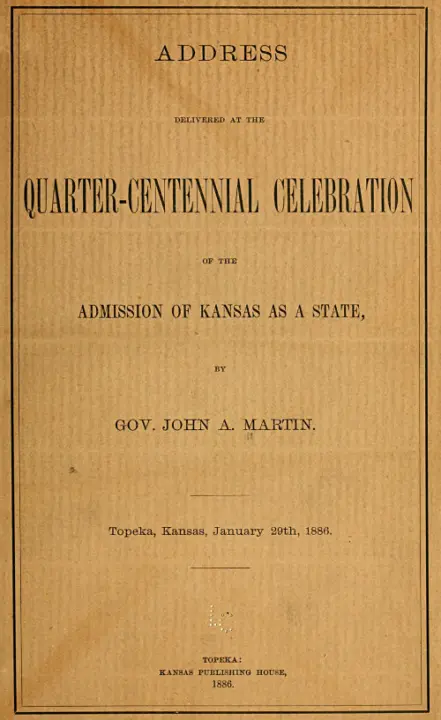
The Wyandotte Convention: an address
John Alexander Martin
THE CLASSIC COLLECTION · 1888
"Addresses: by John A. Martin. Delivered in Kansas." by John Alexander Martin is a collection of speeches and addresses written in the late 19th century. The book compiles oratory pieces delivered by Martin, who served as Governor of Kansas, reflecting on the state’s history, development, and key social issues. The content illuminates Martin's personal connection to Kansas and the pivotal moments that shaped its identity, focusing on themes such as patriotism, civic duty, and the fight against slavery. The beginning of the work introduces Martin's deep commitment to Kansas, describing his busy life in office and his significant involvement in the state's early historical events, particularly during the Civil War era. The introduction highlights his extensive experience, detailing his contributions to the Republican Party in shaping Kansas’s constitution and legislation. It emphasizes the importance of his addresses, which serve not only as records of the past but also as narratives that convey the spirit and values of Kansans. Through anecdotes and historical context, Martin’s speeches aim to inspire readers with a sense of pride in the state's journey from a turbulent territory to a robust state within the Union.
Introduction adapted from the source catalogue; source summaries may be automatically generated.
Free to read · English · 92,751 words · No account needed
MAKE TIME FOR A GOOD BOOK
On by default. Untick to stop anonymous reading totals. Each page counts after 10 seconds in view. How this works.
Anonymous counting is on unless you have switched it off.
The value of the farm crops of Kansas, for the five years ending with 1870, aggregated $59,298,414; for the next succeeding five years their value was $135,958,214; for the next five years, $264,334,824; and for the five years ending with 1885, the farm crops of Kansas aggregated in value $503,485,316. Thus during the past twenty years the farmers of Kansas have produced crops whose aggregate value reached the enormous sum of $963,076,768.
The increase in the value of farms, of farm implements, and of farm products, (including farm crops, products of live stock, and market garden, apiarian and horticultural products,) is shown in the following table. It will be seen that these values have generally doubled every five years:
═══════════╤═══════════╤═══════════╤═══════════ │ Value of │ Value of │ Value of Year. │ farms. │ farm │ farm │ │implements.│products. ───────────┼───────────┼───────────┬┴────────── 1860 │$12,258,239│ $727,694│ $4,878,350 1865 │ 24,796,535│ 1,200,720│ 10,653,235 1870 │ 90,327,040│ 4,053,312│ 27,630,651 1875 │123,852,466│ 7,935,645│ 43,970,414 1880 │235,178,936│ 15,652,848│ 84,521,486 1885 │408,073,454│ 9,604,117│143,577,018 ───────────┴───────────┴───────────┴───────────
The value of the farm products of Kansas, from 1876 to 1880, inclusive, aggregated $356,557,802, while their value from 1881 to 1885, inclusive, aggregated the enormous sum of $738,676,912.
The steady development of the State is further illustrated by the figures showing the increase of taxable acres. In 1860 only 1,778,400 acres were subject to taxation; in 1865 this area had been enlarged to 3,500,000 acres; in 1870 to 8,480,839 acres; in 1875 to 17,672,187 acres; in 1880 to 22,386,435 acres; and in 1885 to 27,710,981 acres.
In the number and value of its live stock, Kansas ranked, in 1880, as the eighth State of the Union. In 1860 the live stock of Kansas aggregated in value only a little over three million dollars; in 1865 it aggregated over seven millions; in 1870, over twenty-three millions; in 1875, nearly twenty-nine millions; in 1880, over sixty-one millions; and in 1885, nearly one hundred and eighteen million dollars. The following table gives the number of horses, mules, cows, cattle, sheep, and swine, and their aggregate value, for the years 1861 and 1865, and every year thereafter to and including 1885:
═══════╤═════════╤════════╤═══════╤═════════╤═════════╤═════════╤═══════════ │ │ │ │ │ │ │ Value of Year.│Horses.│Mules.│Cows.│Cattle.│Sheep. │Swine. │ live │ │ │ │ │ │ │ stock. ───────┼─────────┼────────┼───────┼─────────┼─────────┼─────────┼─────────── 1861 │ 20,344│ 1,496│ 28,550│ 74,905│ 17,569│ 138,224│ $3,332,450 1865 │ 32,469│ 2,490│ 71,996│ 130,307│ 82,662│ 95,429│ 7,324,659 1866 │ 38,968│ 2,863│ 82,075│ 139,428│ 108,287│ 127,875│ 9,127,306 1867 │ 39,968│ 2,936│ 85,120│ 140,560│ 106,287│ 132,750│ 10,081,590 1868 │ 42,859│ 2,405│ 89,461│ 146,399│ 101,789│ 149,662│ 9,962,311 1869 │ 50,573│ 2,597│109,142│ 165,430│ 107,896│ 137,848│ 12,902,830 1870 │ 117,786│ 11,786│123,440│ 250,527│ 109,088│ 206,587│ 23,173,185 1871 │ 156,000│ 14,900│162,000│ 345,000│ 115,000│ 304,800│ 31,823,484 1872 │ 180,900│ 16,300│191,100│ 397,400│ 116,100│ 381,000│ 28,488,704 1873 │ 198,900│ 17,400│214,000│ 457,000│ 123,000│ 457,200│ 30,013,898 1874 │ 220,700│ 19,100│231,000│ 507,200│ 141,000│ 484,600│ 31,163,058 1875 │ 207,376│ 24,964│225,028│ 478,295│ 106,224│ 292,658│ 28,610,257 1876 │ 214,811│ 26,421│227,274│ 473,350│ 143,962│ 330,355│ 32,489,293 1877 │ 241,208│ 32,628│261,642│ 519,346│ 205,770│ 704,862│ 33,015,647 1878 │ 274,450│ 40,564│286,241│ 586,002│ 243,760│1,195,044│ 36,913,534 1879 │ 324,766│ 51,981│322,020│ 654,443│ 311,862│1,264,494│ 54,775,497 1880 │ 367,589│ 58,303│366,640│ 748,672│ 426,492│1,281,630│ 61,563,956 1881 │ 383,805│ 58,780│406,706│ 839,751│ 806,323│1,173,199│ 69,814,340 1882 │ 398,678│ 56,654│433,381│ 971,116│ 978,077│1,228,683│ 83,869,199 1883 │ 423,426│ 59,262│471,548│1,133,154│1,154,196│1,393,968│104,539,888 1884 │ 461,136│ 64,889│530,904│1,328,021│1,206,297│1,953,144│115,645,050 1885 │ 513,507│ 75,165│575,887│1,397,131│ 875,193│2,461,520│117,881,699 ───────┴─────────┴────────┴───────┴─────────┴─────────┴─────────┴───────────
Kansas is an agricultural State. It has no gold or silver, no iron, and just coal enough to furnish fuel. It is the farmers’ and stockmen’s State. Its development simply shows what good old Mother Earth, when in her happiest vein, can do. “Agriculture,” says Colton, “is the most certain source of strength, wealth, and independence; commerce, in all emergencies, looks to agriculture both for defense and for supply.” The growth and prosperity of Kansas afford a striking illustration of what intelligent farmers, with a productive soil and a genial climate for their workshop, can accomplish—what wealth they can create, what enterprise they can stimulate.
Your reading position is saved on this browser. Take it to another device with a library code. Reading pages adapt to text, rather than matching a printed edition.
BEHIND THE BOOK
This eBook is for the use of anyone anywhere in the United States and most other parts of the world at no cost and with almost no restrictions whatsoever. You may copy it, give it away or re-use it under the terms of the Project Gutenberg License included with this eBook or online at www.gutenberg.org. If you are not located in the United States, you will have to check the laws of the country where you are located before using this eBook. Read the source licence.
The original source file, including credits and licence, is retained by this library. Request an original-format copy at no charge. Please include the book title and Project Gutenberg identifier #56917.
KEEP YOUR CURIOSITY GOING

David Patterson (Spirit) Hatch

David Patterson (Spirit) Hatch

David Patterson (Spirit) Hatch
Cécile Tormay

Moritz Busch
John L. Ransom